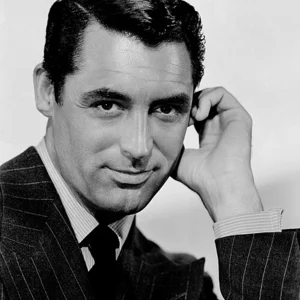

Cary Grant was an Anglo-American actor and an iconic figure of Hollywood's golden age. The embodiment of elegance and charm, he excelled in sophisticated comedy as well as in thrillers, notably working alongside Alfred Hitchcock.
Cary Grant(1904 — 1986)
Cary Grant
États-Unis, Royaume-Uni
6 min read
Frequently asked questions
Key Facts
- Born on January 18, 1904, in Bristol (England), under the name Archibald Alec Leach
- Began his Hollywood career in the 1930s and became a star of sophisticated comedy (screwball comedy)
- Starred in several iconic films for Alfred Hitchcock: Suspicion (1941), To Catch a Thief (1955), North by Northwest (1959)
- Received an Honorary Academy Award in 1970 for his lifetime achievement
- Died on November 29, 1986, in Davenport (Iowa, United States)
Works & Achievements
Howard Hawks's cult screwball comedy, in which he forms a hilarious duo with Katharine Hepburn.
Howard Hawks's breakneck-paced comedy, a model of fast-talking Hollywood repartee.
A sophisticated comedy alongside Hepburn and James Stewart, a major critical and commercial success.
His first film with Hitchcock, in which he plays a possibly murderous husband, playing on the ambiguity of his charm.
Hitchcock's espionage thriller with Ingrid Bergman, often cited among his greatest roles.
Hitchcock's film shot on the French Riviera, a perfect showcase for his elegance, with Grace Kelly.
Hitchcock's masterpiece and an iconic role: an advertising executive mistaken for someone else, chased across the United States.
A crime comedy with Audrey Hepburn, one of his last great successes before retirement.
Anecdotes
Cary Grant isn't his real name: he was born Archibald Alec Leach in Bristol, England, into a humble family. As a teenager, he joined a troupe of acrobats and stilt-walkers, the Bob Pender Troupe, with whom he crossed the Atlantic around 1920. It wasn't until 1931, under contract with Paramount studios, that he adopted the elegant name Cary Grant.
His mother was committed to an asylum when he was nine years old, and his father led him to believe for years that she had died. Cary Grant only learned she was alive when he was an adult, in his twenties. This childhood wound marked him deeply and may partly explain his lifelong quest for elegance and self-mastery.
From the 1930s to the 1960s, Grant made four films with Alfred Hitchcock: “Suspicion” (1941), “Notorious” (1946), “To Catch a Thief” (1955) and “North by Northwest” (1959). Hitchcock saw in him the ideal actor to play charming heroes swept up against their will into dangerous situations.
Although he was one of Hollywood's most famous actors, Cary Grant never won an Oscar for a role. To make up for this oversight, the Academy awarded him an honorary Oscar in 1970, celebrating his entire career and his unique talent.
He is credited with a famous line: “Everybody wants to be Cary Grant. Even I want to be Cary Grant.” It sums up the distance he felt between the image of perfection he projected on screen and the man he really was, Archie Leach.
Primary Sources
Everyone wants to be Cary Grant. Even I want to be Cary Grant.
Hitchcock discusses his collaboration with Grant, noting that he perfectly embodied the ordinary, charming man caught up in an intrigue beyond his control.
The Academy honors Cary Grant for his unique talent and his entire career in service of the art of film, with the respect and affection of his peers.
Key Places
Birthplace of Archibald Leach, where he grew up in a working-class household before setting off to seek his fortune on the stage.
The young acrobat's first American destination, where he made his debut in vaudeville and Broadway revues.
The film capital where Grant signed with Paramount and shot nearly all of his films during the golden age of the studios.
The town where Cary Grant died in 1986, while there for a performance of his show “A Conversation with Cary Grant.”
Typical Objects

The black jacket-and-bow-tie suit that Cary Grant wore on screen with legendary ease. He made it the emblem of twentieth-century masculine elegance.

The perfectly fitted gray suit, notably the one in “North by Northwest”, which became a benchmark of men's style. Grant personally oversaw the cut of his clothes.

The device that filmed actors on celluloid in the Hollywood studios. It is the central tool of the golden age of classic cinema.

The illustrated placard that announced films outside theaters and turned actors into stars. Cary Grant's face on them drew the crowds.

The golden trophy awarded by the Academy of Motion Picture Arts and Sciences. Grant received an honorary one in 1970.

An omnipresent prop in the cinema of the 1930s–1950s, handled with nonchalance by leading men. It was part of the acting and of the refinement displayed on screen.
School Curriculum
Vocabulary & Tags
Key Vocabulary
Tags
Daily Life
Morning
On a Hollywood film set, the day begins very early: makeup, hair, and costume fittings at dawn. Cary Grant, mindful of his appearance, would personally check the cut of his clothes and the lighting that showed him to best advantage.
Afternoon
The afternoon was spent on the soundstages of the great studios, shooting take after take under the director's guidance. Between scenes, the actor rehearsed his lines, fine-tuned his performance, and waited through the lighting and set adjustments.
Evening
A star's evenings blended society dinners, premieres, and receptions where one had to tend to one's public image. Grant, rather reserved in private life, balanced these obligations with quieter moments.
Food
Like the stars of his era who watched their figure for the camera, he kept an eye on his diet. The Hollywood lifestyle mixed fashionable restaurants, cocktails, and light meals between shoots.
Clothing
Cary Grant was an absolute benchmark of masculine elegance: impeccably cut bespoke suits, white shirts, and understated ties. He favored refined simplicity over extravagance.
Housing
He lived in California, near Hollywood, in the comfort reserved for the great film stars. His home reflected the prestige of the American star system of the day.
Historical Timeline
Period Vocabulary
Liens externes & ressources
Références
Œuvres
L'Impossible Monsieur Bébé (Bringing Up Baby)
1938
La Dame du vendredi (His Girl Friday)
1940
Indiscrétions (The Philadelphia Story)
1940
Les Enchaînés (Notorious)
1946
La Mort aux trousses (North by Northwest)
1959