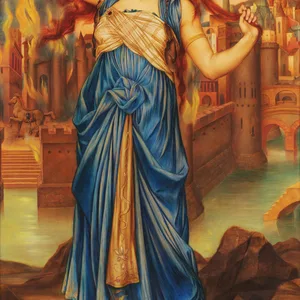

Trojan prophetess and daughter of King Priam, Cassandra was granted the gift of prophecy by Apollo, then cursed so that no one would ever believe her. A tragic figure of Greek mythology, she foretold the fall of Troy but could not prevent it.
Cassandra
Cassandra
10 min read
Frequently asked questions
Famous Quotes
« "Troy will burn, and no one will listen to me." (words attributed by the Greek literary tradition)»
Key Facts
- Daughter of King Priam and Queen Hecuba, princess of Troy in Greek mythology
- Apollo granted her the gift of prophecy; after she rejected his advances, he cursed her so that her predictions would never be believed
- She foretold the doom of the Trojan Horse and the destruction of the city, but was not heeded
- After the fall of Troy, she was taken as a slave and fell to Agamemnon, whom she accompanied to Mycenae
- Her myth is preserved in Greek written sources: Homer's Iliad, Aeschylus's Agamemnon, and Euripides's The Trojan Women
Works & Achievements
Cassandra's act in this tragedy stands as one of the pinnacles of ancient drama: in a trance, she relives the past crimes of the House of Atreus and predicts the murders to come with terrifying precision. This text definitively established Cassandra's image as a tragic visionary in Western culture.
Euripides portrays Cassandra in the aftermath of Troy's fall, brandishing a wedding torch to celebrate her captivity as a triumph over her oppressors. Written during the Peloponnesian War, the play is a profound meditation on the suffering of the vanquished.
In Aeneas's account of the fall of Troy, Virgil recalls that Cassandra alone had warned the Trojans of the wooden horse's trap. This brief but decisive mention carried the myth into all of Latin and medieval culture.
A long, esoteric poem composed entirely of prophecies spoken by Cassandra (here called Alexandra), famous for its deliberate obscurity, which mimics the incomprehensible nature of her oracles. It is the most extensive ancient source on the actual content of her predictions.
A mythographic compilation that gathers and systematizes the story of Cassandra's life, from Apollo's gift to her death at Mycenae. A foundational reference for Greek mythology, it ensured the character's transmission across the centuries.
Anecdotes
According to mythological tradition, Apollo fell in love with Cassandra and granted her the gift of prophecy to win her affection. When she rejected his advances despite this gift, the god could not take back his power — but he cursed her instead: no one would ever believe her predictions. Condemned to see the future without being able to change it, she became one of the most tragic figures in Greek mythology.
When Paris returned from Sparta with Helen, Cassandra begged her father Priam and the Trojans to expel them at once, sensing that this union would unleash a devastating war. No one listened. She had already prophesied at his birth that Paris would bring ruin to Troy, and had been ignored then too — which led Priam to abandon the infant on Mount Ida.
When the Greeks offered the Trojans the famous wooden horse, Cassandra was the only one to expose the trap. She seized a torch and an axe, trying to burn and destroy the war machine, screaming that enemy soldiers were hidden inside. Her fellow citizens, euphoric at the prospect of imminent victory, dismissed her as mad and brought the horse through the city gates.
After the fall of Troy, Cassandra took refuge in the temple of Athena seeking protection. The Greek warrior Ajax the Lesser assaulted her there, committing an act of sacrilege against the goddess. Even the Greeks themselves were scandalized: Athena, enraged, demanded vengeance and unleashed terrible storms against the Greek fleet on its return voyage. The divine justice Cassandra had foretold was ultimately fulfilled.
Taken as a slave by Agamemnon, king of Mycenae, Cassandra loudly prophesied both her own murder and the king's before they had even entered the palace. In Aeschylus's play, she describes with haunting precision the bloody bath, the axe, and the treacherous Clytemnestra waiting for her husband. The servants present only understood the meaning of her words after the killings had taken place.
Primary Sources
Cassandra, like golden Aphrodite, had climbed to the citadel of Pergamon. She saw her father standing on his chariot, and the herald crying through the city.
Apollo, Apollo! God of the roads, my destroyer! Where have you brought me? Into what house? […] This house, I say, is hated by the gods; it has witnessed murders among kin, severed heads, and slit throats.
Mother, crown my head with garlands of triumph and rejoice in my royal wedding! For if you find me in tears, drag me away by force: if there is any oracle of Apollo worth heeding, Agamemnon, that famous king of the Greeks, will find in me a bride more fatal than Helen.
Cassandra alone foretold the coming ruin of her homeland, opening her divinely inspired lips — Cassandra whom the Trojans, by the god's decree, were never to believe.
Cassandra, the most beautiful of Priam's daughters, was loved by Apollo, who promised to teach her the art of prophecy if she yielded to his desire. After learning the art, she refused to lie with him; he therefore stripped her of the power of persuasion.
Key Places
Legendary city at the crossroads of Europe and Asia, Cassandra's birthplace and the setting for all her ignored prophecies. Archaeological excavations at Hisarlik, in Turkey, have revealed multiple layers of civilization corresponding to Homeric Troy.
Sanctuary housing the sacred statue of Athena (the Palladium) that guaranteed Troy's protection. Cassandra took refuge there during the sack of the city; it was here that Ajax the Lesser committed his sacrilege, unleashing the goddess's wrath.
Sacred mountain overlooking the plain of Troy where, according to myth, the Judgment of Paris took place and where the young prince was abandoned as a child. A meeting place between gods and mortals, it is intimately tied to the fate of the Trojan royal family.
The powerful royal city of Agamemnon, king of the Achaeans, where Cassandra was brought as a slave after the fall of Troy. It was in the palace of Mycenae that she uttered her final prophecies before being murdered by Clytemnestra.
Apollo's great oracular sanctuary where the Pythia delivered her prophecies amid sacred vapors. Although Cassandra is an independent Trojan prophetess, Delphi represents the center of the Greek oracular world whose patron god she shares.
Typical Objects

The laurel was Apollo's sacred plant, worn by prophets and poets inspired by the god. Cassandra, priestess and prophetess, wore it as a sign of her divine consecration — a crown that marked both her gift and her curse.

During the episode of the Trojan Horse, Cassandra seized a torch in an attempt to set the wooden horse ablaze and expose the Greek ruse. The torch also featured in nocturnal rituals at sanctuaries, symbolizing prophetic light cutting through the darkness of collective ignorance.

Greek priestesses and prophetesses wore white veils during religious ceremonies as a sign of purity and consecration to the god. Cassandra, a virgin consecrated to Apollo, is often depicted dressed and veiled in white.

A bronze or terracotta vessel in which incense and resins were burned during oracular consultations. The smoke rising toward the sky was believed to facilitate communication between the human world and the divine.

A flat metal cup used to pour libations — liquid offerings of wine, water, or oil — to the gods during rituals. As both a king's daughter and a priestess, Cassandra took part in the sacrificial ceremonies that marked the rhythm of Trojan life.

In some versions of the myth, Cassandra attempts to strike the Trojan Horse with an axe. This instrument of war and sacrifice was also found in Greek temples, associated with the rites of slaughtering animals offered to the gods.
School Curriculum
Vocabulary & Tags
Key Vocabulary
Tags
Daily Life
Morning
Cassandra begins her day at sunrise with ritual ablutions and a prayer at the temple of Apollo within Troy's citadel. As King Priam's daughter, she is attended by handmaidens who prepare her garments and adornments. The first hours of the day are devoted to libations and the reading of omens — the flight of birds, the crackling of flames — which may bring her new visions.
Afternoon
In the afternoon, Cassandra takes part in the activities of the royal court: audiences with her father Priam, attendance at war councils from the ramparts, and sometimes weaving in the gynaikeion (the women's quarters) alongside her sisters. But her visions seize her at any moment, tearing her away from these everyday occupations and casting her into a future no one wishes to hear. She paces the palace galleries, restless, trying in vain to make herself believed.
Evening
In the evening, the royal family gathers for the deipnon, the main meal taken at sunset, consisting of barley bread, roasted meat, cheese, olives, and wine mixed with water. Meals are also religious occasions: the first portions are offered to the gods. For Cassandra, these family evenings are painful — in every beloved face, she sees the shadow of the death she has foretold.
Food
Like all Trojan aristocrats, Cassandra eats wheat or barley bread, meats (lamb, beef, game) roasted on a spit, fish and seafood, vegetables (chickpeas, lentils, onions), and fresh or dried fruits (figs, pomegranates, grapes). Wine, always diluted with water in a krater, accompanies every meal. Ritual meals include barley cakes offered to the gods before being eaten.
Clothing
Cassandra wears the peplos, a long tunic of wool or white linen, fastened at the shoulders with gold or bronze fibulae and belted at the waist. During religious ceremonies, a light veil (kalyptra) covers her head. Her sandals are of soft leather. As both a prophetess and a king's daughter, she wears gold jewelry — bracelets, pendant necklaces, earrings — along with her laurel crown consecrated to Apollo.
Housing
Cassandra lives in the royal palace of Troy — the citadel of Pergamon — a vast complex of limestone with thick walls, colonnaded courtyards, and rooms adorned with frescoes. She occupies her own apartments in the gynaikeion, the wing reserved for noblewomen. The megaron, the great hall with its central hearth, is the heart of royal communal life. Terraces offer a direct view over the plain where battles unfold, turning every outward glance into confirmation of her prophecies.
Historical Timeline
Period Vocabulary
Visual Style
Esthétique de la tragédie grecque classique : drapés blancs et or, palette ocre et terracotta, ombres de torche sur la pierre, entre la splendeur royale troyenne et le pressentiment de la catastrophe.
Sound Ambience
Ambiance de la Troie légendaire : vents sur les remparts, feux sacrificiels, musique rituelle au son de l'aulos, et le grondement sourd de la guerre qui approche.
Liens externes & ressources
Références
Œuvres
Agamemnon — Eschyle (scènes de Cassandre)
458 av. J.-C.
Les Troyennes — Euripide
415 av. J.-C.
Énéide — Virgile (Chant II)
29-19 av. J.-C.
Alexandra — Lycophron
IIIe siècle av. J.-C.
Bibliothèque — Pseudo-Apollodore
Ier-IIe siècle ap. J.-C.