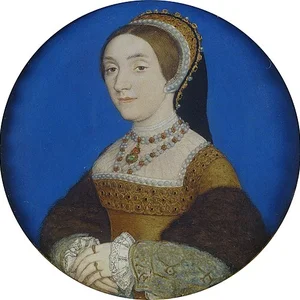

Catherine Howard was the fifth wife of King Henry VIII of England, whom she married in 1540. A very young queen consort, she was accused of adultery and treason, then executed in 1542.
Catherine Howard(1523 — 1542)
Catherine Howard
royaume d'Angleterre
6 min read
Frequently asked questions
Key Facts
- Married Henry VIII of England in July 1540, becoming his fifth wife
- Cousin of Anne Boleyn, Henry VIII's second wife
- Accused of adultery and treason against the Crown in 1541
- Executed by beheading at the Tower of London on 13 February 1542
- Her marriage was annulled shortly before her execution
Works & Achievements
By marrying the king on the very day of Cromwell's execution, she became queen consort of England and Henry VIII's fifth wife.
She brought youth and cheerfulness to an aging court, presiding over feasts, dances, and ceremonies alongside the king.
She accompanied Henry VIII on his tour of northern England, intended to assert royal authority after the revolts.
Like every queen, she adopted a personal motto expressing her submission to the king, engraved on her emblems.
Her case led to a change in English law: concealing a romantic past before marrying the king became a crime of treason.
Anecdotes
Catherine Howard was the cousin of Anne Boleyn, the second wife of Henry VIII, who was likewise beheaded for adultery and treason. Two queens from the same family, the Howards, thus perished on the scaffold six years apart.
Henry VIII, charmed by her youth and high spirits, called her his “rose without a thorn.” He even had a medal struck in her honour, convinced that he had finally found marital happiness.
When she learned that she was to be arrested, legend has it that she escaped from her apartments at Hampton Court Palace and ran towards the chapel where the king was praying, screaming his name. The guards caught her: the corridor has supposedly been “haunted” by her cries ever since, earning it the nickname the Haunted Gallery.
The night before her execution, she is said to have asked that the block be brought to her cell so she could practise laying her head upon it correctly, in order to die with dignity. On 13 February 1542, at around 18 or 19 years of age, she was beheaded at the Tower of London.
Her downfall was hastened by a law passed during her trial: it became an act of high treason for a woman to conceal her romantic past before marrying the king. Parliament condemned her by a “bill of attainder,” without any genuine trial before a court.
Primary Sources
She admitted to having had relations with Francis Dereham before her marriage, begging the king for mercy while denying any adultery committed during her time as queen.
The dispatches record the inquiry conducted by the Privy Council into the queen's conduct and the interrogations of Dereham and Thomas Culpeper.
“... for I would die of longing to see you...”: this letter, found among Culpeper's belongings, served as damning evidence at the trial.
Chapuys reports to the emperor the disgrace and execution of the queen, as well as the mood of King Henry VIII.
Key Places
Royal residence of Henry VIII where Catherine spent much of her brief reign. Its “Haunted Gallery” commemorates her desperate dash toward the king.
Royal fortress where Catherine was imprisoned and then beheaded on 13 February 1542. She is buried in the Chapel of St Peter ad Vincula, near her cousin Anne Boleyn.
Home of the Dowager Duchess of Norfolk, where Catherine was raised among many young girls and where her youthful relationships began.
Henry VIII's main London residence, where part of the queen's court life unfolded and where the deliberations of her trial were held.
A stop on the great royal progress of 1541 through the north; it is the setting of certain secret meetings held against the queen at her trial.
Typical Objects

Heavy court gown with a stiff bodice, full sleeves and an open skirt revealing a richly embroidered petticoat. A symbol of her rank as queen consort.

A rounded French-style headdress worn by the ladies of the Tudor court, adorned with pearls and fabric trim. Catherine preferred it to the more austere English gable hood.

Necklaces, rings and pendants given by Henry VIII to his young wife. They were confiscated when she fell from grace.

A medal struck by Henry VIII in Catherine's honour, bearing a Latin motto celebrating her supposed purity. A witness to the king's idealisation of his queen.

A love note in Catherine's own hand found in Culpeper's possession, which became a key exhibit at her trial. A rare personal document from a Tudor queen.

The wooden block on which the condemned laid her head, struck by the executioner's axe. The instrument of executions at the Tower of London.
School Curriculum
Vocabulary & Tags
Key Vocabulary
Tags
Daily Life
Morning
The queen was woken by her ladies-in-waiting, then attended Mass in the royal chapel. She was afterwards dressed in a heavy court gown — a long, codified process governed by Tudor etiquette.
Afternoon
Afternoons were divided between walks in the gardens, games of cards or dice, and receiving courtiers. Catherine, renowned for her liveliness, was especially fond of dancing and music.
Evening
Evenings at court brought together banquets, entertainments, and balls in the great hall. The young queen shone there, with the king showering her with gifts and attentions.
Food
The royal table offered roasted meats (beef, game, poultry), pies, fish, and white bread, washed down with wine and ale. Vegetables were rare; candied fruits and sweet desserts marked one's rank.
Clothing
Catherine wore gowns of velvet and silk embroidered with gold thread, French hoods adorned with pearls, and many jewels given to her by the king. Every outfit asserted her status as queen.
Housing
She lived in the queen's apartments of the great royal palaces (Hampton Court, Whitehall) — rooms richly hung with tapestries, heated by vast fireplaces, and furnished with four-poster beds.
Historical Timeline
Period Vocabulary
Liens externes & ressources
Références
Œuvres
Mariage avec Henri VIII
28 juillet 1540
Rôle de reine consort à la cour Tudor
1540-1541
Participation au grand voyage royal du Nord (Royal Progress)
1541
Devise « Non autre volonté que la sienne » (No other will but his)
1540
Procès et condamnation par bill of attainder
1542