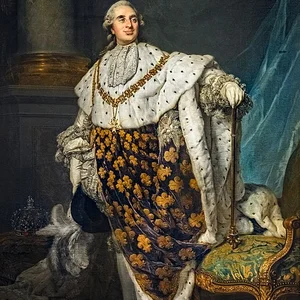

King of France and Navarre from 1774 to 1791, then King of the French from 1791 to 1792. His reign was marked by the French Revolution, attempted reforms, and the abolition of the Ancien Régime. Arrested during the Flight to Varennes in 1791, he was tried and executed by guillotine on January 21, 1793.
Louis XVI(1754 — 1793)
Louis XVI
France
8 min read
Frequently asked questions
Famous Quotes
« Is this a revolt? No, Sire, it is a revolution.»
« All is not lost when the king retains his courage and the affection of his people.»
Key Facts
- 1774: Accession to the throne of France at the age of 20
- 1789: Convening of the Estates-General and the beginning of the French Revolution
- 1791: The king's attempted flight to Varennes (night of June 20–21), arrested and brought back to Paris
- 1792: Abolition of the monarchy, proclamation of the Republic
- 1793: Trial and execution by guillotine on January 21 in Paris
Works & Achievements
Granting civil status to Protestants and Jews in France, this edict is one of Louis XVI's great liberal reforms, inspired by Enlightenment ideas and paving the way for revolutionary civic equality.
Louis XVI committed France militarily and financially alongside the American insurgents, contributing to the victory of the American Revolution and the birth of the United States of America.
Faced with the State's financial crisis, Louis XVI convened the Estates-General, bringing together for the first time since 1614 the three orders of the kingdom, inadvertently triggering the revolutionary process.
By accepting the first French Constitution, Louis XVI became the first constitutional king of France, transforming the absolute monarchy into a constitutional monarchy, even though this acceptance was deemed coerced by the revolutionaries.
Louis XVI personally funded and prepared the scientific expedition of Jean-François de Galaup de La Pérouse around the world, illustrating his interest in geographical sciences and colonial competition.
Anecdotes
Louis XVI was passionate about locksmithing: he had a personal workshop at Versailles where he made and repaired locks with the craftsman Gamain. This passion for manual work stood in stark contrast to the ceremonial obligations of court life, and his contemporaries saw it as the mark of a king who was more craftsman than monarch.
On June 20, 1791, Louis XVI and his family attempted to flee France disguised as servants, hidden inside a traveling berline carriage. Recognized at Varennes by the postmaster Jean-Baptiste Drouet from his portrait on an assignat, the king was arrested and escorted back to Paris, an event that irrevocably sealed his loss of legitimacy.
Louis XVI was the first King of France to receive a smallpox inoculation, in 1774, shortly after his accession. This courageous and forward-thinking decision, inspired by Enlightenment ideas, helped popularize the practice in France at a time when it was highly controversial among physicians and the general public.
At his trial in December 1792, Louis XVI defended himself calmly and with dignity before the National Convention. He denied having ordered any massacres and asserted that he had always acted for the happiness of his people, rejecting the name "Louis Capet" used by the revolutionaries.
Louis XVI was an avid reader and enthusiast of astronomy and geography. He followed the voyages of La Pérouse with great interest — expeditions he had personally helped to organize — and one of his last thoughts on the morning of his execution is said to have been concern for the fate of the missing expedition.
Primary Sources
On July 14, 1789, Louis XVI notes laconically in his personal diary: "Nothing." — a reference to his hunting day, with no mention of the storming of the Bastille, illustrating the disconnect between the king and the revolutionary events.
"I am innocent of everything I am charged with. I have never feared that my conduct would be examined publicly; I have always acted in accordance with the laws."
"I die in the Catholic, Apostolic and Roman faith [...] I forgive with all my heart those who have made themselves my enemies, without my having given them any cause."
The king justifies the dismissal of his finance minister by invoking the need for a firmer government, without anticipating the popular consequences of this decision.
"I accept the Constitution; I commit to upholding it internally, to defending it against attacks from without, and to enforcing its laws."
Key Places
Louis XVI's main residence until October 1789. The Hall of Mirrors was the setting for decisive events, and in the Estates-General chamber he vainly attempted to regain control of the political crisis.
The royal family's forced residence from October 1789. The palace was stormed on 10 August 1792, marking the effective end of the monarchy. Louis XVI spent his final years as king there.
Small town in Lorraine where Louis XVI and his family were arrested on 21 June 1791 during their attempted flight abroad. This failure proved to be the decisive turning point of the French Revolution.
Medieval prison where Louis XVI was incarcerated with his family from August 1792. It was there that he was separated from his loved ones and wrote his will before his execution.
The site of Louis XVI's execution by guillotine on 21 January 1793. The crowd gathered in the square witnessed the death of the last king of the Ancien Régime.
Typical Objects

Louis XVI practiced locksmithing as his favorite hobby in his workshop at Versailles. These tools symbolize the contradiction between his artisanal passion and the demands of royal power.

A large enclosed carriage used for royal travel, made infamous during the Flight to Varennes in June 1791. Its slowness and ostentatious luxury contributed to the king's arrest.
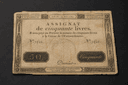
A revolutionary banknote bearing the king's portrait, ironically used by postmaster Drouet to recognize Louis XVI during his flight to Varennes.

Louis XVI had a passion for science, astronomy, and geography. He owned optical instruments and closely followed the scientific explorations of his era.

Official acts bearing Louis XVI's seal, most notably the acceptance of the Constitution of 1791, represent the king's attempts to adapt to constitutional monarchy.

Louis XVI was deeply devout and observant. During his final days of captivity in the Temple, he devoted himself to religious reading and prayer with the non-juring priest Henry Essex Edgeworth.
School Curriculum
Vocabulary & Tags
Key Vocabulary
Tags
Mouvement
Daily Life
Morning
Louis XVI rose early, often before dawn, to practice hunting, which was his main passion. The king's lever was a public ceremony at Versailles where courtiers attended in large numbers to witness his toilette and dressing, following a protocol inherited from Louis XIV.
Afternoon
The afternoon was devoted to audiences, ministerial councils, and affairs of state. Louis XVI carefully read the reports and memoranda submitted to him, then often retired to his locksmithing workshop to work with his hands, an activity that brought him genuine relief.
Evening
Evenings at Versailles were marked by games, performances, and concerts organized by Marie-Antoinette, in which Louis XVI sometimes participated without enthusiasm. He preferred intimate family gatherings and went to bed early, unlike the queen, who hosted suppers until dawn.
Food
Louis XVI was renowned for his considerable appetite: he could consume several meat dishes, poultry, pastries, and wine at each meal. His contemporaries noted that even on difficult days he never neglected his food, which at times drew criticism from the starving people.
Clothing
The king wore silk and gold embroidered garments at official ceremonies, with a powdered wig, white silk stockings, buckled shoes, and a court sword. In daily life, he preferred simpler outfits for hunting or his workshop, and his contemporaries noted his relative indifference to sartorial elegance compared to those around him.
Housing
Louis XVI resided primarily at the Palace of Versailles until October 1789, in royal apartments of extraordinary richness, surrounded by hundreds of servants and courtiers. After the October Days, the royal family was forced to move to the Tuileries, then imprisoned in the Temple Tower from August 1792 onwards, in conditions of increasing isolation.
Historical Timeline
Period Vocabulary
Visual Style
Esthétique contrastée entre la splendeur baroque et néoclassique de Versailles et la rudesse austère de la Révolution, reflétant la trajectoire tragique d'un roi entre deux mondes.
Sound Ambience
Sonorités contrastées entre le faste musical de la cour de Versailles et le fracas révolutionnaire des rues de Paris, ponctuées par le silence recueilli de la captivité au Temple.
Liens externes & ressources
Références
Œuvres
Édit de Versailles (Édit de tolérance)
1787
Soutien à l'indépendance américaine
1778-1783
Convocation des États généraux
1789
Acceptation de la Constitution de 1791
1791
Organisation du voyage de La Pérouse
1785