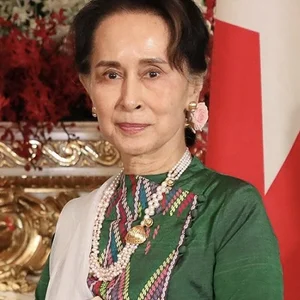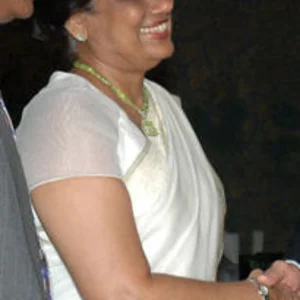

A Sri Lankan politician, she was the first woman president of Sri Lanka (1994-2005). The daughter of two Prime Ministers, she sought to end the civil war between the state and the Tamil Tigers.
Chandrika Kumaratunga(1945 — ?)
Chandrika Kumaratunga
Sri Lanka
5 min read
Frequently asked questions
Key Facts
- Born in 1945 in Colombo, daughter of Solomon and Sirimavo Bandaranaike, both heads of the Sri Lankan government
- Elected president of Sri Lanka in 1994, becoming the first woman to hold this office
- Survived a suicide bombing by the Tamil Tigers (LTTE) in December 1999, losing the use of one eye
- Re-elected president in 1999, she remained in power until 2005
- Attempted unsuccessfully to negotiate peace with the Tamil separatists during her terms in office
Works & Achievements
Her election to the presidency made her the first woman to lead the Sri Lankan state, after having served as Prime Minister the same year.
A national campaign she launched to win Sinhalese public opinion over to the idea of a compromise with the Tamil minority.
An ambitious reform aimed at granting autonomy to the Tamil provinces in order to address the roots of the civil war, ultimately not adopted.
During her presidency, and despite a tense cohabitation, a ceasefire negotiated through Norwegian mediation temporarily halted the fighting.
With her husband Vijaya, she founded this progressive party, the first step in her independent political career.
After her presidency, she chaired this body tasked with fostering reconciliation among the island's communities.
Anecdotes
Chandrika Kumaratunga was born into an extraordinary family: both her father and her mother served as Prime Ministers of Sri Lanka. Her mother, Sirimavo Bandaranaike, became in 1960 the very first woman head of government in world history.
When she was 14, her father, Prime Minister S.W.R.D. Bandaranaike, was assassinated by a Buddhist monk in 1959. This family tragedy deeply marked her childhood and drew her into the world of politics at a very early age.
As a young woman, she left Sri Lanka to study in Paris, at the Institut d'études politiques (Sciences Po). There she learned French and discovered the ideas of the 1960s European left.
In 1988, her husband Vijaya Kumaratunga, a famous film actor turned politician, was assassinated outside their home before their children's eyes. Devastated, Chandrika went to live in London for a time before returning to politics.
On 18 December 1999, in the middle of the election campaign, she narrowly escaped a suicide bombing attributed to the Tamil Tigers: the explosion left her blind in her right eye. Three days later, she won the presidential election all the same.
Primary Sources
She declares that she has received a clear mandate from the people to end the war and build a lasting peace among all the communities of the island.
Wounded but alive, she speaks to the Sri Lankan people to affirm that violence will not make her abandon her quest for peace.
The text proposes transferring significant powers to the provinces in order to grant broad autonomy to Tamil-majority regions, without dividing the country.
She explains that she wants to address the root causes of the conflict, acknowledging the grievances of the Tamil minority while refusing the partition of the island.
Key Places
The island's economic capital, where she was born in 1945 and where she held power, both as president and head of government.
Institute of Political Studies where she pursued her higher education in the 1960s and learned French.
The Bandaranaike family estate, cradle of this Sri Lankan political dynasty and the family's electoral stronghold.
The district where the December 1999 rally was held, during which a suicide bombing left her severely wounded.
Typical Objects

Traditional garment of South Asian women that she wore during official ceremonies, a symbol of her Sri Lankan cultural roots.

Emblem of her peace movement launched in 1995, the white lotus represented reconciliation between the Sinhalese and the Tamils.

After the 1999 attack that cost her her right eye, she often wore tinted glasses, a visible mark of the price paid for her political struggle.

Symbol of Sri Lankan democracy through which she came to power, winning the elections of 1994 and then of 1999.

Tool of large campaign rallies; it was at one of these rallies, microphone in hand, that she was targeted in the 1999 attack.

Reform document that she championed to grant autonomy to the Tamil provinces and attempt to end the war.
School Curriculum
Vocabulary & Tags
Key Vocabulary
Daily Life
Morning
As president, her mornings began with security briefings and updates on the military situation in the north and east of the island. She received advisers and ministers at her official residence in Colombo.
Afternoon
The afternoon was devoted to affairs of state: signing decrees, audiences with foreign diplomats, and preparing the constitutional reform projects she championed in the name of peace.
Evening
In the evening, she attended official dinners or gatherings of her party. During election periods, her evenings were spent at public rallies, sometimes under heavy protection following the 1999 assassination attempt.
Food
Like most Sri Lankans, she ate mainly rice served with spicy curries (vegetables, fish, dhal lentils) and Ceylon tea, the island's national pride.
Clothing
She most often appeared in a sari, the traditional garment of South Asian women, choosing understated colors for official ceremonies and frequently wearing glasses after the injury to her eye.
Housing
As president, she lived in the state residences of Colombo, protected by extensive security measures. Her family was also tied to the ancestral estate of Horagolla, in the countryside.
Historical Timeline
Period Vocabulary
Liens externes & ressources
Références
Œuvres
Première femme présidente du Sri Lanka
1994
Mouvement pacifiste « Sudu Nelum »
1995
Projet de dévolution constitutionnelle
2000
Cessez-le-feu de 2002
2002
Co-fondation du Sri Lanka Mahajana Party
1984
Bureau pour l'unité nationale et la réconciliation
2015