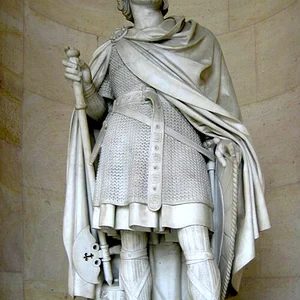

Charles Martel was mayor of the palace of Austrasia and then de facto ruler of the kingdom of the Franks. Born into the Pippinid family, he imposed Carolingian authority and halted the Arab-Muslim advance at the Battle of Poitiers in 732. The grandfather of Charlemagne, he paved the way for the rise of the Carolingian dynasty.
Charles Martel(688 — 741)
Charles Martel
royaume des Francs
7 min read
Frequently asked questions
Key Facts
- Becomes mayor of the palace of Austrasia in 717 after the death of his father Pepin of Herstal
- Wins the Battle of Poitiers in 732 (or 733) against the troops of the governor Abd al-Rahman, halting the Muslim push toward the north
- Reunifies all the Frankish territories (Neustria, Austrasia, Burgundy, Aquitaine) under his authority
- Holds power in practice without bearing the royal title until his death in 741
- Grandfather of Charlemagne and father of Pepin the Short, the official founder of the Carolingian dynasty
Works & Achievements
Charles halted the advance of Abd al-Rahman's army that had come from al-Andalus. The event earned him a lasting reputation as a defender of Western Christendom.
After his victories over the Neustrians, Charles brought Austrasia, Neustria, and Burgundy together under his authority. He restored the unity of Frankish power.
Charles developed an army of heavily equipped horsemen, funded by the distribution of land. This change foreshadowed the feudal society to come.
He led expeditions against the Frisians, Saxons, Bavarians, Alamanni, and Aquitanians. In doing so he consolidated and extended the borders of the Frankish kingdom.
Charles protected the missionary Saint Boniface in his work of Christianizing the Germanic peoples. In this way he tied Frankish power to the expansion of the Church.
Upon the death of Theuderic IV, Charles ruled alone without appointing a new king. He thus prepared the transfer of power to his own dynasty.
Before his death, Charles divided the kingdom between Pepin the Short and Carloman like a true sovereign. This act paved the way for the Carolingian accession of 751.
Anecdotes
His nickname “Martel” means “the hammer”: it was given to him after the Battle of Poitiers in 732, because he supposedly struck his enemies the way a hammer crushes metal. This epithet, which appears in the texts only much later, has remained attached to him forever.
Charles was not a king: he held the title of “mayor of the palace.” In his time, the Merovingian kings were so insignificant that they were nicknamed the “do-nothing kings,” while the mayors of the palace held the real military and political power.
When he died in 741, Charles Martel divided the kingdom between his two sons, Pepin the Short and Carloman, as if he were a king — even though officially he was not. During the final years, the Frankish throne even remained vacant, without any Merovingian king at all.
To fund his armies of horsemen, Charles Martel did not hesitate to confiscate lands and property from the Church to distribute them among his warriors. This earned him the lasting hostility of part of the clergy, despite his role as defender of Christendom.
He is the grandfather of Charlemagne: his son Pepin the Short would become the first Carolingian king in 751, and his grandson Charlemagne would be crowned emperor in the year 800. Charles Martel thus laid the foundations of one of the greatest dynasties in the history of France.
Primary Sources
Prince Charles, having drawn up his battle lines against them and falling upon them like a valiant warrior, took them by surprise. With Christ's help, he overturned their tents and rushed into the fray to slaughter them.
Charles, at the head of his warriors, fought many battles and subdued the rebellious peoples, governing the kingdom of the Franks with firmness in the days of the Merovingian kings.
The peoples of the North stood motionless as a wall, and like a band of cold frozen in place, they annihilated the Arabs with the edge of the sword.
Charles, a man of indomitable courage, took into his hands the governance of the entire kingdom of the Franks and brought the rebellious neighboring nations under his authority.
Key Places
Family estate of the Pippinids, near Liège in present-day Belgium, the cradle of power for Charles's family. It is one of the centers of the emerging Carolingian authority.
A town in Aquitaine near which Charles confronted the army that had come from Spain in 732. The battle, fought on the road to Tours, became the symbol of his role as defender of the Franks.
A former city of Neustria where Charles won a decisive victory in 719, consolidating his authority over the entire Frankish kingdom.
A Frankish royal palace on the Oise, a place of residence and government for the mayors of the palace and the Carolingian sovereigns.
A great sanctuary north of Paris where Charles Martel was buried in 741. The site would become the necropolis of the kings of France.
A town in the Loire Valley home to the rich sanctuary of Saint Martin, the presumed objective of the expedition halted by Charles in 732; the battle is sometimes called the “Battle of Tours.”
Typical Objects

A long double-edged sword used by Frankish warriors for close combat. A prestigious weapon, it was often the object of great care and symbolized the fighter's status.

A throwing axe characteristic of the Franks, whose very name evokes this people. Warriors hurled it at the enemy before the clash of the lines to break shields and enemy ranks.

A defensive armor made of interlinked iron rings or plates sewn onto leather, protecting the warrior's torso. Costly, it was reserved for the fighting elite around the mayor of the palace.

A wooden shield reinforced with a central iron boss, held by Frankish foot soldiers. Aligned with those of their companions, it formed a formidable defensive wall, as at Poitiers.

A polearm with an iron point, used both by foot soldiers and by the rising cavalry. It was the most widespread weapon of the Frankish armies.

Written documents sealed by which the mayor of the palace granted lands, privileges, and donations. They were the concrete instrument of his political authority over the kingdom.
School Curriculum
Vocabulary & Tags
Key Vocabulary
Daily Life
Morning
A mayor of the palace's day began early, often on one of the royal estates where the court moved from season to season. After a prayer, Charles received his loyal followers, listened to messengers, and gave his orders. In wartime, the morning was devoted to organizing the troops and inspecting weapons.
Afternoon
The afternoon was divided between the affairs of the kingdom — passing judgments, granting lands, receiving ambassadors — and military exercises or hunting. Hunting on horseback, the favorite sport of the Frankish aristocracy, kept the warriors' endurance sharp while affirming the leader's prestige.
Evening
In the evening, the mayor of the palace presided over a great feast in the common hall, surrounded by his loyal warriors. They ate, drank, and listened to tales of warlike exploits. These banquets strengthened the bonds of loyalty between the leader and his armed entourage.
Food
The diet of the Frankish aristocracy was rich in meat, especially game from the hunt (deer, wild boar) and pork. They also ate bread, cereal porridges, cheese, and vegetables, all washed down with wine and beer (ale) during the great feasts.
Clothing
Charles wore quality garments that marked his rank: a linen or wool tunic, braies (a kind of trousers), a cloak fastened with a fibula, and hose. On campaign, he donned the byrnie or chain mail, and his ornamented weapons displayed his status as a war leader.
Housing
There was no fixed capital: the court moved between the royal palaces and estates (Herstal, Quierzy, Jupille). These residences were large complexes of wood and stone comprising a vast common hall, agricultural outbuildings, and stables, at the heart of rural estates.
Historical Timeline
Period Vocabulary
Liens externes & ressources
Références
Œuvres
Victoire de la bataille de Poitiers
732
Réunification du royaume franc
vers 719
Réforme militaire et essor de la cavalerie
vers 730-740
Campagnes de soumission des peuples périphériques
720-738
Soutien à l'évangélisation de la Germanie
vers 723
Gouvernement sans roi mérovingien
737-741
Partage du royaume entre ses fils
741