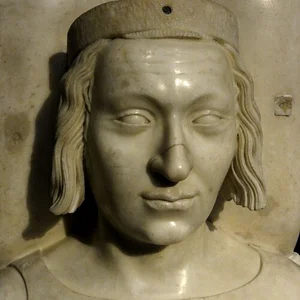

King of France from 1364 to 1380, Charles V restored the kingdom after the defeats of the early Hundred Years' War. Thanks to his constable Du Guesclin, he reconquered nearly all the lost territory and reestablished royal authority.
Charles V the Wise(1338 — 1380)
Charles V of France
France
6 min read
Frequently asked questions
Key Facts
- Regent of the kingdom during the captivity of his father John II the Good, after the defeat at Poitiers (1356)
- Becomes King of France in 1364 and is crowned at Reims the same year
- Appoints Bertrand Du Guesclin Constable of France in 1370 to lead the reconquest
- Reconquers nearly all the territories ceded to England in the Treaty of Brétigny (1370s)
- Strengthens the royal state: permanent taxation, reorganization of the army, expansion of the Louvre, building of a rich royal library; dies in 1380
Works & Achievements
Through a strategy of attrition and with the help of Du Guesclin, Charles V recaptured almost all the lands ceded to the English in 1360.
Assembling a library of more than 1,000 manuscripts, a distant ancestor of the Bibliothèque nationale de France.
Introduction of permanent taxes and a more professional army to fund the war on a lasting basis.
A fortress defending Paris that later became a symbol of the Ancien Régime.
An imposing residential tower and a symbol of restored royal power.
Commissions of translations of Aristotle, Saint Augustine, and other authors to spread knowledge in the French language.
Strengthening of the navy, allied with Castile, which led to the naval victory of La Rochelle in 1372.
Anecdotes
Charles V was a learned and cerebral king, nicknamed "the Wise": he gathered nearly 1,200 manuscripts in a library housed in a tower of the Louvre, a distant ancestor of the future National Library of France. He had works by Aristotle and Saint Augustine translated into French to make them accessible.
Rather than confronting the English in great pitched battles, where France had been crushed at Crécy and Poitiers, Charles V chose a strategy of attrition: harassment, sieges, and recapturing towns one by one. This caution made it possible to reconquer almost all the lost territory without risking another catastrophe.
The king entrusted the sword of Constable, the highest military office in the kingdom, to Bertrand Du Guesclin, a minor Breton noble reputed to be ugly but a formidable tactician. This bold choice, based on merit rather than rank, was one of the keys to the French recovery.
Charles V suffered from fragile health and a swollen right hand that almost prevented him from holding a sword, a possible after-effect of a poisoning endured during his youth. Yet this physically weakened king governed with remarkable administrative energy from his study chambers.
To protect Paris, Charles V had the fortress of the Bastille built and reinforced the capital's defensive walls. He also transformed the Louvre, until then an austere stronghold, into a more refined and habitable royal residence.
Primary Sources
Christine de Pizan praises the king's wisdom: “He loved books and learning, and wished that many works be translated from Latin into French so that everyone might benefit from them.”
Froissart recounts the strategy of attrition recommended by the king and carried out by Du Guesclin to retake towns and castles from the English without great pitched battles.
The official chronicle of the monarchy, written and expanded under Charles V, which presents the reign as a recovery of the kingdom after the setbacks of the preceding reigns.
Key Places
Fortified residence dear to Charles V, who had a mighty keep built there. The king died there in 1380.
A former fortress that Charles V turned into a royal residence, where he set up his famous library of manuscripts.
Traditional site of the coronation of the kings of France, where Charles V was crowned in 1364.
A fortress built under Charles V to defend the eastern entrance to Paris during the Hundred Years' War.
Necropolis of the kings of France where Charles V was buried, like most of his predecessors.
Typical Objects

Golden scepter topped with a statuette of Charlemagne, a symbol of royal legitimacy and of the link to the Carolingian dynasty. It was used during coronations and is preserved at the Louvre.

A book copied and illustrated by hand, often a French translation commissioned by the king. Charles V amassed more than a thousand of them in his library at the Louvre.

A sword handed to the highest military commander of the kingdom, the constable, here Bertrand Du Guesclin. It embodied command of the armies in the king's name.

A golden crown adorned with precious stones worn during the coronation at Reims. It made the king God's anointed and the legitimate sovereign of France.

An emerging firearm used during the sieges of the 14th century. Its use began to transform the art of war during the reign of Charles V.

In 1370, Charles V had a mechanical clock installed on a tower of the royal palace, one of the first in Paris. It marked the time of the city to the steady rhythm of its gears.
School Curriculum
Vocabulary & Tags
Key Vocabulary
Daily Life
Morning
The king would rise in his apartments at the Louvre or Vincennes, attend morning Mass, then hold council with his ministers and jurists. His fragile health forced him to measure his efforts carefully.
Afternoon
The afternoon was devoted to the affairs of the kingdom: audiences, reading military reports, signing decrees, and discussions with advisors. Charles V governed from his study far more than on the battlefield.
Evening
In the evening, the king liked to withdraw to his library to read or to listen to manuscripts being read aloud. He surrounded himself with scholars and clerics with whom he discussed philosophy and history.
Food
The royal table offered meats, game, fish, and wheat bread, seasoned with costly spices as a sign of prestige. Wine accompanied the meals, served according to a codified ceremonial.
Clothing
Charles V wore rich, long robes lined with fur, embroidered with gold and adorned with the fleur-de-lis. The crown and the ceremonial mantle marked solemn occasions.
Housing
The king lived in fortified residences of growing comfort, such as the transformed Louvre and the keep of Vincennes. Tapestries, fireplaces, and carved furniture made them dwellings worthy of a sovereign.
Historical Timeline
Period Vocabulary
Liens externes & ressources
Références
Œuvres
Reconquête du territoire perdu à Brétigny
1369-1377
Bibliothèque royale du Louvre
vers 1368
Réforme de l'armée et de la fiscalité royales
1360-1380
Construction de la Bastille
1370-1383
Donjon du château de Vincennes
vers 1370
Traductions savantes en français
1370-1377
Reconstitution de la flotte de guerre
vers 1370