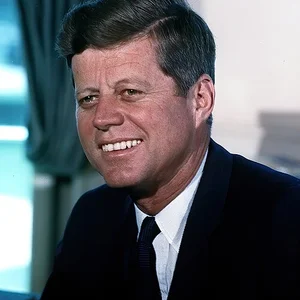

President of the United States from 1961 to 1963, John F. Kennedy embodies the political modernity of the 20th century. His term was marked by critical moments of the Cold War, notably the Cuban Missile Crisis, and by his commitment to civil rights before his assassination in Dallas.
John F. Kennedy(1917 — 1963)
John Fitzgerald Kennedy
États-Unis
8 min read
Frequently asked questions
Famous Quotes
« Ask not what your country can do for you – ask what you can do for your country.»
« The only thing necessary for the triumph of evil is for good men to do nothing.»
Key Facts
- Elected President of the United States in 1960, the youngest American president at the time
- Cuban Missile Crisis in October 1962: nuclear standoff with the USSR, resolved without war
- Support for the civil rights movement, including Martin Luther King's speech in 1963
- Escalation of involvement in Vietnam through an increased number of American military advisors
- Assassinated in Dallas, Texas, on November 22, 1963
Works & Achievements
A book written by Kennedy about American senators who demonstrated political courage in the face of public opinion. It earned him the Pulitzer Prize in 1957 and strengthened his intellectual credibility ahead of his presidential campaign.
An economic and social aid program for Latin American countries launched to counter the influence of Castrist communism. It aimed to fund development, education, and agrarian reform throughout the region.
An organization created by executive order to send American volunteers to assist with development in third-world countries. Still active today, the Peace Corps embodies the ideal of service and citizen diplomacy championed by Kennedy.
Kennedy set the goal of sending a man to the Moon before the end of the decade as part of the Space Race against the USSR. Although he did not live to see Neil Armstrong land on the Moon in 1969, his political impetus proved decisive.
Signed by the United States, the USSR, and the United Kingdom, this landmark treaty banned nuclear testing in the atmosphere, underwater, and in outer space. It marked the first concrete step toward nuclear disarmament of the Cold War era.
Kennedy submitted ambitious legislation to Congress prohibiting racial segregation in public places and employment discrimination. Passed after his death under Johnson, the Civil Rights Act of 1964 brought this commitment to fruition.
Anecdotes
During the Cuban Missile Crisis in October 1962, Kennedy received aerial photographs proving the presence of Soviet missiles 90 miles from the American coastline. For thirteen days, the world held its breath: Kennedy chose a naval blockade over an air strike, narrowly avoiding nuclear war.
Kennedy secretly suffered from Addison's disease, a serious adrenal insufficiency, and chronic herniated discs that forced him to wear an orthopedic back brace. Despite this constant pain, he projected an image of vitality and youth in public that captivated an entire generation of Americans.
On June 26, 1963, before hundreds of thousands of Berliners, Kennedy delivered his famous speech declaring 'Ich bin ein Berliner' — 'I am a Berliner.' This phrase, a symbol of solidarity with the residents of West Berlin encircled by the Wall, had an electrifying effect on the crowd and still resonates today.
Kennedy was a voracious and fast reader: he read approximately 1,200 words per minute. A passionate student of history, he particularly admired Barbara Tuchman's book on World War I, and drew on his reading to manage diplomatic crises with a more nuanced approach than his military advisors.
On the day of his assassination in Dallas, November 22, 1963, Kennedy had refused to have plexiglass panels protect his open-top limousine, wishing to remain visible to the crowd. The Warren Commission concluded that Lee Harvey Oswald acted alone, but the circumstances of the assassination continue to fuel historical debate.
Primary Sources
Ask not what your country can do for you – ask what you can do for your country.
It shall be the policy of this Nation to regard any nuclear missile launched from Cuba against any nation in the Western Hemisphere as an attack by the Soviet Union on the United States, requiring a full retaliatory response upon the Soviet Union.
Let us talk about peace. What kind of peace do we seek? […] A peace for all men and all time, not merely peace in our time, not merely peace for Americans, but peace for all men and all time.
Race has no place at a starting line, in a classroom, in a voting booth, in a dormitory, or in a courtroom. […] Equal treatment of all our citizens must be the goal of our society.
There are many people in the world who really don't understand, or say they don't, what is the great issue between the free world and the Communist world. Let them come to Berlin. […] Ich bin ein Berliner.
Key Places
Heart of American executive power, this is where Kennedy led the United States from January 1961 to November 1963, notably during the major diplomatic crises of the Cold War.
Site of the failed April 1961 landing organized by the CIA with anti-Castro Cuban exiles; this defeat had a lasting impact on Kennedy's foreign policy toward Cuba and Latin America.
In front of this city hall, Kennedy delivered his famous 'Ich bin ein Berliner' speech on June 26, 1963, affirming American solidarity in the face of the Soviet threat and the Berlin Wall.
Historic square where the presidential motorcade was ambushed on November 22, 1963; Kennedy's assassination there caused a profound national and worldwide trauma.
Kennedy's burial site since November 25, 1963, marked by an eternal flame. This site has become a place of remembrance and pilgrimage visited by millions of people each year.
Typical Objects

Kennedy suffered from severe back pain and used a specially designed rocking chair daily to relieve it. This rocking chair became one of the visual symbols of his presidency, present in the Oval Office as well as his residences.

Established after the Cuban Missile Crisis in 1963, the red telephone allowed direct and rapid communication between the American president and the Soviet leader to prevent any nuclear misunderstanding. Its creation is directly linked to the lessons learned from the thirteen days of crisis.

During World War II, Kennedy commanded the torpedo boat PT-109, which was rammed and sunk by a Japanese destroyer in 1943. His bravery in rescuing his men made him a war hero and helped shape his public image.

Kennedy worked carefully on his speeches, annotating and correcting texts prepared by his speechwriters such as Ted Sorensen. These manuscripts bear witness to a president who was mindful of linguistic precision and the rhetorical impact of his public addresses.

This black convertible limousine was Kennedy's official vehicle for public travel. It was in this car that he was assassinated in Dallas on November 22, 1963, making the automobile a symbol of the national tragedy.

A great aficionado of Cuban cigars, Kennedy had a personal stockpile of 1,200 cigars assembled on the very eve of signing the trade embargo against Cuba in 1962, an anecdote that illustrates the complexity of his political positions.
School Curriculum
Vocabulary & Tags
Key Vocabulary
Tags
Concept
Daily Life
Morning
Kennedy rose around 7:30 AM and invariably began his day with an intensive reading of national and international newspapers — up to nine dailies. He would take a hot bath to relieve his back pain before heading to the Oval Office around 9 AM for the first staff meetings.
Afternoon
Presidential afternoons were structured around intelligence briefings, meetings with advisors, and diplomatic engagements. Kennedy liked to allow himself a brief one-hour nap after lunch — a medical recommendation to spare his back — before resuming his activities.
Evening
Kennedy devoted his evenings to his family, dining together at the White House whenever his official duties permitted. An avid reader, he often ended his days reviewing files or reading history books, and appreciated the cultural receptions organized by Jackie.
Food
As Kennedy suffered from Addison's disease, his diet was medically supervised; he was particularly fond of New England clam chowder, seafood dishes, and steaks. Family meals were simple and regular, far from ceremonial pomp.
Clothing
Kennedy set a sober and modern sartorial standard: tailored two-piece suits in navy blue or charcoal gray, white shirts, and slim ties. He was one of the first presidents to forgo the traditional hat at his inauguration, helping to shift American men's fashion.
Housing
Kennedy resided at the White House in Washington D.C., which Jackie completely renovated by calling on American artists and craftsmen to showcase the national cultural heritage. The family spent weekends at Camp David or at the Kennedy family residence in Hyannis Port, Massachusetts.
Historical Timeline
Period Vocabulary
Visual Style
L'esthétique visuelle de l'époque Kennedy oscille entre l'élégance sobre du début des années 1960 — costumes sombres, modernité architecturale — et la tension dramatique de la Guerre froide, captée en noir et blanc par les premiers grands médias télévisés.
Sound Ambience
L'environnement sonore de Kennedy mêle le cliquetis des machines à écrire des conseillers présidentiels, les bulletins d'information radiodiffusés et les foules enthousiasmes lors des déplacements officiels, dans le contexte tendu de la Guerre froide.
Liens externes & ressources
Références
Œuvres
Profiles in Courage (Portraits d'hommes courageux)
1956
Alliance pour le progrès (Alianza para el Progreso)
1961
Corps de la Paix (Peace Corps)
1961
Programme Apollo (discours 'We choose to go to the Moon')
1961-1962
Traité d'interdiction partielle des essais nucléaires
Août 1963
Projet de loi sur les droits civiques
Juin 1963