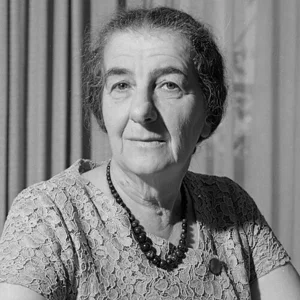

Golda Meir, born in Ukraine and emigrated to Mandatory Palestine, is one of the founders of the State of Israel. The first woman Prime Minister of Israel (1969–1974), she embodies the building of the young state and faced the Yom Kippur War in 1973.
Golda Meir(1898 — 1978)
Golda Meir
Israël, Palestine mandataire
8 min read
Frequently asked questions
Famous Quotes
« We can forgive the Arabs for killing our children. We cannot forgive them for forcing us to kill their children.»
« Peace will come when the Arabs love their children more than they hate us.»
Key Facts
- Born in Kiev in 1898, she emigrated to the United States before settling in Mandatory Palestine in 1921.
- She signed the Declaration of Independence of the State of Israel on May 14, 1948.
- Foreign Minister from 1956 to 1966, she developed Israel's diplomatic ties with Africa.
- The first woman Prime Minister of Israel, she governed from 1969 to 1974.
- She resigned in 1974 following criticism over her handling of the Yom Kippur War (October 1973).
Works & Achievements
Golda Meir was one of the 37 founding signatories of the State of Israel. Her signature on this historic document symbolizes her central role in the creation of the Jewish state.
A few weeks before the declaration of independence, Golda Meir traveled across the United States to raise funds from American Jewish communities. She gathered $50 million in a matter of weeks, a decisive sum for arming the nascent Israeli forces.
For seven years, she led Israel's social policy, overseeing the construction of hundreds of thousands of housing units to accommodate Jewish immigrants from around the world.
Golda Meir represented Israel on the international stage for ten years, notably developing relations with the newly independent African states, symbolizing solidarity among developing peoples.
The first woman to lead the Israeli government, she managed the diplomatic crisis following the Munich Olympics (1972) and faced the ordeal of the Yom Kippur War (1973).
A personal account tracing her childhood in Ukraine, her immigration to America and then to Palestine, and her political career. This book remains a valuable historical source on the founding of Israel.
Anecdotes
Golda Meir was born in Kiev in 1898 into a poor Jewish family. As a child, she experienced the terror of anti-Jewish pogroms in Ukraine, a traumatic experience that forged her deep conviction that the Jewish people needed a state of their own to survive.
An immigrant to the United States at the age of eight, Golda Mabovitch (her maiden name) sold ice cream with her sister to pay for her studies in Milwaukee. She became a schoolteacher and then a passionate Zionist activist, organizing fundraising drives in American Jewish communities.
In 1948, a few weeks before Israel's declaration of independence, Golda Meir disguised herself as an Arab woman to secretly meet King Abdullah of Jordan in Amman. She hoped to prevent war, but the mission failed: the War of Independence broke out nonetheless on May 14, 1948.
Appointed Prime Minister in 1969 at the age of 71, Golda Meir was nicknamed 'the grandmother of Israel'. She was known for holding informal cabinet meetings around her kitchen table, where she herself served coffee and cakes while making crucial decisions of state.
During the Yom Kippur War in October 1973, Golda Meir was warned at 2 a.m. of an imminent attack by Egypt and Syria. Within hours, she had to make the decision not to strike first — a momentous decision that weighed on her for the rest of her life, even though it saved Israel diplomatically in the eyes of the international community.
Primary Sources
I remember the day I arrived in Palestine. The soil was arid, the conditions difficult, but I had the feeling of finally being home, in the land of my ancestors.
I am aware of the burden and responsibility that fall upon me. I will do everything in my power to guarantee the security and prosperity of our State.
We can forgive the Arabs for killing us. But we cannot forgive them for forcing us to kill their children. Peace will come when the Arabs love their children more than they hate us.
I bear the responsibility for this war on my shoulders. Had I made different decisions, perhaps we could have saved lives. It is a burden I will carry until my death.
Key Places
Golda Meir's birthplace, then part of the Russian Empire. It was there that she experienced the anti-Jewish pogroms that marked her childhood and shaped her political consciousness.
The city where Golda grew up after her family emigrated in 1906. She studied there, became a teacher, and an active Zionist activist within the American Jewish community.
Golda's first home in Mandatory Palestine from 1921. There she discovered pioneer Zionist communal life and developed as a leader.
The city where Israeli independence was proclaimed on May 14, 1948. Golda Meir signed the declaration in the museum hall and recounted bursting into tears during this historic ceremony.
The capital where Golda Meir served as Foreign Minister and then Prime Minister. Her official residence in Jerusalem was the nerve center of her governmental action.
The city where Golda Meir led numerous diplomatic missions and fundraising efforts for the Zionist cause, notably in 1948 to finance the nascent Israeli army.
Typical Objects

Golda Meir was rarely photographed without her black handbag, which became a symbol of her austere and pragmatic style. It represented the image of an ordinary woman exercising power without ostentation.

A heavy smoker throughout her life, Golda Meir smoked cigarettes constantly, including during cabinet sessions. This trait illustrated her direct, unaffected personality.
📷 Domaine public · Wikimedia Commons ↗
Her kitchen in Jerusalem was the informal setting for many government meetings. She would personally serve coffee and cakes to her ministers, blending warmth with the exercise of power.

Golda Meir is one of the 37 signatories of this founding document. She later recounted that she wept while signing it, fully aware of the historical significance of the moment.

During her tenure as Prime Minister, the secure telephone linking Tel Aviv to Washington and allied capitals was a daily tool of her diplomacy, particularly during the Yom Kippur War.

During the Yom Kippur War, Golda Meir studied the front maps each night with her generals. These maps symbolized the crushing burden of life-and-death decisions she was required to make.
School Curriculum
Vocabulary & Tags
Key Vocabulary
Tags
Daily Life
Morning
Golda Meir woke up early, often as early as 5:30 AM, and began her day by reading newspapers and security reports. A heavy smoker, she lit her first cigarette with her coffee. She personally answered certain letters from citizens, attaching great importance to direct contact with the people.
Afternoon
Her afternoons were devoted to cabinet meetings, diplomatic audiences, and sessions at the Knesset. She preferred direct discussions over formal protocols, never hesitating to cut short overly lengthy speeches. She maintained regular contact with foreign leaders, particularly American ones, by telephone.
Evening
In the evening, Golda Meir often received colleagues and ministers in her kitchen for informal meetings over coffee and cakes she had baked herself. These 'kitchen meetings' were sometimes more decisive than formal councils. She read extensively before going to sleep, often late into the night.
Food
Golda Meir favored simple, traditional Eastern European cuisine, inherited from her Ukrainian childhood and her years on the kibbutz. She enjoyed cooking for her loved ones and preparing traditional Jewish holiday dishes (challah bread, roast chicken, apple strudel). She ate simply, with no particular taste for refined gastronomy.
Clothing
Her wardrobe style was resolutely austere and functional: dark suits (black, grey, navy), flat-heeled shoes, hair worn in a strict bun. She carried the same black handbag on all occasions. This deliberately understated style reflected her pioneering values and her rejection of ostentatious luxury, in sharp contrast with the attire of contemporary Western female leaders.
Housing
Golda Meir lived in modest accommodations throughout her life, in keeping with the pioneering ideal she embodied. During her tenure as Prime Minister, she resided in the official residence in Jerusalem, but continued to frequent her small personal apartment. Before her official duties, she had lived on a kibbutz in simple communal housing, and later in a standard apartment in Tel Aviv.
Historical Timeline
Period Vocabulary
Visual Style
Style documentaire photographique des années 1960-1970, en noir et blanc contrasté, évoquant la rigueur des pionniers sionistes et l'austérité volontaire d'une dirigeante qui refusait tout faste.
Sound Ambience
Ambiance d'un bureau gouvernemental israélien des années 1960-1970, mêlant l'atmosphère méditerranéenne de Jérusalem aux sons de la diplomatie et de la tension géopolitique permanente.
Liens externes & ressources
Références
Œuvres
Signature de la Déclaration d'indépendance d'Israël
14 mai 1948
Mission diplomatique aux États-Unis — collecte de 50 millions de dollars
1948
Ministre du Travail d'Israël
1949-1956
Ministre des Affaires étrangères d'Israël
1956-1966
Premier ministre d'Israël
1969-1974
My Life (Ma vie) — autobiographie
1975