 flip
flipMafé (Peanut Sauce with Meat)
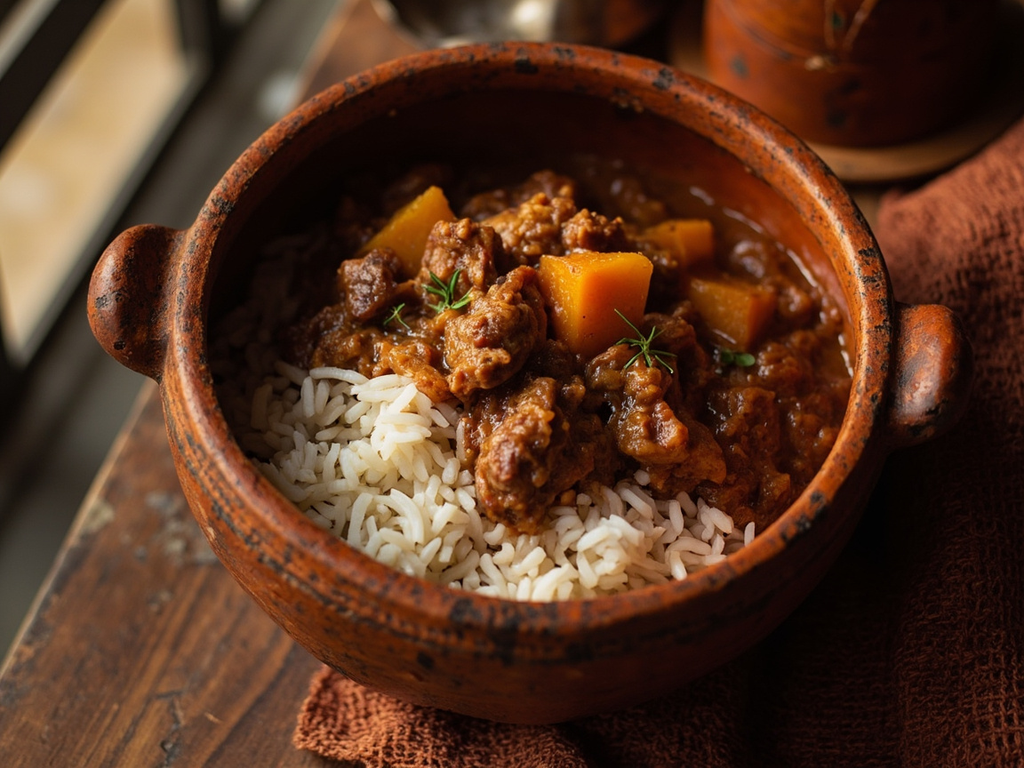
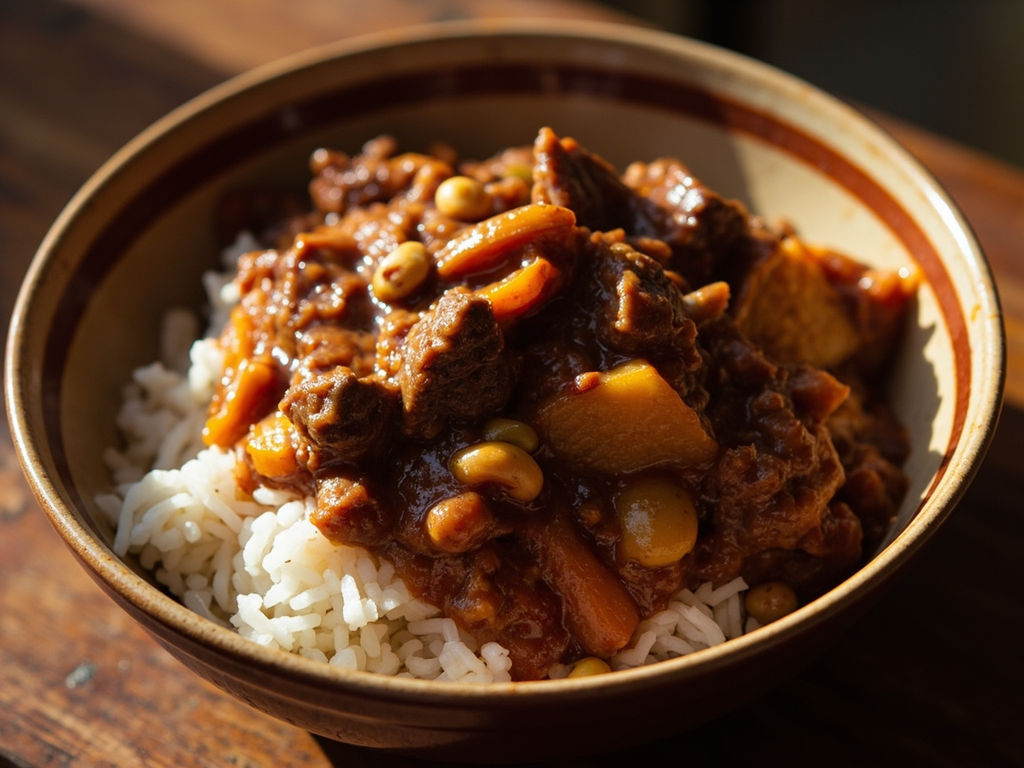
Mafé (Peanut Sauce with Meat)
Why this dish? Mafé is the quintessential everyday dish of Senegalese families, economical and filling. Its peanut base comes from the heart of Senegal's peanut basin, a region that Diop, son of Thieytou in Serer-Wolof country, knew intimately. It is the weekday meal, the one that satisfies after a day's work in the lab or the fields.
A creamy, deep sauce where peanut paste coats simmered meat and a few root vegetables, all poured over a bed of white rice. Comforting, dense, fragrant.
Mafé is the everyday sauce, the one that ruins no one and satisfies everyone. You dilute the peanut paste from our terroir in the broth, gently, without letting it curdle, and you let the meat melt in it with a little cassava and cabbage. Know that the peanut is the wealth of our countryside: it nourishes the body as it has long nourished the country's economy. Pour it generously over the rice, and you will understand why no Senegalese ever tires of it.
- •Pure peanut paste — a good ladleful (binder and central flavor)
- •Beef or mutton — pieces for stewing (protein)
- •Onion, tomato — to taste (base)
- •Cassava, cabbage, carrot, sweet potato — according to the market (vegetables)
- •Guedj — a shard (umami)
- •White rice — the base (accompaniment)
Mafé (Peanut Sauce with Meat)
A creamy, deep sauce where peanut paste coats simmered meat and a few root vegetables, all poured over a bed of white rice. Comforting, dense, fragrant.
Why this dish? Mafé is the quintessential everyday dish of Senegalese families, economical and filling. Its peanut base comes from the heart of Senegal's peanut basin, a region that Diop, son of Thieytou in Serer-Wolof country, knew intimately. It is the weekday meal, the one that satisfies after a day's work in the lab or the fields.
Mafé is the everyday sauce, the one that ruins no one and satisfies everyone. You dilute the peanut paste from our terroir in the broth, gently, without letting it curdle, and you let the meat melt in it with a little cassava and cabbage. Know that the peanut is the wealth of our countryside: it nourishes the body as it has long nourished the country's economy. Pour it generously over the rice, and you will understand why no Senegalese ever tires of it.
Ingredients (period version)
- Pure peanut paste — a good ladleful (binder and central flavor)
- Beef or mutton — pieces for stewing (protein)
- Onion, tomato — to taste (base)
- Cassava, cabbage, carrot, sweet potato — according to the market (vegetables)
- Guedj — a shard (umami)
- White rice — the base (accompaniment)
Ingredients
- 100% peanut paste (no sugar) — 150 g (central binder)
- Beef for braising (shank, chuck) — 600 g (protein)
- 1 large onion + 2 tbsp tomato paste — — (base)
- Cassava, 1/4 cabbage, 2 carrots, 1 sweet potato — — (vegetables)
- Guedj — 10 g (optional) (umami)
- White rice — 300 g (base)
Method
- Sear the meat in oil, add sliced onion then tomato paste, let it roast for 2 minutes.
- Cover with water, add guedj, and simmer for 45 minutes.
- Dilute the peanut paste in a ladle of warm broth to avoid lumps, then stir it into the pot.
- Add root vegetables and simmer on low heat for 30 to 40 minutes, without boiling too hard (the peanut oil should rise to the surface).
- Adjust salt, serve the thick, glossy sauce over white rice in the large shared dish.
How it was made : Peanuts, introduced to West Africa after the Atlantic exchanges, became the dominant crop of colonial and then independent Senegal in the 20th century (the 'peanut basin'). Mafé is its most popular culinary expression; it was cooked slowly over a wood fire, the sauce thickening for hours.
The contemporary twist : A spoonful of crushed roasted peanut paste on top when serving, for crunch and toasted flavor.
Sources : Pierre Thiam, Yolele! Recipes from the Heart of Senegal (2008)
Cheikh Anta Diop · Charactorium