 flip
flipMafé (Rice with Peanut Sauce)
Mafé (Rice with Peanut Sauce)
Why this dish? A domestic dish throughout Senegal and Guinea, mafé is the ordinary table Niane found in Conakry as well as Dakar: a family meal around a calabash, eaten by hand, that expresses the daily hospitality of the Manding country where he collected the words of the griots.
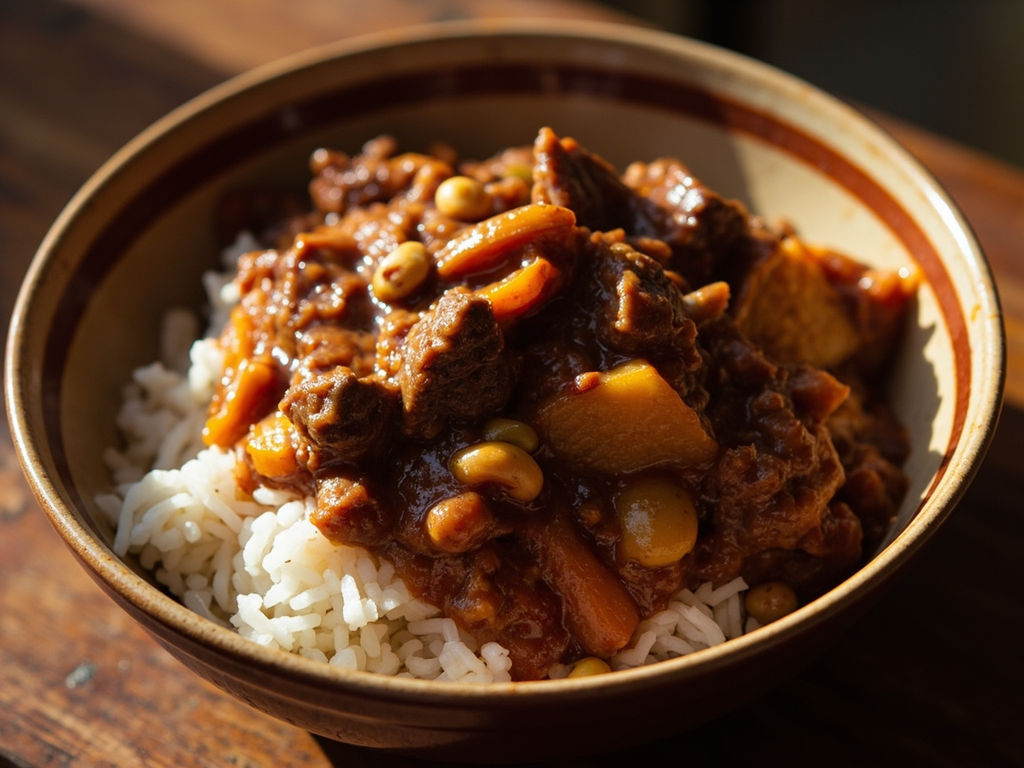
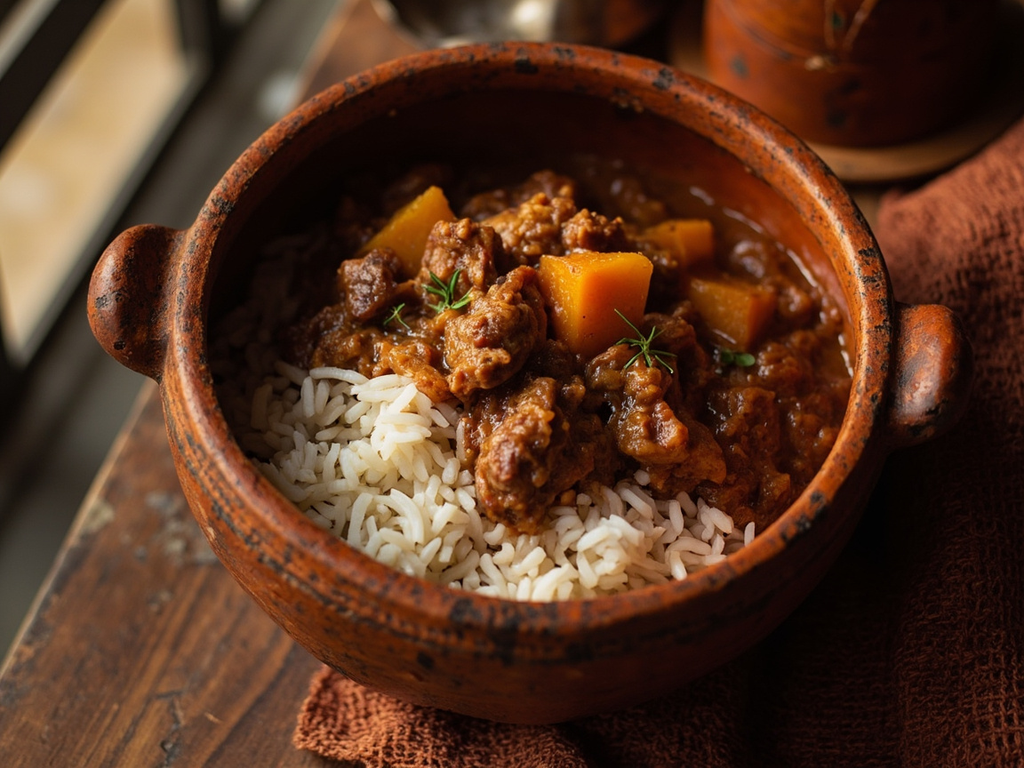
Meat slowly simmered in a creamy, flavorful, and slightly spicy peanut sauce, poured over a bed of shared white rice. The ultimate comfort dish of West Africa.
You see, among us mafé needs no explanation: you smell it from the courtyard, when the roasted peanut aroma fills the air. My mother would pound the paste in the mortar until its oil oozed out, then she would let the meat tenderize for hours, without haste — because patience, in cooking as in the transmission of stories, is everything. We would pour the sauce in the center of the calabash and eat together, with the right hand; the one who shares the bowl is no longer a stranger. Taste it slowly, and you will understand why I say that a meal, like an epic, is only savored in a circle.
- •Peanut paste pounded in a mortar — a good ladleful (binder and body of the sauce)
- •Mutton or beef — according to the household (slow-cooked protein)
- •Onions — a few (aromatic base)
- •Fresh tomato and tomato paste — as needed (acidity and color)
- •Sweet potato, cassava, cabbage — what the market offers (root vegetables)
- •White rice — the base of the dish (supporting cereal)
- •Chili, salt, bouillon cube (20th century) — to taste (seasoning)
Mafé (Rice with Peanut Sauce)
Meat slowly simmered in a creamy, flavorful, and slightly spicy peanut sauce, poured over a bed of shared white rice. The ultimate comfort dish of West Africa.
Why this dish? A domestic dish throughout Senegal and Guinea, mafé is the ordinary table Niane found in Conakry as well as Dakar: a family meal around a calabash, eaten by hand, that expresses the daily hospitality of the Manding country where he collected the words of the griots.
You see, among us mafé needs no explanation: you smell it from the courtyard, when the roasted peanut aroma fills the air. My mother would pound the paste in the mortar until its oil oozed out, then she would let the meat tenderize for hours, without haste — because patience, in cooking as in the transmission of stories, is everything. We would pour the sauce in the center of the calabash and eat together, with the right hand; the one who shares the bowl is no longer a stranger. Taste it slowly, and you will understand why I say that a meal, like an epic, is only savored in a circle.
Ingredients (period version)
- Peanut paste pounded in a mortar — a good ladleful (binder and body of the sauce)
- Mutton or beef — according to the household (slow-cooked protein)
- Onions — a few (aromatic base)
- Fresh tomato and tomato paste — as needed (acidity and color)
- Sweet potato, cassava, cabbage — what the market offers (root vegetables)
- White rice — the base of the dish (supporting cereal)
- Chili, salt, bouillon cube (20th century) — to taste (seasoning)
Ingredients
- Pure peanut butter (unsweetened) — 150 g (binder and body of the sauce)
- Lamb shoulder or stewing beef — 800 g, in pieces (protein)
- Onions — 2 large, sliced (aromatic base)
- Tomato paste — 2 tbsp (color, umami)
- Sweet potato + cassava — 400 g total, in large cubes (root vegetables)
- Cabbage (a quarter), carrot — to taste (vegetables)
- Whole Scotch bonnet chili — 1 (not pierced) (aroma, controlled heat)
- Long-grain white rice — 400 g (base)
- Bouillon cube, salt — to taste (seasoning)
Method
- Brown the meat with the onions in a little oil until colored.
- Add tomato paste, cook 2 minutes, then cover with hot water and simmer for 30 minutes.
- Thin the peanut paste with a ladleful of hot broth, then stir it in to avoid lumps.
- Add the vegetables and the whole chili; cook over low heat for 40 minutes, until the peanut oil rises to the surface.
- Adjust salt; cook the white rice separately.
- Plate the rice, pour the sauce in the center, serve hot in a large sharing dish.
How it was made : Before the blender, peanuts were roasted then pounded in a mortar into an oily paste; cooking over three stones and wood fire took all morning. The bouillon cube only appeared in the 20th century; previously, flavor was boosted with fermented néré (soumbala).
The contemporary twist : Serve in individual portions with a molded rice quenelle and a dusting of crushed roasted peanuts for crunch.
Djibril Tamsir Niane · Charactorium