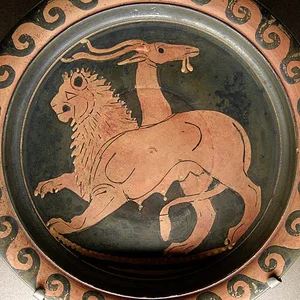

Monster from Greek mythology, born of Typhon and Echidna. A flame-breathing hybrid creature, she was slain by the hero Bellerophon riding the winged horse Pegasus.
Chimera
Chimera
8 min read
Frequently asked questions
Key Facts
- Daughter of Typhon and Echidna, two of the most fearsome monsters in Greek mythology
- A hybrid body: lion's head, goat's body, serpent's or dragon's tail
- Capable of breathing fire, she laid waste to Lycia (Asia Minor)
- Slain by the hero Bellerophon, riding the winged horse Pegasus, using a spear tipped with lead melted by her own breath
- First mentioned in Homer's Iliad (Book VI)
Works & Achievements
The first written mention of the Chimera in world literature. Homer briefly but precisely describes the monster's anatomy and the context of the feat performed by Bellerophon, son of Glaucus.
Hesiod establishes the complete genealogy of the Greek monsters, placing the Chimera among the offspring of Typhon and Echidna, alongside the Lernaean Hydra, Cerberus, and the Sphinx. This text is the definitive mythological source.
Pindar celebrates Bellerophon's feat of riding Pegasus to slay the Chimera in this victory ode. The poem is one of the most lyrical evocations of the myth in classical Greek literature.
Apollodorus compiles the most complete account of the Chimera myth, detailing her birth, her devastation of Lycia, and her defeat at the hands of Bellerophon. This mythological encyclopedia remains an essential reference for historians.
A masterpiece of Etruscan bronze sculpture, discovered in Arezzo in 1553 and now held at the National Archaeological Museum of Florence. The statue depicts a wounded, roaring Chimera and stands as one of the most expressive representations of the monster.
Ovid incorporates the Chimera into his monumental work tracing Greco-Roman myths, ensuring the myth's transmission to the Roman world and to medieval and Renaissance generations.
Anecdotes
The Chimera is one of the strangest creatures in Greek mythology: it has the head of a lion, the body of a goat, and the tail of a venomous serpent. This combination of three terrifying animals symbolized, for the Ancients, the chaotic and uncontrollable forces of wild nature.
King Iobates of Lycia sent Bellerophon to fight the Chimera with the secret hope that the monster would kill him. It was a suicide mission disguised as a heroic quest, for the Chimera had already ravaged the entire region, breathing fire upon villages and livestock.
Without Pegasus, the famous winged horse, Bellerophon could never have defeated the Chimera. By fighting from the air, he stayed out of reach of the deadly flames and could strike the creature from above, where it was most vulnerable.
According to one version of the myth recorded by the ancient author Tzetzes, Bellerophon attached a lump of lead to the tip of his spear. By plunging it into the Chimera's flaming maw, the intense heat melted the metal, which poured down the monster's throat and suffocated it.
The word 'chimera' has entered the English language to describe a wild fantasy, an impossible illusion, or an unachievable scheme. This shift in meaning shows just how deeply the mythological monster impressed the Ancients: like the Chimera itself, some dreams seem forever out of reach.
Primary Sources
She was of divine descent, not human: in front, a lion; behind, a serpent; in the middle, a goat, and she breathed the fierce force of blazing fire.
Echidna also bore the terrible, great Chimera who breathes raging fire, terrible and great and swift-footed and strong. She had three heads, one of a grim-faced lion, one of a goat, and one of a serpent, a powerful dragon.
He tamed the fire-breathing monster, the Chimera, riding upon Pegasus.
The Chimera was raised by Amisodarus, as mentioned in the Iliad. She was a divine creature with the head of a lion, the tail of a dragon, and in the middle, that of a goat, and she breathed fire.
The Chimera, armed with fire in the middle, a lion at the front, a serpent at the tail.
Key Places
A region of Asia Minor where the Chimera wreaked havoc according to myth, devastating the countryside and terrorizing its inhabitants. King Iobates of Lycia sent Bellerophon to fight the monster and rid his kingdom of this scourge.
The hometown of Bellerophon, the hero who defeated the Chimera. It was here that he tamed Pegasus using a golden bridle given to him by the goddess Athena, before setting out on his quest.
The home of the Greek gods and the symbolic birthplace of great heroic myths. The Olympian gods — notably Athena and Poseidon — intervene in the fate of Bellerophon and his battles against monsters.
The city where the famous Chimera of Arezzo was discovered in 1553 — an Etruscan bronze statue dating from the 4th century BCE. This masterpiece bears witness to how widely the myth of the Chimera spread beyond the boundaries of the Greek world.
Typical Objects

The Chimera breathes fire from its lion's mouth — its primary weapon and most feared feature. This fiery breath devastates villages and forests, making the monster nearly invincible in close combat.

According to some ancient accounts, Bellerophon fixed molten lead to the tip of his spear to slay the Chimera. The heat of the monster's flames melted the metal inside its throat, suffocating it from within.

The central part of the Chimera's body is that of a goat, a symbol of untamability and mountainous terrain. The goat horns appear distinctly in all Greek artistic depictions of the monster.

The rear of the Chimera's body is a venomous serpent or dragon tail, capable of biting and poisoning any creature that approaches from behind. This tail completes the picture of a creature deadly from every angle.

Athenian potters of the 5th century BCE depicted the Chimera on numerous vases and amphorae, spreading its image throughout the Mediterranean world. These ceramics remain our best visual sources on the myth today.

The hero Bellerophon had to protect himself from the Chimera's flames during their battle. His shield and armor represent the equipment of the classic Greek hero confronting the monstrous forces of chaos.
School Curriculum
Vocabulary & Tags
Key Vocabulary
Daily Life
Morning
At sunrise over the hills of Lycia, the Chimera leaves the dark den where it has spent the night and roams its territory in search of prey. It roars from the heights, signaling its presence to the surrounding villages, whose inhabitants flee at its approach.
Afternoon
In the heat of the Mediterranean day, the Chimera hunts and ravages the flocks of goats and sheep belonging to Lycian farmers. Its fiery breath sets fields and forests ablaze, leaving behind a trail of desolation across the limestone hillsides.
Evening
As dusk falls, the Chimera retreats to its lair in the steep gorges, surrounded by rocks blackened by its own flames. It settles into the darkness — a terrible guardian of a territory no one dares cross after nightfall.
Food
The Chimera feeds on livestock, deer, and, according to ancient accounts, sometimes unwary humans. A creature of chaos, it does not hunt out of necessity but out of a destructive instinct, often leaving its prey half-charred without fully devouring them.
Clothing
As a mythological being rather than a human, the Chimera wears no clothing. Its body is covered with a lion's fur at the front, a goat's coat in the middle, and serpent scales at the rear, forming a natural armor that few weapons could penetrate.
Housing
The Chimera dwells in caves and deep gorges carved into the limestone mountains of Lycia, whose walls are blackened and glassy from the repeated blasts of its fiery breath. This scorched and barren territory keeps both humans and animals at a distance.
Historical Timeline
Period Vocabulary
Visual Style
Style céramique grec à figures rouges sur fond noir, avec des flammes orangées, des contours nets et une composition monumentale évoquant la puissance terrifiante du monstre hybride dans le paysage rocailleux de la Lycie antique.
Sound Ambience
Ambiance sonore de la Lycie antique ravagée par la Chimère : rugissements de lion, flammes crépitantes, sifflement du serpent et vent sur les rochers calcinés des montagnes méditerranéennes.
Liens externes & ressources
Références
Œuvres
Iliade d'Homère (chant VI)
vers -750
Théogonie d'Hésiode
vers -700
Olympiques XIII de Pindare
-476
Bibliothèque d'Apollodore (II, 3)
Ier-IIe siècle apr. J.-C.
Chimère d'Arezzo (sculpture étrusque)
IVe siècle av. J.-C.
Métamorphoses d'Ovide
8 apr. J.-C.