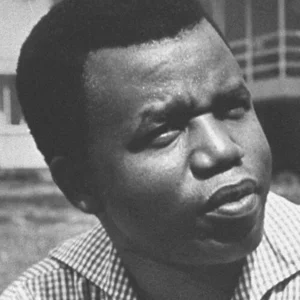

Chinua Achebe was a Nigerian novelist, poet and critic, a major figure of African literature in English. His novel *Things Fall Apart* (1958) is regarded as the founding work of the modern African novel.
Chinua Achebe(1930 — 2013)
Chinua Achebe
Nigeria, colonie et protectorat du Nigeria
7 min read
Frequently asked questions
Famous Quotes
« Until the lions have their own historians, the history of the hunt will always glorify the hunter.»
Key Facts
- Born in 1930 in Ogidi, in southeastern Nigeria, within the Igbo community
- Published *Things Fall Apart* in 1958, which sold more than 20 million copies and was translated into some fifty languages
- Sided with Biafra during the Nigerian Civil War (1967-1970)
- Published a critical essay on racism in Joseph Conrad's *Heart of Darkness* in 1975
- Died in 2013 in Boston, in the United States, hailed as the “father of modern African literature”
Works & Achievements
Founding novel of modern African literature, recounting the downfall of Okonkwo and the collapse of an Igbo society confronted with colonization. Translated into more than fifty languages and sold in millions of copies.
Spiritual sequel to the first novel, about an educated young Nigerian caught between tradition and the corruption of a fading colonial society.
Novel about an Igbo priest confronted with the British administration and Christian missions, deepening the clash of cultures.
Political satire of an independent Nigeria riddled with corruption, whose ending eerily anticipates the coups of 1966.
Resounding lecture denouncing the racism of Conrad's *Heart of Darkness*, a key text of postcolonial criticism.
Political pamphlet attributing Nigeria's ills to the failure of its leaders.
Novel about power and dictatorship in an imaginary Africa, shortlisted for the Booker Prize.
Personal memoir of the Biafran War (1967-1970) and the fate of the Igbo people.
Anecdotes
The title of his most famous novel, *Things Fall Apart*, is borrowed from a poem by the Irishman W. B. Yeats, “The Second Coming”: “Things fall apart; the centre cannot hold.” Achebe wanted to show how the arrival of the British colonizers shatters a previously cohesive Igbo society.
Achebe wrote in English, the language of the colonizer, but he wove Igbo proverbs and imagery into it. He championed the idea that an African writer could “make English carry the weight of his African experience,” rather than imitating the English.
In 1975, during a lecture at the University of Massachusetts, Achebe accused Joseph Conrad's famous novel *Heart of Darkness* of being deeply racist, because it reduced Africans to a voiceless backdrop. This stance caused an uproar and remains a key reference text in postcolonial studies.
In 1990, a serious car accident on a road in Nigeria left him paralyzed in the lower limbs; he used a wheelchair for the rest of his life and continued his teaching in the United States.
Twice, in 2004 and then in 2011, Achebe declined Nigeria's high distinction of “Commander of the Federal Republic,” to protest against the corruption and misgovernment of his country. He felt that one could not honor a writer while letting his home state sink into ruin.
Primary Sources
Okonkwo was well known throughout the nine villages and even beyond. His fame rested on solid personal achievements.
Among the Igbo the art of conversation is regarded very highly, and proverbs are the palm-oil with which words are eaten.
Joseph Conrad was a thoroughgoing racist. That this continues to be glossed over today is in itself scandalous.
The trouble with Nigeria is simply and squarely a failure of leadership. There is nothing basically wrong with the Nigerian character.
Key Places
Igbo town in southeastern Nigeria where Achebe was born in 1930, into a Christian family. This village world, criss-crossed by Christian missions, inspired the setting of his first novels.
Nigeria's first university, where Achebe studied from 1948 and discovered the colonial literature that drove him to tell Africa's story “from the inside.”
Major port city where Achebe worked for the Nigerian Broadcasting Service during the 1950s and 1960s. It was here that he directed radio programmes and published *Things Fall Apart*.
Southeastern campus where Achebe taught and led an academic life, at the heart of the region that would become Biafra during the civil war.
American city where Achebe died in 2013, after years of teaching at American universities (Bard College, Brown University).
Typical Objects

The working tool of the mid-20th-century writer and journalist, on which Achebe composed his novels before the computer age. It symbolizes the appropriation of the English language in the service of an African voice.

A bitter seed shared during visits and ceremonies among the Igbo, a gesture of hospitality and respect. It opens many scenes of *Things Fall Apart* (“he who brings kola brings life”).

The staple tuber of Igbo food and economy, a sign of wealth and manliness in the villages Achebe describes. Cultivating large fields of yams built a man's reputation, as it did for Okonkwo.

A central instrument in Achebe's career, who directed programming for the Nigerian Broadcasting Service in Lagos. Radio carried information across a multilingual country in the midst of decolonization.

A percussion instrument made of wood or hide that set the rhythm for festivals, wrestling matches, and village announcements. In Achebe's novels, its beat summons the community and paces collective life.

Indispensable after the 1990 accident that left him paralyzed, it accompanied Achebe through his final years of teaching in the United States. It never hindered his work as a writer and professor.
School Curriculum
Vocabulary & Tags
Key Vocabulary
Daily Life
Morning
During the years when he runs the radio station in Lagos, Achebe begins his day early by reading the newspapers and preparing programs. Before leaving, he shares a simple breakfast and keeps a moment to write a few pages of a novel in peace.
Afternoon
The afternoon is spent at the office of the Nigerian Broadcasting Service or, later, on the university campus at Nsukka: meetings, teaching, correspondence, and correcting manuscripts. He also devotes time to talking with other African writers and students.
Evening
In the evening, Achebe writes and reads at length, working on his sentences to weave in Igbo proverbs and turns of phrase. He gladly welcomes visitors for conversation, faithful to the hospitality tradition of his culture.
Food
His table blends the staples of Igbo cuisine — yams, cassava, spicy soups (egusi) served with fish or meat — with foods introduced by colonization. The kola nut remains reserved for moments of welcome and respect.
Clothing
Depending on the occasion, Achebe wears the Western suit of the office worker and academic, or traditional garments such as the embroidered tunic and the Igbo cap during ceremonies. In this way he embodies the back-and-forth between two worlds.
Housing
He lives as a man of modern cities, in civil-servant housing in Lagos, then in university residences at Nsukka, and finally on American campuses. These homes contrast with the obi (the chief's hut) and the village compounds he describes in his novels.
Historical Timeline
Period Vocabulary
Liens externes & ressources
Références
Œuvres
Things Fall Apart (Le monde s'effondre)
1958
No Longer at Ease (Le malaise)
1960
Arrow of God (La flèche de Dieu)
1964
A Man of the People (Le démagogue)
1966
An Image of Africa (essai)
1975
The Trouble with Nigeria (essai)
1983
Anthills of the Savannah (Les termitières de la savane)
1987