
French philosopher and poet of Italian origin
Christine de Pizan(1364 — 1430)
Christine de Pizan
France
8 min read
Frequently asked questions
Key Facts
- Née vers 1364 à Venise, elle grandit à la cour de Charles V où son père était astrologue royal, ce qui lui permit de recevoir une éducation exceptionnelle pour une femme de l'époque.
- Veuve à 25 ans (vers 1390), elle subvint seule à ses besoins et à ceux de ses enfants en devenant l'une des premières femmes professionnelles de lettres en Europe.
- Elle participa vers 1401-1402 à la « Querelle du Roman de la Rose », dénonçant publiquement la misogynie de l'œuvre de Jean de Meun dans une correspondance restée célèbre.
- Elle écrivit en 1405 « Le Livre de la Cité des Dames », œuvre majeure défendant la valeur et les capacités intellectuelles des femmes à travers l'histoire.
- En 1429, elle rédigea le « Ditié de Jehanne d'Arc », premier texte littéraire connu à célébrer Jeanne d'Arc de son vivant.
Works & Achievements
Christine's first openly feminist text, in which she denounces the misogyny of clergymen and defends the honor of women. It marks the beginning of her engaged literary career.
A long allegorical poem of 23,636 verses in which Christine traces the history of the world and her own life, making Fortune a central figure of human existence.
Christine's masterpiece: an imaginary city built with the help of three allegorical figures (Reason, Rectitude, Justice) and populated by illustrious women from history. A founding work of Western feminism.
A practical education treatise addressed to women of all social backgrounds, from princess to peasant. It constitutes a valuable testimony on the lives of women in the Middle Ages.
A biography commissioned by Philip the Bold, Duke of Burgundy, in tribute to the late king. It is an important historical source on the reign of Charles V.
A military treatise drawing on Vegetius and Frontinus, which was printed in England by William Caxton in 1489. It bears witness to the extraordinary breadth of Christine's knowledge.
The only contemporary poem celebrating Joan of Arc, written after the lifting of the siege of Orléans. It is the last known text by Christine, composed after eleven years of silence in a convent.
Anecdotes
Upon the death of her husband Étienne de Castel in 1389, Christine de Pizan found herself a widow at 25 with three children to support and heavy debts. Rather than remarrying, she made the exceptional decision for the time to live by her pen, becoming the first woman in Europe to earn her living through writing.
Christine dared to publicly oppose Jean de Meun, author of the second part of the Roman de la Rose, whom she accused of misogyny. This literary quarrel, known as the 'Querelle du Roman de la Rose', unfolded through letters exchanged between 1401 and 1402 and caused a great stir at the French court.
To write The Book of the City of Ladies in 1405, Christine drew direct inspiration from Boccaccio's De mulieribus claris, but reversed its argument: where the Italian author often denigrated women, she constructed an imaginary city populated by illustrious women to defend their dignity and intelligence.
In 1418, when Paris was seized by the Burgundians, Christine took refuge at the convent of Poissy where her daughter lived. She spent eleven years there in cloistered silence, before taking up her pen one last time in 1429 to celebrate the victories of Joan of Arc in a dithyrambic poem, the Ditié de Jehanne d'Arc.
Primary Sources
I, Christine, found myself one day seated in my study, surrounded by many volumes of various authors... And then I felt great displeasure with myself and with all of womankind.
It is truly worthy of remembrance That God, through a tender virgin, Wished — a miracle made manifest — To pour His grace upon France.
Many clerics say in general, And many people believe them well, That woman is worthy of no good, That all are fickle.
Every woman, whatever her station, must have in her heart strength and vigor to resist the adversities of Fortune.
At that time, I, Christine, Left my bed early in the morning, And from my chamber to a hall I went directly without delay.
Key Places
Christine de Pizan's birthplace, where she was born in 1364. Her Italian origins gave her a humanist culture that she brought with her to the French court.
Residence of the French court where Christine grew up alongside her father, astrologer to King Charles V. This environment allowed her to receive an exceptional education for a woman of the time.
Parisian residence of Charles V and later Charles VI, where Christine frequented the court, received literary commissions, and met the great patrons who would fund her works.
Dominican convent where Christine took refuge in 1418 to escape political unrest. She spent her final years there alongside her daughter, a nun in that community.
The principal intellectual centre of medieval Europe, with which Christine was closely connected through scholars and theologians such as Jean Gerson, who supported her in the Querelle du Roman de la Rose.
Typical Objects

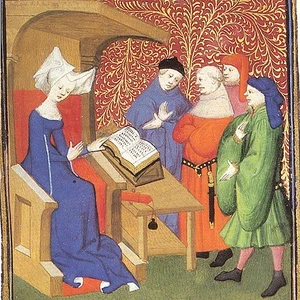
A slanted lectern rested on the knees or on a table, allowing Christine to hold her parchments while she wrote. Christine is often depicted at her writing desk in the illuminations of her manuscripts.

A quill cut from a reed or goose feather, dipped in a horn inkwell. Christine wrote and corrected her texts herself, also supervising the copying of her manuscripts.

A book copied by hand on parchment and adorned with coloured miniatures. Christine personally oversaw the production of her manuscripts, particularly those offered to Queen Isabeau of Bavaria and to great lords.

A widow's garment that Christine wore after the death of her husband in 1389. She herself refers to it in her autobiographical writings to underscore her condition as a woman alone who had to provide for herself.

An indispensable light source for working after sunset in her study. Christine herself describes her long nightly vigils spent reading and writing in The Path of Long Study.

A reusable medium for taking notes or drafting texts before transcribing them onto parchment. A common tool among medieval scholars for the first drafts of their writings.
School Curriculum
Vocabulary & Tags
Key Vocabulary
Daily Life
Morning
Christine rose at dawn, awakened by matins. After a brief prayer, she would settle into her study before sunrise, making use of the morning silence to read and annotate the Latin and French texts that fed her work.
Afternoon
The afternoon was devoted to writing and to overseeing the copyists who transcribed her manuscripts. She sometimes received messengers from court bearing commissions or replies to her epistles, and managed the practical affairs of her writing workshop.
Evening
In the evening, by candlelight, Christine would reread and correct her texts or compose new poems. She also devoted time to her children and, later in life, to the divine offices at the convent of Poissy.
Food
Like the prosperous Parisians of her time, Christine ate wheat bread, cooked vegetables, fish on fast days and meat on other days. Wine diluted with water was the ordinary daily drink.
Clothing
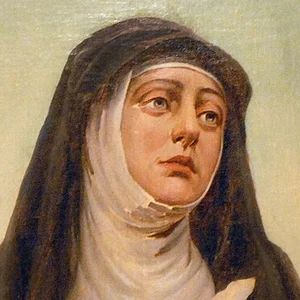
As a widow, Christine wore a long black or dark gown with a white or black veil on her head (the wimple and widow's headdress). She herself refers to this in her autobiographical poems to underscore her condition.
Housing
Christine lived in Paris in a townhouse, likely in the University quarter or close to the royal court. Her 'chambre d'estude' — the study she describes in The Book of the City of Ladies — was a room set aside for reading and writing, a luxury reserved for the learned.
Historical Timeline
Period Vocabulary
Visual Style
Style enluminure gothique internationale parisienne vers 1400, avec fonds or, bleus lapis, rouges vermillon et encadrements architecturaux gothiques flamboyants.
Sound Ambience
Atmosphère feutrée d'un scriptorium parisien médiéval, mêlant le grattement de la plume sur le parchemin aux cloches lointaines de Notre-Dame et aux bruits du couvent.
Liens externes & ressources
Références
Œuvres
L'Épître au dieu d'Amours
1399
Le Livre de la Mutation de Fortune
1403
Le Livre de la Cité des Dames
1405
Le Livre des Trois Vertus (Trésor de la Cité des Dames)
1405
Le Livre des faits et bonnes mœurs du sage roi Charles V
1404
Le Livre des faits d'armes et de chevalerie
1410
Le Ditié de Jehanne d'Arc
1429