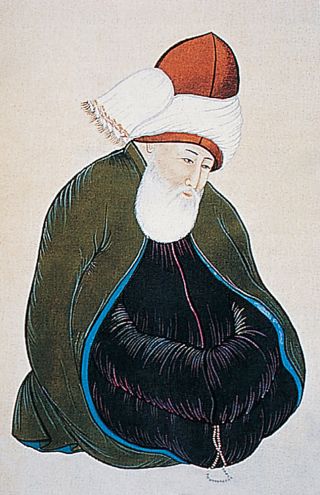
Jalal ad-Din Rumi(1207 — 1273)
Jalal ad-Din Rumi
8 min read
Persian poet and mystic of the 13th century, founder of the Whirling Dervishes order. His masterwork, the Masnavi, is a monument of Sufi literature. He lived primarily in Konya, in Seljuk Anatolia.
Frequently asked questions
Famous Quotes
« Come, come, whoever you are, come. Whether you are an infidel, an idolater, or a fire-worshiper, come. »
« Words are the veil on the face of the Beloved. »
Key Facts
- Born in 1207 in Balkh (present-day Afghanistan), into a family of theologians
- In 1244, he met the mystic Shams of Tabriz, who radically transformed his spiritual life
- Composed the Masnavi, a mystical poem of more than 25,000 couplets, around 1258–1273
- Founded the Mevlevi Order, known as the Whirling Dervishes, in Konya
- Died in 1273 in Konya; his mausoleum remains a place of pilgrimage to this day
Works & Achievements
Rumi's absolute masterpiece, this poem in six books totaling nearly 25,000 couplets in Persian stands as one of the great monuments of mystical literature worldwide. Nicknamed 'the Persian Quran,' it weaves together stories, parables, and theological meditations.
A vast collection of some 40,000 lyrical verses (ghazals and rubā'iyyāt) composed in tribute to his lost friend Shams of Tabriz. It is the most intense expression of his mysticism of love, where divine love and human love become one.
A collection of prose discourses transcribed by his disciples during his spiritual gatherings. This text offers a valuable introduction to his mystical thought in a more accessible language than his poetry.
A collection of seven sermons delivered by Rumi before his disciples, illustrating his art of oral teaching that blends Quranic exegesis with instructive anecdotes.
A body of letters addressed to dignitaries, disciples, and friends, revealing the networker and spiritual guide who remained attentive to individual destinies beyond his stature as a great poet.
Anecdotes
The meeting between Rûmî and the mysterious dervish Shams of Tabriz in 1244 in Konya was an absolute turning point in the poet's life. According to tradition, Shams asked him a question so profound that Rûmî fell from his horse, struck with stupor. This intense mystical friendship transformed the rigorous scholar into a poet ablaze with inspiration.
When Shams of Tabriz disappeared for the second time around 1248, Rûmî was consumed by such grief that he began spinning in the streets of Konya, arms outstretched, as a sign of mourning and spiritual ecstasy. This ritual gesture is the origin of the whirling dervishes' dance, the samâ'.
Rûmî dictated nearly all of his masterpiece, the Masnavi, to his disciple Husam Chalabi. Husam, upon seeing the opening verses on a scrap of paper, implored the master to continue; Rûmî handed him the notebook and said: 'You shall set the rhythm.' The six volumes were thus composed over nearly fifteen years.
At Rûmî's death in December 1273 in Konya, thousands of devoted followers came to mourn at his funeral — Christians, Jews, and Muslims alike. It is said that he himself had described his death as his 'wedding with the Eternal,' calling that day the Shab-e Arûs, the 'Night of the Wedding,' an anniversary still celebrated every year.
Rûmî had spent his entire youth studying traditional Islamic sciences and was a renowned jurist before his encounter with Shams. His students were initially shocked to see their master abandon lessons in law for poetry and music. He replied that he had found something deeper than all the books combined.
Primary Sources
Listen to the reed, this flute of cane, how it tells of separation: 'Since they cut me from my reed bed, men and women have wept at my song.'
I am the slave of one whose heart and soul are awake, not of one who sleeps even while speaking of knowledge.
The Prophet said: 'Die before you die.' Seek therefore to die before you die, so that you need not fear death when it comes.
My soul is like a mirror: if you look at it, you will see God; if you look at God, you will find yourself there.
Key Places
Rumi's birthplace in 1207, then a major center of Islamic culture before its destruction by the Mongols. It was here that his father was a respected theologian and that Rumi's spiritual education began.
Capital of the Seljuk Sultanate of Rum, where Rumi spent most of his adult life. It was here that he taught, composed his major works, met Shams of Tabriz, and founded the Mevlevi order.
Rumi's burial site, which has become the global spiritual center of the Mevlevi order and one of the most visited pilgrimage sites in the Islamic world. The green dome is an iconic symbol of Konya.
A great Persian city where Rumi's family stopped during their exile from Balkh. It is here that the young Rumi is said to have met the poet Farid ud-Din Attar, who symbolically presented him with his book the Asrarnameh.
The intellectual capital of the Islamic world, where Rumi studied for several years. Its destruction by the Mongols in 1258 was a civilizational trauma that Rumi witnessed as a contemporary.