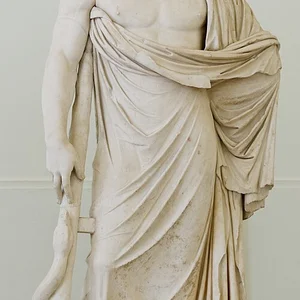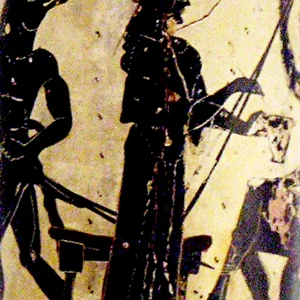

Circe is an enchantress from Greek mythology, daughter of the sun god Helios, known for her magical powers. In Homer's Odyssey, she transforms Odysseus's companions into pigs before becoming the hero's ally.
Circe
Circe
8 min read
Frequently asked questions
Famous Quotes
« "Come into my house, so that I may offer you food and drink." (words attributed by the Homeric tradition, Odyssey, Book X)»
Key Facts
- Daughter of the sun god Helios and the Oceanid Perse, according to Greek mythological tradition.
- She lives on the island of Aeaea and masters potions, magical herbs, and incantations.
- In the Odyssey (composed around the 8th century BCE), she transforms Odysseus's companions into pigs using a magic wand.
- Odysseus, protected by the herb moly given to him by Hermes, resists her spells and forces her to restore his men to human form.
- Circe keeps Odysseus on her island for a year and shows him how to descend to the Underworld to consult Tiresias.
Works & Achievements
The founding text of the Circe myth, and the first complete account of the episode in which Odysseus's companions are transformed and the hero spends a year on the island of Aeaea.
The text that places Circe within the Greek divine genealogy, making her the daughter of the god Helios and the sister of Aeëtes, king of Colchis.
An Alexandrian epic poem in which Circe plays the role of a purifying priestess, cleansing Medea and Jason of their crime in a solemn ritual.
Virgil describes Circe's island as a land of transformations, which Aeneas sails past in the night, his companions hearing the groans of men changed into beasts.
Ovid develops new stories around Circe — her jealous passions, the transformations of Scylla and Picus — greatly enriching the character for the Latin and medieval traditions.
A philosophical dialogue in which Circe serves as a pretext for reflecting on animal virtue: one of Odysseus's companions, turned into a pig, refuses to return to human form, preferring his animal condition.
Anecdotes
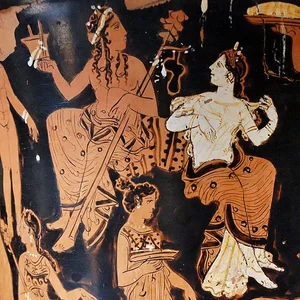
In Homer's Odyssey, Circe transforms Odysseus's companions into pigs upon their arrival on her island of Aeaea. Odysseus, protected by a magical herb called moly given to him by Hermes, resists her enchantment and forces the sorceress to restore his men to human form.
Circe is one of the rare female figures in Greek mythology to hold genuine autonomous power, independent of any god or hero. She masters medicinal plants and poisons, and personally prepares her magic potions in her palace surrounded by tamed wild animals.
After her reconciliation with Odysseus, Circe becomes his lover and keeps him on her island for an entire year. She then reveals to him how to journey to the Underworld to consult the shade of the seer Tiresias, offering him decisive guidance for his return to Ithaca.
According to certain mythological versions, Circe is the mother of Telegonus, son of Odysseus, who will accidentally kill his own father without recognizing him. This tragedy illustrates the power of intertwined fates that characterize Greek epic narratives.
Circe is also known for having aided the Argonauts led by Jason. She purifies Medea and Jason of the murder of Absyrtus, performing a ritual of catharsis essential to lifting the stain of shed blood.
Primary Sources
They came at once to the halls of Circe; she brought them in and seated them on chairs and thrones. Then she prepared for them a mixture of cheese, barley meal, and pale honey with Pramnian wine, and stirred into the drink baneful drugs to make them forget their homeland.
It was the divine Circe who revealed this to me — she who first warned me of all these perils. She said: you will go first to the house of Hades and dread Persephone, to consult the shade of the Theban prophet Tiresias.
Helios, the Sun, fathered Circe and Aeëtes, king of magnificent counsel, whose daughter was the lovely Medea of the slender ankles.
They came ashore on the island of Aeaea, the dwelling of Circe, and found her washing her hair in the sea. She had been tormented by a fearful vision in her sleep, and the walls of her chambers had been dripping with blood.
Circe, powerful in her herbs and magic spells, transformed Scylla into a hideous monster; and Picus, for having spurned her love, was turned into a woodpecker by the jealous sorceress.
Key Places
The mythical home of Circe, described by Homer as a land surrounded by water and covered in dense forests. Traditionally identified with Cape Circeo on the Tyrrhenian coast of Italy.
A promontory on the coast of Latium that the ancients associated with Circe's island. Circe's name is still embedded in Italian place names and ancient tradition.
The homeland of Medea, Circe's niece according to Greek mythology. A distant land east of the Black Sea, associated with eastern magic and the Golden Fleece sought by the Argonauts.
The dwelling of the sun god Helios, Circe's father. Homer and Hesiod place it in the east, where the sun rises, symbolizing the divine and radiant origins of the sorceress.
Typical Objects

Circe's most iconic instrument, her wand is used to touch her victims and transform them. Homer describes it as the tool of her power over bodies and minds.

A drink prepared from honey, wine, cheese, and flour mixed with powerful plant-based drugs. This enchanted brew makes men forget their homeland and transforms them into beasts.

A magical herb with a white flower and black root, given to Odysseus by Hermes to neutralize Circe's powers. It symbolizes the divine antidote against magic and trickery.

Circe is often depicted weaving in her palace, much like Penelope or Calypso. In Greek mythology, weaving is an attribute of powerful women, mistresses of their own space and time.

Both a cooking vessel and a tool for preparing potions, the cauldron is the working instrument of enchantresses in antiquity. Circe uses it to brew her concoctions of herbs gathered from the forest.

Around Circe's palace roam lions and wolves as gentle as domestic animals — former men she has transformed. They are the visible sign of her power and warn visitors of the danger that awaits them.
School Curriculum
Vocabulary & Tags
Key Vocabulary
Tags
Daily Life
Morning
Circe rises at dawn in her polished stone palace at the heart of the island of Aeaea. She goes out into the forest to gather the medicinal plants and magical herbs she needs, knowing each one by name and property. She sings as she works — Homer emphasizes the sweetness of her voice.
Afternoon
The afternoon is devoted to preparing her philters and potions in bronze cauldrons heated over fire. She also weaves at her great loom, an activity that symbolizes in Greek culture the mastery of time and fate. Her tamed animals — lions, wolves, men she has transformed — accompany her in silence.
Evening
In the evening, Circe welcomes travelers who land on her island, inviting them to her table for a carefully prepared feast. She offers them drink in golden cups, blending her powerful drugs into their wine according to her intentions. When night falls, she recites incantations by moonlight, invoking the forces of the stars and the gods of the underworld.
Food
Circe serves her guests refined dishes: cheese, honey, golden barley flour, Pramnian wine — aristocratic Greek foods laced with supernatural powers. As a goddess, she is not subject to ordinary human needs and draws her energy from the herbs she gathers and the rituals she performs.
Clothing
Circe is depicted wearing long robes in vivid colors — gold or purple — draped in the Greek style and fastened with precious metal brooches. Her hair is long and carefully kept, adorned with golden pins or diadems, a mark of her divine status. She sometimes wears a light veil that billows in the sea breeze.
Housing
Her palace is built of polished stone at the center of the island, surrounded by a forest of oaks and firs. The rooms are richly decorated with tapestries woven by her own hands; the smooth stone floors and high ceilings echo with her singing. Torches burn constantly, and a central fire feeds her bronze cauldron.
Historical Timeline
Period Vocabulary
Visual Style
Palette de couleurs profondes et ensorcelantes inspirée de la céramique attique et de la peinture symboliste, évoquant la puissance et le mystère d'une enchanteresse antique.
Sound Ambience
Une atmosphère envoûtante mêlant forêt dense, feu de chaudron et présence animale inquiétante sur une île isolée de la Méditerranée antique.
Liens externes & ressources
Références
Œuvres
L'Odyssée – Homère, chants X et XII
VIIIe siècle av. J.-C.
Théogonie – Hésiode
VIIe siècle av. J.-C.
Argonautiques – Apollonios de Rhodes
IIIe siècle av. J.-C.
Énéide – Virgile, chant VII
vers 19 av. J.-C.
Métamorphoses – Ovide, chants XIII–XIV
vers 7 apr. J.-C.
Gryllos – Plutarque
IIe siècle apr. J.-C.