
Cixi, Empress Dowager of China, dominated the politics of the Qing dynasty for nearly fifty years. A shrewd and authoritarian regent, she governed an empire facing Western colonial pressures and internal rebellions, leaving an ambivalent legacy on China's modernization.
Cixi(1835 — 1908)
Cixi
dynastie Qing
9 min read
Frequently asked questions
Key Facts
- 1852: Entered the Forbidden City as a concubine of the Xianfeng Emperor
- 1861: After the emperor's death, she became regent in the name of her son, the Tongzhi Emperor
- 1875–1908: Effective regent during the reign of the Guangxu Emperor, her nephew, whom she had imprisoned in 1898
- 1898: Coup against the Hundred Days' Reform, halting the country's liberal modernization
- 1900: Support for the Boxer Rebellion against foreign powers, followed by the flight of the imperial court and the humiliating Boxer Protocol
Works & Achievements
Cixi financed the reconstruction of the Summer Palace, destroyed by Franco-British forces in 1860, by diverting funds from the imperial navy. This 2.9 km² architectural complex, listed as a UNESCO World Heritage Site, is her most visible legacy.
Following the Boxer disaster, Cixi launched a sweeping modernization program: abolition of the imperial examinations (1905), establishment of modern schools, military reform, sending students abroad, and drafting a constitution. These reforms, too late in coming, could not save the dynasty.
Cixi's first regency, during which she governed China in the name of her minor son. She stabilized the empire in the aftermath of the Taiping Rebellion and negotiated with foreign powers.
Cixi put an end to Emperor Guangxu's liberal reforms after only 103 days, had the reformers arrested — including Kang Youwei and Tang Sitong (who was executed) — and restored conservatism at court. This episode remains debated by historians as to its true motivations.
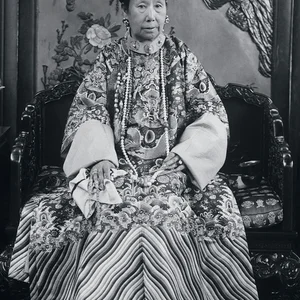
The first official portrait of the empress, painted by American artist Katherine Carl, intended to present imperial China in a favorable light to the Western world. It stands as a unique testimony to Cixi's appearance and staging of power.
Anecdotes
Cixi entered the Forbidden City at the age of sixteen as a lower-ranking concubine of Emperor Xianfeng. Through her exceptional intelligence and mastery of calligraphy — a rare skill among court women — she quickly became indispensable to the emperor, who dictated his edicts to her, thereby gaining considerable political influence.
In 1861, following the death of Emperor Xianfeng, Cixi organized a coup d'état with Empress Ci'an to overthrow the regency council composed of eight princes. She had the regents arrested, three of them executed, and seized power in the name of her five-year-old son, the future Emperor Tongzhi. This was one of the rare moments in Chinese history when women took hold of state power in such a manner.
Cixi was passionate about Peking opera (jingju). She had a three-story theater built in the Summer Palace — the Grand Theater of Harmonious Virtue — and regularly attended performances. She funded entire troupes, knew hundreds of roles by heart, and sometimes participated in rehearsals herself.
In 1908, just a few hours before her death, Cixi designated Puyi, a two-and-a-half-year-old child, as her successor. She had previously had Emperor Guangxu, her nephew, imprisoned and then likely poisoned; he died on November 14, 1908, the day before her own death. Cixi had thus maintained control of China until her very last breath.
American photographer Katherine Carl produced the first official portrait of Cixi around 1903, intended for the Saint Louis World's Fair. Cixi, wary of Western technologies, imposed very strict conditions on the session: the photographer had to prostrate herself, never raise her eyes toward the empress, and the photographs were subject to lengthy negotiations. This portrait was Cixi's attempt to manage her image with Western powers following the disaster of the Boxer Rebellion.
Primary Sources
The eight regents have failed in their duties and acted contrary to the imperial will. We order their immediate arrest and the seizure of their official seals, so that the regency may be carried out in accordance with rites and law.
Her Majesty rose each morning before dawn. She prayed before the Buddha statues, then underwent her lengthy toilette assisted by numerous ladies-in-waiting. Her nails, protected by long sheaths of gold and jade, were the object of constant care and symbolized her absolute rank.
The Empress Dowager received the diplomatic corps with calculated magnificence. She personally distributed cakes to the ambassadors' wives, displaying a sudden affability that contrasted sharply with the hostility toward foreigners she had shown during the events of 1900.
The traditional examination system, in place for more than a thousand years, is henceforth abolished. New schools teaching science and foreign languages shall be established in every province, in order to train the servants the Empire needs in the face of the challenges of the present age.
A woman must never hold power in China. It must never again be permitted for a woman to govern the affairs of the State, as I have done. This is contrary to the natural order of things and can only lead the country to its ruin.
Key Places
The official residence of the emperors and seat of imperial government, the Forbidden City was the center of Cixi's power for nearly fifty years. She lived there from her arrival as a concubine in 1851 until her death in 1908.
Cixi had this imperial palace rebuilt between 1886 and 1895, diverting funds intended for the imperial navy for that purpose. It became her favorite residence and the place where she received foreign ambassadors after 1902.
The imperial mountain summer residence where Emperor Xianfeng died in 1861. It was here that Cixi, present at his side, orchestrated the coup d'état that would allow her to seize power.
Cixi fled here when allied troops seized Beijing during the Boxer Rebellion in 1900. This humiliating retreat by palanquin across hundreds of kilometers left a deep mark on her reign.
A grand Buddhist temple that Cixi visited regularly on pilgrimage, particularly for her birthday. Her Buddhist devotion was sincere and influenced many political and artistic decisions of her court.
Typical Objects

Cixi wore long gilded nail guards encrusted with precious stones to protect her excessively long nails, an absolute symbol of imperial rank. They testified that she never worked with her hands and held supreme power.

The jade seal engraved with the imperial arms was the ultimate instrument of power: no law or edict had force unless stamped with this seal. Cixi seized it during the coup of 1861 to legitimize her authority.

Cixi was known to smoke a water pipe regularly, a common practice in Chinese aristocratic courts. Her ladies-in-waiting would prepare and light her pipe according to a precise ritual during moments of leisure.

Cixi traveled exclusively by palanquin, carried by sixteen bearers in imperial yellow livery. No gaze was to meet hers during her movements through the Forbidden City or toward the Summer Palace.

A passionate devotee of jingju (Peking opera), Cixi owned a vast collection of stage costumes and props. She funded the finest troupes in the empire and attended performances from a private balcony.

Mastery of calligraphy had been one of the first qualities that distinguished the young Cixi at the court of Emperor Xianfeng. She continued throughout her life to write inscriptions in large characters, offering her calligraphic works as the highest of rewards.
School Curriculum
Vocabulary & Tags
Key Vocabulary
Daily Life
Morning
Cixi rose before dawn, around 5 a.m., and began with Buddhist prayers before the altars in her chambers, burning incense and reciting sutras. Her ladies-in-waiting then assisted her through an elaborate one-to-two-hour grooming ritual: facial care with rice milk, hair styled in the phoenix-wing fashion, application of white powder and rouge, and the fitting of jade and gold nail guards.
Afternoon
Afternoons were devoted to political audiences and reviewing ministers' memorials from behind a yellow silk curtain, in keeping with the protocol that forbade looking the Empress Dowager directly in the face. Cixi also enjoyed strolling through the gardens of the Summer Palace by boat on Kunming Lake, overseeing her collections of paintings and porcelain, or attending opera rehearsals.
Evening
Evenings often featured Peking opera performances in the grand theatre of the Summer Palace, followed by a late supper with her ladies-in-waiting. Cixi sometimes played mahjong or card games before retiring. She also devoted time to calligraphy and reading classical Chinese novels.
Food
Cixi was renowned for the extreme sophistication of her table: imperial meals traditionally comprised one hundred and eight different dishes, though most were purely symbolic. Her favourite dishes included Peking duck, dumplings (jiaozi) that she had enjoyed since her Manchu childhood, dried mushrooms, and vegetables from the imperial garden. She drank Longjing tea and regularly consumed donkey milk to maintain her complexion.
Clothing
Cixi wore Manchu qipao robes (qizhuang) in embroidered silk in colours codified by rank: imperial yellow was reserved for major ceremonies, blue and purple for everyday wear. Her robes were embroidered with phoenixes (the empress's symbol), peonies, and auspicious bats. In winter, the linings were of sable or fox fur. Her flowerpot-sole shoes, characteristic of Manchu fashion, gave her a distinctive swaying gait.
Housing
Cixi resided primarily in two locations: the apartments of the Palace of Tranquility within the Forbidden City for official affairs, and the Summer Palace (Yiheyuan), which she had rebuilt as her personal residence. Her private apartments at the Summer Palace, overlooking Kunming Lake, were decorated with thousands of art objects, hanging scrolls, cloisonné planters, and lacquered furniture. The throne hall in which she held audiences was adorned with embroidered screens, silk lanterns, and bronze incense burners.
Historical Timeline
Period Vocabulary
Visual Style
L'esthétique de Cixi est celle de la cour Qing à son apogée décoratif : somptueux tissus brodés aux couleurs impériales, coiffures monumentales, symboles ésotériques du pouvoir entremêlant traditions mandchoue et chinoise.
Sound Ambience
L'univers sonore de Cixi mêle la solennité des processions impériales, les mélodies de l'opéra de Pékin qu'elle chérissait, et le calme contemplé des jardins du Palais d'Été au fil des saisons.
Liens externes & ressources
Références
Œuvres
Reconstruction du Palais d'Été (Yiheyuan)
1886-1895
Réformes Xinzheng (新政)
1901-1908
Régence au nom de l'empereur Tongzhi
1861-1873
Suppression des Cent Jours de réforme
1898
Portrait officiel pour l'Exposition universelle de Saint-Louis
1903-1904