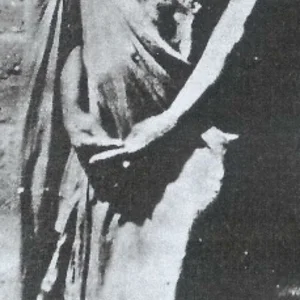

A Rwandan medium of the Kinyarwanda people, Muhumusa embodied the Nyabingi spirit and led an anti-colonial resistance against European powers in the early 20th century. She is considered a major spiritual and political figure of the African Great Lakes region.
Muhumusa
Muhumusa
8 min read
Frequently asked questions
Key Facts
- According to Rwandan oral tradition, Muhumusa was possessed by the Nyabingi spirit, which granted her considerable spiritual and political authority.
- She organized an armed revolt against German and British colonization in the Great Lakes region, active primarily between 1908 and 1913.
- She was captured by British colonial authorities in 1911 and held in detention until her death, around 1945.
- The Nyabingi movement she embodied continued after her arrest, inspiring further anti-colonial revolts into the 1920s.
- Sources on Muhumusa come primarily from Rwandan oral traditions and British and German colonial reports, which describe her with suspicion as an 'agitator.'
Works & Achievements
Muhumusa united fighters from both sides of the German-British border, creating a supra-ethnic anti-colonial resistance movement founded on the spiritual authority of Nyabingi.
A series of coordinated attacks on British posts in the Kigezi district, demonstrating organized military capability and forcing colonial authorities to mobilize significant forces.
By publicly embodying the Nyabingi spirit and explicitly linking it to anti-colonial resistance, Muhumusa transformed this cult into an enduring liberation ideology that outlived her capture.
A political effort to place her son Biregeya on the throne of Rwanda, representing resistance to both German colonial interference and the local chiefs who collaborated with it.
Anecdotes
Muhumusa claimed to be the medium of Nyabingi, a powerful female spirit venerated throughout the Great Lakes region. Her voice was believed to be that of the spirit itself: followers traveled from afar to consult her and bring offerings, convinced she could heal the sick and foretell the future.
Around 1908, following the death of her husband, the Rwandan mwami (king) Kigeli IV Rwabugiri, Muhumusa attempted to place her son Biregeya on the throne. Faced with opposition from local chiefs and the Germans, she turned to armed resistance, rallying hundreds of supporters from both sides of the German-British border under her banner.
In 1911, Muhumusa launched a series of raids against British colonial posts in present-day Uganda. Her warriors believed she was protected by Nyabingi and therefore invincible. The British authorities considered her so dangerous that they mobilized several companies of soldiers to capture her.
After her capture by the British in October 1911, Muhumusa was exiled to Kampala and then to Hoima, far from her homeland. She was kept under house arrest until her death around 1945, as colonial authorities feared that her mere presence in the Great Lakes region could spark new uprisings.
The Nyabingi movement she embodied did not die with her exile: female mediums took up her mantle, and Nyabingi rebellions shook British and German territories well into the 1920s, making Muhumusa the founding figure of a lasting anticolonial resistance.
Primary Sources
Muhumusa, a woman of considerable influence claiming to be possessed by the Nyabingi spirit, has gathered followers and is conducting raids on the border posts. Her capture is considered essential to the pacification of the region.
The elders said she spoke with the voice of Nyabingi. When she walked, people stepped aside. She was not afraid of the Europeans, for Nyabingi protected her.
Nyabingi does not die. Muhumusa is not defeated. The spirit crosses the borders the White men drew across our land.
Die Zauberin Muhumusa hat mehrere hundert Anhänger um sich geschart und bedroht die Ordnung in der Grenzregion. [The sorceress Muhumusa has gathered several hundred followers and is threatening order in the border region.]
Our grandparents followed her because she spoke the truth: the Europeans were taking our land and our cattle. She was the only one who stood up to them, with the help of the spirits.
Key Places
Muhumusa's region of origin and the birthplace of the Nyabingi cult. It was here that she consolidated her spiritual influence before leading her armed resistance against colonial forces.
The area where Muhumusa conducted raids against British outposts in 1911. This mountainous territory provided natural refuges for her warriors and was crossed by the German-British border.
The city where Muhumusa was first exiled following her capture by the British in 1911, far from her region of influence in order to break her hold over her followers.
The site of her permanent exile, where Muhumusa lived under house arrest and British supervision until her death around 1945, kept away from the Great Lakes region to prevent any renewed uprising.
A sacred volcano of the region and a site of memory for the Nyabingi cult. Its slopes formed a symbolic space of resistance and spiritual communion for Muhumusa's followers.
Typical Objects

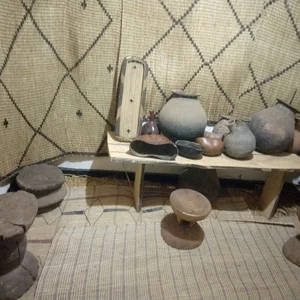
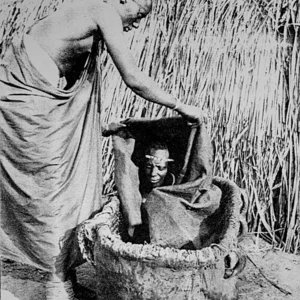
A large woven basket used during Nyabingi possession ceremonies to receive offerings. As a medium, Muhumusa presided over these rituals in which the Nyabingi spirit was believed to speak through her.

The weapon carried by the warriors who followed Muhumusa on her anti-colonial raids. It symbolized both military resistance and the protection that Nyabingi granted to her faithful.

A garment and marker of status in 19th-century Kinyarwanda society. As a high-ranking woman and spirit medium, Muhumusa wore fine hides during ceremonies and public audiences.

A vessel made from a dried gourd, used for libations and offerings during Nyabingi ceremonies. The presence of the gourd marked the sacred space in which the medium entered into communication with the spirit.

An instrument that set the rhythm of ceremonies and calls to assembly. The sound of the drum signaled Muhumusa's summons to her followers and gave structure to the possession rituals.

A collection of plants and protective objects that Muhumusa distributed to her supporters to make them invulnerable to colonial bullets, according to Nyabingi belief.
School Curriculum
Vocabulary & Tags
Key Vocabulary
Tags
Daily Life
Morning
Muhumusa rose before dawn to perform morning rituals dedicated to Nyabingi: libations of cow's milk, invocations in Kinyarwanda, and reading natural signs — the flight of birds, the behavior of cattle — to guide the day's decisions.
Afternoon
Afternoons were devoted to audiences: village chiefs, warriors, and followers came to present their problems. As a medium, she rendered judgments and distributed protective amulets, exercising both spiritual and political authority over a vast community.
Evening
Evenings brought those closest to her together for meals and strategic discussions, often gathered around a fire. Elders passed down ancestral stories, griots recounted the deeds of resistance fighters, and Muhumusa prepared the nocturnal possession ceremonies held during times of crisis.
Food
Her diet reflected the food of the Rwandan highlands: sorghum, yams, beans, plantains, and fermented cow's milk (ikivuguto). Ceremonial meals included beef, reserved for important occasions and ritual offerings.
Clothing
Muhumusa wore carefully tanned and draped cowhides, a mark of her high standing in Kinyarwanda society. During ceremonies, she adorned herself with bead ornaments, copper bracelets, and elaborate headdresses that signified her role as a medium of Nyabingi.
Housing
She lived in a large round hut with a wooden frame and thatched roof, surrounded by a cattle enclosure — a sign of wealth and prestige. The interior included a sacred area reserved for Nyabingi rituals, separated from the everyday living space.
Historical Timeline
Period Vocabulary
Visual Style
Palette terreuse et volcanique des Grands Lacs, style documentaire teinté d'art ethnographique est-africain, soulignant l'autorité spirituelle et la résistance d'une figure féminine majeure.
Sound Ambience
Paysage sonore des hauts plateaux des Grands Lacs : tambours rituels, chants en kinyarwanda et bruits de la savane volcanique, mêlés à la tension d'une époque de résistance.
Liens externes & ressources
Références
Œuvres
Organisation de la résistance Nyabingi transfrontalière
1908-1911
Raids contre les postes coloniaux du Kigezi
1911
Transmission et pérennisation du culte Nyabingi
fin XIXe – début XXe siècle
Tentative de restauration dynastique rwandaise
1908