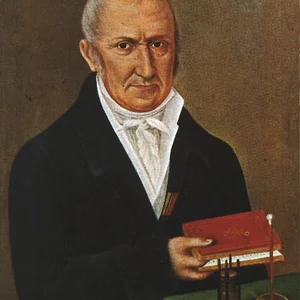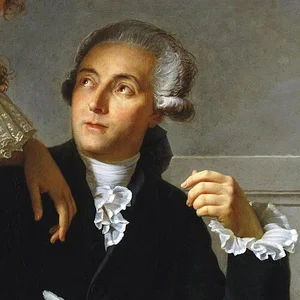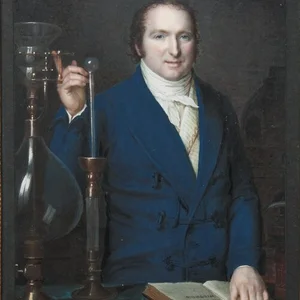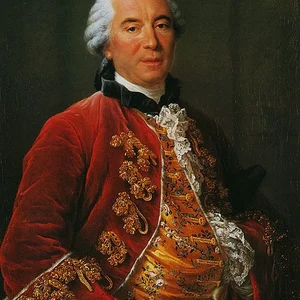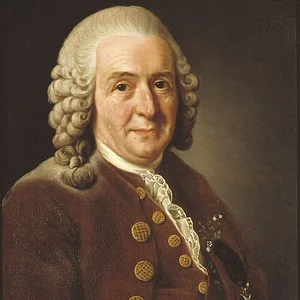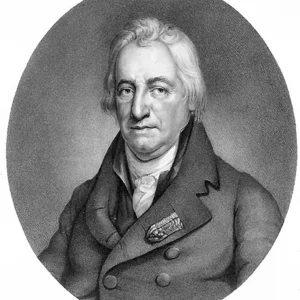

French chemist (1748–1822), collaborator of Lavoisier and founder of modern chemistry. He discovered the bleaching properties of chlorine and formulated the laws of chemical affinity, challenging the notion of complete chemical reactions.
Claude Louis Berthollet(1748 — 1822)
Claude-Louis Berthollet
France, royaume de Sardaigne
8 min read
Frequently asked questions
Key Facts
- 1748: born in Talloires, Savoy
- 1785: discovery of the bleaching properties of chlorine, applied to textile whitening
- 1787: co-author of the new chemical nomenclature alongside Lavoisier, Guyton de Morveau, and Fourcroy
- 1803: publication of the *Essai de statique chimique*, theorizing the laws of affinity
- 1822: died in Arcueil, where he had founded the Société d'Arcueil
Works & Achievements
A collective work co-written with Lavoisier, Guyton de Morveau, and Fourcroy, replacing alchemical names with a logical terminology based on the composition of substances. It remains the founding text of modern chemistry as a science of language.
A memoir presented to the Academy in which Berthollet describes the properties of oxygenated muriatic acid (chlorine) and its bleaching power, laying the foundations for industrial bleaching.
A practical and theoretical treatise on the dyeing of fabrics, combining the chemistry of dyes with artisanal expertise. It reflects the Enlightenment drive to apply science to industry.
Berthollet's first major theoretical exposition on the forces governing chemical reactions, challenging the notion of complete reactions and introducing the idea of equilibrium dependent on the masses of substances present.
Berthollet's theoretical masterpiece in two volumes, laying the groundwork for what science would later call chemical thermodynamics and the concept of chemical equilibrium. Translated into several languages, it profoundly influenced European chemistry.
Anecdotes
In 1785, Berthollet presented to the Académie des sciences his research on the bleaching properties of chlorine. He realized that this gas, recently discovered by Scheele, could whiten textiles without sunlight or long days of air-drying. Thanks to him, a factory was established in the village of Javel, near Paris, giving birth to the famous “Javel water” still in use today.
In 1798, Berthollet joined Napoleon Bonaparte’s Egyptian expedition as a scientist on the Commission des sciences et arts. Observing the natron lakes in the Egyptian desert — vast expanses of water saturated with sodium carbonate — he realized that chemical reactions could reverse direction depending on conditions. This discovery, made in the heart of the desert, would go on to transform theoretical chemistry.
Back in France, Berthollet argued that chemical reactions do not always run to completion and that the composition of a compound can vary depending on the initial proportions of the reactants. His colleague Joseph Louis Proust strongly disagreed. This “dispute over definite proportions,” which lasted from 1801 to 1808, is one of the most famous controversies in the history of chemistry — and it was ultimately Proust who was right, even though Berthollet had put his finger on a genuine complexity.
At his estate in Arcueil, on the outskirts of Paris, Berthollet and the mathematician Laplace gathered a small elite of young scientists every week: Gay-Lussac, Humboldt, Biot, Arago. These informal meetings, known as the Société d’Arcueil, gave rise to landmark work on gases, heat, and light. Berthollet personally funded the experiments and made his laboratory available to the group.
Berthollet was one of four scientists — along with Lavoisier, Guyton de Morveau, and Fourcroy — who in 1787 drafted the “Méthode de nomenclature chimique.” This text replaced obscure alchemical names such as “vitriol of Venus” or “salt of Saturn” with logical terms such as “copper sulfate” or “lead acetate.” It was this reform that gave chemistry its universal scientific language.
Primary Sources
We sought to establish a chemical nomenclature founded on philosophical principles and capable of expressing in a precise manner the nature and composition of substances.
Oxygenated muriatic acid possesses the property of destroying the color of most vegetable and animal matter, a property that can be used for the bleaching of linens and threads.
Affinity does not act alone in determining the outcome of a chemical reaction; the mass of the substances present also plays a decisive role in the product obtained.
There is no such thing as a complete chemical reaction in the absolute sense of the term. Any combination is liable to partially decompose if the conditions of mass and temperature vary, and the final state is a state of equilibrium between opposing forces.
The process consists in exposing fabrics to the action of oxygenated muriatic acid dissolved in water, making it possible to achieve in a few hours a degree of whitening that sun and air could only have produced over several weeks.
Key Places
Village on the shores of Lake Annecy where Berthollet was born on **9 December 1748**. He was then a subject of the King of Sardinia and would not become French until after the Revolution.
Institution where Berthollet was admitted in **1777** and where he presented his work on chlorine and chemical nomenclature. It was here that he met Lavoisier and joined the effort to reform the language of chemistry.
Berthollet's private residence and laboratory in Arcueil, south of Paris, where he founded the Société d'Arcueil with Laplace and welcomed the leading scientists of his day.
Salt lake in the Egyptian desert where Berthollet, during the **1798** expedition, observed the natural formation of sodium carbonate from common salt. This observation inspired him to develop his theory of chemical equilibria.
Factory established in the village of Javel (now part of the **15th arrondissement** of Paris) that commercialized the first chlorine-based bleaching product, *eau de Javel*, developed thanks to Berthollet's research.
Typical Objects

A vessel with a long curved neck used for distilling and collecting gases. Berthollet used it to prepare and manipulate chlorine in his experiments on bleaching.

An indispensable instrument in the laboratories of Lavoisier and Berthollet for weighing reactants and the products of a reaction. Rigorous measurement was at the heart of the new chemistry they were building together.

A device for collecting gases produced during a chemical reaction by directing them upward under an inverted bell jar filled with water. Berthollet used it to isolate and study oxygenated muriatic acid (chlorine).

A handwritten register in which the chemist recorded his observations, procedures, and results. Berthollet's notebooks bear witness to his rigorous method and his theoretical reflections on chemical affinity.

Vessels of various shapes, carefully stoppered and labeled, containing the salts, acids, and bases under study. Berthollet's collection of reagents was renowned among the scientists of his day.

A small firebox built from refractory bricks and fueled by charcoal, used to heat chemical reactions at a controlled temperature. It was standard equipment in every serious laboratory of the 18th century.
School Curriculum
Vocabulary & Tags
Key Vocabulary
Daily Life
Morning
Berthollet rises early and devotes the first hours of the morning to reading scientific memoirs and writing correspondence with European scholars. He then goes down to his laboratory at Arcueil to prepare his experiments, surrounded by his assistants, carefully weighing reagents on his precision balance.
Afternoon
The afternoon is dedicated to chemical work proper: distillations, reactions in retorts, and the observation and measurement of the products obtained. When teaching at the École Polytechnique, he delivers lectures on applied chemistry to audiences of students from across France.
Evening
On evenings when the Société d'Arcueil meets, Berthollet welcomes Laplace, Gay-Lussac, Humboldt, and Arago into his drawing room around a well-laden table. Discussions freely blend experimental results, theoretical hypotheses, and international scientific news. On other evenings, he re-reads and annotates his working notebooks before retiring.
Food
Like the prosperous bourgeois of his era, Berthollet eats two main meals: a light breakfast in mid-morning and a substantial dinner in the late afternoon, comprising roasted meats, vegetables, cheeses, and white bread. Table wine, diluted with water, accompanies every meal; coffee, highly fashionable in learned circles, closes intellectual gatherings.
Clothing
In the laboratory, Berthollet wears a large leather or heavy canvas apron over his coat to protect his clothes from acids and splashes. In society, he dresses in the French-style coat and later, under the Empire, in the dark buttoned frock coat, knee breeches or long trousers, and a powdered wig in his youth, later replaced by his own grey hair.
Housing
Berthollet lives on his large estate at Arcueil, a few leagues from Paris, which includes a manor house with a drawing room and library, a well-equipped adjoining laboratory, and a garden. This property, acquired through the fortune accumulated during the Egyptian expedition and his imperial offices, allows him to practise both science and intellectual hospitality.
Historical Timeline
Period Vocabulary
Liens externes & ressources
Références
Œuvres
Méthode de nomenclature chimique
1787
Observations sur quelques combinaisons de l'acide nitreux
1785
Éléments de l'art de la teinture
1791
Recherches sur les lois de l'affinité
1801
Essai de statique chimique
1803