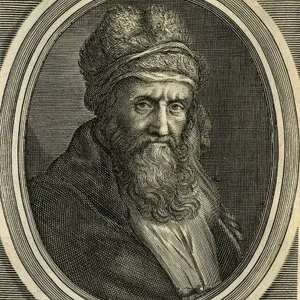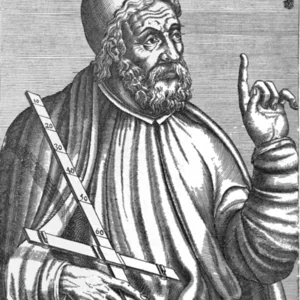

Greek astronomer, mathematician, and geographer of the 2nd century, he developed a geocentric model of the universe that would dominate scientific thought for over 1,400 years. His encyclopedic work synthesizes ancient knowledge in astronomy, geography, and optics.
Claudius Ptolemy(100 — 170)
Claudius Ptolemy
Rome antique
7 min read
Frequently asked questions
Key Facts
- Around 150 AD: composition of the Almagest, a landmark astronomical treatise laying out the geocentric system
- Around 150 AD: composition of the Geography, a cartographic work in 8 books with coordinates for 8,000 locations
- His geocentric model (Earth at the center of the universe) remained dominant until Copernicus in the 16th century
- He worked at the Library of Alexandria, the foremost intellectual center of the ancient world
- His works on optics and music were also standard references throughout the Middle Ages
Works & Achievements
An astronomical encyclopedia in 13 books laying out the geocentric model of the universe. A standard reference in astronomy for over 1,400 years, it was translated into Arabic and then Latin, passing Greek science on to the Middle Ages.
A treatise in 8 books providing the geographical coordinates of nearly 8,000 locations, along with a cartographic projection system and instructions for drawing world maps. Rediscovered during the Renaissance, it directly inspired the Age of Exploration.
An astrological treatise in 4 books that systematizes the supposed influence of celestial bodies on people and nations. A foundational text of Western astrology, it remains a valuable source on how the ancient world understood the cosmos.
A treatise in 5 books studying vision, mirrors, and the refraction of light. Ptolemy carried out experimental measurements of refraction angles, anticipating work that would later be attributed to Ibn al-Haytham.
A treatise on music theory linking musical intervals to mathematical ratios and the movements of the celestial spheres. It reflects Ptolemy's encyclopedic ambition to find universal laws governing every field of knowledge.
A treatise describing the stereographic projection of the celestial sphere onto a flat surface. This text forms the theoretical foundation for the construction of astrolabes, instruments that would dominate medieval astronomy.
Anecdotes
Ptolemy lived in Alexandria, the intellectual capital of the ancient world, home to the greatest library ever assembled. It was in this exceptional setting that he was able to synthesize centuries of Babylonian and Greek astronomical observations to construct his model of the universe.
His geocentric model, presented in the Almagest, was so accurate in predicting planetary positions that it was used without serious challenge for fourteen centuries, until Copernicus proposed a heliocentric model in 1543. The precision of Ptolemy's calculations rested on the ingenious use of epicycles and deferents.
His Geography contained the coordinates of nearly 8,000 locations in the known world, from Ireland to the coasts of Southeast Asia. Although some distances were incorrect — most notably his underestimation of Earth's circumference — these maps guided navigators and explorers well into the Renaissance.
Ptolemy is one of the first scholars to have written a comprehensive treatise on optics, studying the refraction of light through different media. He conducted experiments by submerging objects in water and measuring refraction angles, anticipating by several centuries work that would long be attributed to medieval Arab scholars.
Primary Sources
The Earth is at the center of the universe, motionless, and the stars revolve around it in uniform circular motion. The planets move on epicycles whose centers travel along deferents centered on the Earth.
We shall set out the principles of mathematical geography, then enumerate the peoples, cities, mountains, rivers, and seas with their respective latitudes and longitudes, so that a representation of the inhabited world may be drawn.
The influence of celestial bodies on earthly beings is manifest: the sun warms, the moon moistens, and the planets, through their respective positions, alter the temperaments and destinies of men and nations.
When a visual ray passes from a less dense medium into a denser one, it bends toward the perpendicular at the point of contact between the two media. We have measured these angles for air, water, and glass.
Key Places
The main city where Ptolemy worked, home to the Museum and the Library. It was here that he carried out all of his observations and wrote his major works.
A unique intellectual institution from which Ptolemy drew on the work of his Greek predecessors (Hipparchus, Eratosthenes) and Babylonian scholars. It represents the continuity of ancient science.
The island where Hipparchus worked in the 2nd century BCE, whose observations and star catalogue served as the primary source on which Ptolemy relied when building the Almagest.
A city whose astronomers had accumulated centuries of planetary observations. Ptolemy incorporated this Babylonian data into his own calculations, ensuring a millennia-long scientific continuity.
The political capital of the Empire in which Ptolemy lived and worked. The Pax Romana ensured the free movement of knowledge and scholars between East and West.
Typical Objects

An instrument for measuring the position of celestial bodies, used by Alexandrian astronomers. Ptolemy described its theoretical principles and used it for his astronomical observations.

A set of concentric metal rings representing the great circles of the celestial sphere. Ptolemy used this instrument to measure the longitude and latitude of stars.

A graduated ruler fitted with two sighting vanes for measuring angles between celestial bodies. Ptolemy describes its precise use in the Almagest for his measurements of lunar parallax.

The primary writing medium in Alexandria in the 2nd century. Ptolemy's works were first written on papyrus scrolls before being copied onto parchment by medieval scribes.

An essential arithmetic calculation tool for performing the lengthy computations required for astronomical tables. Ptolemy drew on centuries of Babylonian calculations to construct his own tables.

A vertical rod whose shadow is used to measure the height of the Sun at different times and latitudes. Ptolemy used the gnomon to determine the obliquity of the ecliptic.
School Curriculum
Vocabulary & Tags
Key Vocabulary
Daily Life
Morning
Ptolemy rose before dawn to conduct his astronomical observations, recording the positions of celestial bodies on papyrus scrolls using his dioptra and armillary ring. He then devoted the early hours of the day to mathematical calculations and the writing of his treatises, working in the relative quiet of the Mouseion of Alexandria.
Afternoon
The afternoon was dedicated to reading the works of his predecessors — particularly Hipparchus's star catalogue — and to discussions with other scholars at the Mouseion. He might also receive students or visitors wishing to consult his work on geography or astronomy.
Evening
In the evening, Ptolemy returned to his celestial observations, measuring the positions of the planets and the Moon to verify or correct his tables. He worked by the light of an oil lamp to annotate his calculations and prepare his nightly observations, relying on a water clock (clepsydra) to measure time.
Food
The diet of an Alexandrian scholar in the 2nd century was typically Mediterranean: wheat bread, legumes, olives, goat's cheese, fresh fish from the nearby harbor, figs, and grapes. Wine diluted with water was the everyday drink, consumed at meals shared with other members of the Mouseion.
Clothing
Ptolemy wore the dress of Romanized Greek intellectuals: a white linen tunic (chiton) covered by a himation (a large draped woolen cloak), in white or off-white. On his feet, simple leather sandals suited to Alexandria's warm Mediterranean climate.
Housing
Ptolemy most likely lived within the Mouseion complex or nearby, in a house of stone or sun-dried brick with a shaded inner courtyard featuring a grapevine or fig tree. The rooms, with whitewashed walls and mosaic floors, were modestly furnished: a wooden bed, a writing desk, and numerous shelves for his papyrus scrolls.
Historical Timeline
Period Vocabulary
Visual Style
Esthétique helléno-romaine sobre et lumineuse, entre la sérénité des colonnades de marbre et la richesse des instruments scientifiques en laiton, sous la lumière dorée d'Alexandrie.
Sound Ambience
L'environnement sonore d'Alexandrie mêle l'agitation d'un grand port méditerranéen aux silences studieux du Musée et à la solennité des nuits d'observation astronomique.
Liens externes & ressources
Références
Œuvres
Almageste (Μαθηματικὴ Σύνταξις)
vers 150 ap. J.-C.
Géographie (Γεωγραφική Ὑφήγησις)
vers 150 ap. J.-C.
Tétrabible (Ἀποτελεσματικά)
vers 150 ap. J.-C.
Optique
vers 160 ap. J.-C.
Harmoniques (Ἁρμονικά)
vers 160 ap. J.-C.
Planisphère
vers 150 ap. J.-C.