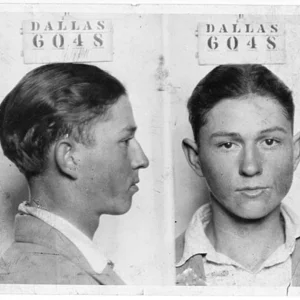

Clyde Barrow is an American criminal from the Great Depression. With his companion Bonnie Parker, he forms the Barrow gang, which multiplies robberies and murders across the central United States before being killed in a police ambush in 1934.
Clyde Barrow(1909 — 1934)
Clyde Barrow
États-Unis
9 min read
Frequently asked questions
Key Facts
- Born March 24, 1909 in Telico, Texas to a poor sharecropping family
- Forms the Barrow gang with Bonnie Parker starting in 1932, in the midst of the Great Depression
- The gang commits numerous robberies and is responsible for the deaths of several people, including police officers
- Killed with Bonnie Parker in a police ambush near Gibsland, Louisiana on May 23, 1934
- Becomes a legendary figure in American popular culture, popularized by the film *Bonnie and Clyde* (1967)
Works & Achievements
The formation of the criminal gang by Clyde Barrow and Bonnie Parker marks one of the darkest chapters in American crime during the Great Depression. This criminal organization would influence the media's perception of crime in the 1930s.
The Barrow Gang committed over 100 robberies and armed heists between 1932 and 1934, along with 13 murders of police officers and civilians. This wave of violent crime mobilized federal and local authorities and marked the peak of criminal activity during the Great Depression.
The images and correspondence discovered in Joplin constitute a unique historical document of criminal life on the run. These testimonies humanize the criminals and turn them into iconic figures of the era, influencing the future portrayal of gangsterism in popular culture.
The national press transformed Clyde Barrow and Bonnie Parker into legendary criminal figures. Their exploits were reported on front pages, creating an aura of danger and romance around their story that persisted long after their deaths.
Anecdotes
In November 1933, the Barrow gang was surprised by police in Joplin, Missouri. During their hasty escape, they left behind a treasure trove for criminologists: photographs of themselves, armed and posing near their loot, as well as intimate letters from Bonnie. These documents, discovered by authorities, were reproduced in newspapers and made Clyde and Bonnie the most publicized criminals of the era.
Clyde Barrow is known for his loyalty to his accomplices and his companion Bonnie. Even when she was captured in 1933, he attempted several times to free her rather than continue alone, which contrasts with the image of a selfish criminal and shows his personal attachment in this context of mass criminality.
The Barrow gang used a modified Ford V8 that became almost as famous as its occupants. This car, nicknamed "jalopy" by the press, was so fast that it escaped police from several states multiple times, making it a symbol of their relentless flight across the central United States.
Between 1932 and 1934, the Barrow gang was suspected of killing about thirteen police officers, making them extremely wanted. This statistic ranks them among the deadliest gangs of the Great Depression, surpassing other criminals of the era in notoriety.
The death of Clyde Barrow on May 23, 1934, during an ambush in Louisiana was a bloody affair: more than 130 bullets were fired in just a few seconds by a brigade of federal and local police. Clyde's body was found riddled with bullets, dramatically ending two and a half years of media-covered crime.
Primary Sources
We live a life of constant flight, sleeping in the car, eating little. Each day could be our last. I often think of you and the life I might have had.
The gang left behind compromising photographs, handwritten letters, and plans for future robberies. The items found allowed authorities to identify gang members and better understand their operational methods.
Images showing Clyde Barrow and Bonnie Parker posing with guns, surrounded by Thompson submachine guns and pistols, in front of and inside their Ford V8. These images, found in Joplin, were reproduced in the national press.
A posse of six federal police officers and four Louisiana police officers opened fire on the gang's vehicle at a road bend. Over 130 rounds were fired in seconds. Clyde Barrow, Bonnie Parker, and two other occupants were killed on the spot.
Daily entries mention places visited, robberies committed, encounters with other criminals, and constant fears of being arrested. The tone reveals the paranoia and psychological exhaustion of life on the run.
Key Places
Hometown of Clyde Barrow, where he grew up in a poor, rural environment. Dallas is the starting point of his criminal career and the home of his family, which he left behind in 1932 to join Bonnie Parker.
Iconic location where the Barrow gang was ambushed by police in November 1933. In Joplin, compromising photographs and letters were discovered that made the gang famous. This ambush turned Clyde and Bonnie into criminal celebrities.
Small rural locality near the Louisiana border where the Barrow gang was ambushed on May 23, 1934. On a remote road, a police posse fired over 130 shots, killing Clyde Barrow, Bonnie Parker, and two other accomplices. This was the end of the gang's saga.
Major highway linking Texas and Oklahoma, used by the Barrow gang for getaways between robberies. Authorities set up several roadblocks here, making it a regular site of confrontations between the gang and police.
Small country banks in Texas, Oklahoma, Louisiana, and Missouri, prime targets for the Barrow gang. These institutions, less protected than big city banks, allowed the gang to finance their flight.
Precarious hiding places where the Barrow gang lay low between robberies. These cheap establishments, typical of rural America during the Great Depression, offered relative anonymity but kept the gang in a constant state of paranoia.
Typical Objects

The famous car used by the Barrow gang for robberies and getaways. This fast automobile became nearly as iconic as its occupants, earning the nickname **'jalopy'** in newspapers. Clyde Barrow valued it for its speed, allowing him to escape police chases across multiple states.

The Barrow gang's weapon of choice, this light machine gun was used in robberies and confrontations with police. It symbolized industrialized violence and modern crime of the 1930s, capable of firing 600 rounds per minute.

Handguns carried by Clyde Barrow and his associates during robberies. These semi-automatic pistols were more accurate and faster than traditional revolvers, giving the gang an armed advantage over police of the era.

The gang used a camera to document their life. The photos discovered in Joplin, showing Clyde, Bonnie, and other members posing with guns, became crucial evidence and caused a sensation in the national press, humanizing the criminals.

Handwritten correspondence from Bonnie and Clyde, discovered during the Joplin ambush, revealed their personal lives, fears, and dreams. These documents became valuable historical testimonies about the psychological experience of a life of crime on the run.

The proceeds from robberies of gas stations, rural banks, and stores. Though modest (often a few hundred dollars), these sums represented wealth the gang could not obtain legally during the Great Depression.

Used to evade police searches and allow the gang to move across states without immediate identification. They symbolized the cunning and criminal ingenuity in the face of authorities.
School Curriculum
Vocabulary & Tags
Key Vocabulary
Tags
Daily Life
Morning
Clyde wakes up in the car before dawn, revolver nearby, constantly alert to the sounds of authorities. After a quick glance at the morning news in small-town newspapers, he prepares the weapons, checks ammunition, and reviews road maps for the next destination or heist.
Afternoon
Afternoons are spent driving to potential targets (gas stations, small rural banks) or fleeing after a recent robbery. Clyde maintains high speed on the roads, changing direction frequently to evade police roadblocks. He stops briefly in anonymous small towns to refuel the car and buy provisions.
Evening
At nightfall, the gang retreats to a cheap motel or an isolated spot. Clyde counts the stolen money, cleans the weapons, and scans newspapers to see if the gang is described. He exchanges anxious glances with Bonnie, often keeping the lights off to stay discreet, sleeping fitfully with a revolver under his pillow.
Food
Typical cheap food of the Great Depression: bread and cold cuts sandwiches, eggs and bacon at small roadside diners, plenty of black coffee, canned goods bought from grocery stores. Meals are eaten quickly and often in the car, never staying long in one place to avoid suspicion.
Clothing
Clyde wears a worn but carefully maintained three-piece suit, a fedora hat, scuffed but re-soled leather shoes. His clothes reflect an attempt at middle-class respectability despite his criminality, a contrast between his gentlemanly appearance and his outlaw actions. In winter, he adds a shabby overcoat.
Housing
The Barrow gang has no fixed home, living mainly in the modified Ford V8 or in seedy motels rented by the night for a few dollars. Temporary hideouts include abandoned farms, isolated cabins, and roadside camps. This rootless itinerant life symbolizes the rejection of the social and economic system of the time.
Historical Timeline
Period Vocabulary
Visual Style
Style noir et blanc caractéristique des années 1930 : contrastes forts entre ombres et lumières, automobile chromée brillante contre paysages désertiques, vêtements usés mais élégants (costume trois pièces, fedora), environnement rural dégradé symbolisant la Grande Dépression, armes métalliques scintillantes, tonalité générale de danger et de fuite.
Sound Ambience
Sons de l'Amérique rurale de la Grande Dépression : moteur rugissant de la Ford V8, crépitement de mitraillette Thompson, crissement des pneus sur routes de gravier, sirènes de police au loin, cliquetis des armes, silence oppressant des grands espaces, jazz à la radio, cris d'ordres lors des braquages.
Liens externes & ressources
Références
Œuvres
Formation du gang Barrow
1932
Campagne de braquages et de meurtres (1932-1934)
1932-1934
Photographies et lettres du gang
1933
Mythologisation médiatique du gang Barrow
1933-1934