Character Catalog

Historical Library

CollectionGalaxy
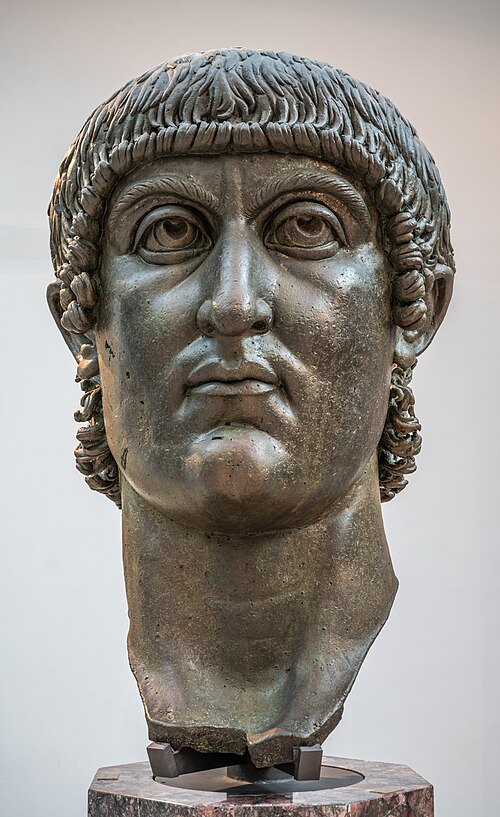
Portrait de Constantine I

Constantine I

Constantine I

272 — 337

Rome antique

PoliticsMonarqueChef militaireReligieux/seAntiquity4th century (early Late Roman Empire)

Roman Emperor from 306 to 337, Constantine I is renowned for establishing religious tolerance toward Christianity through the Edict of Milan in 313 and for founding Constantinople in 330. He marks the turning point of the Roman Empire toward Christianity and the East.

Émotions disponibles (6)

N

Neutre

par défaut

I

Inspiré

P

Pensif

S

Surpris

T

Triste

F

Fier

Key Facts

  • 312: Victory at the Battle of Milvian Bridge, allowing him to take control of the western Roman Empire
  • 313: Edict of Milan granting religious tolerance to Christians and all other cults
  • 325: Convening of the Council of Nicaea to unify Christian doctrine
  • 330: Foundation of Constantinople (modern-day Istanbul) as the new capital of the Empire
  • 337: Death of Constantine and Christian baptism shortly before his passing

Works & Achievements

Foundation of Constantinople (324-330)

Creation of a new imperial capital on the site of Byzantium, endowed with a senate, a hippodrome, forums, and numerous churches. It would remain the capital of the Byzantine Empire for over a thousand years.

Edict of Milan (313)

Decree of religious tolerance granting freedom of worship to Christians and all religions. It marks the end of persecutions and the beginning of the Christianization of the Empire.

Council of Nicaea (325)

First ecumenical council in Christian history, convened and presided over by Constantine. It established the Nicene Creed and condemned Arianism as heresy.

Old St. Peter's Basilica (first) (vers 326-333)

Constantine ordered the construction of the first St. Peter's Basilica on the Vatican Hill, above the presumed tomb of the Apostle Peter. It was replaced by the current building during the Renaissance.

Church of the Holy Sepulchre (vers 326-335)

Built in Jerusalem on the site identified by Helena, Constantine's mother, as the location of the crucifixion and resurrection of Christ. It remains a major pilgrimage site.

Solidus monetary reform (309-312)

Introduction of the gold solidus as the standard currency of the Empire, ensuring remarkable economic stability. This currency remained in use until the fall of Constantinople in 1453.

Arch of Constantine in Rome (315)

Triumphal arch erected by the Senate to commemorate the victory at the Milvian Bridge. Still standing today near the Colosseum, it combines sculpted reliefs from different imperial periods.

Anecdotes

Before the Battle of Milvian Bridge in 312, Constantine reportedly had a famous vision: a luminous cross in the sky accompanied by the words "In hoc signo vinces" (By this sign, thou shalt conquer). He had the Chi-Rho (monogram of Christ) painted on his soldiers' shields and went on to defeat Maxentius.

Constantine had his own eldest son Crispus executed in 326, most likely on the basis of accusations made by his second wife Fausta. Shortly afterward, he also had Fausta herself put to death, suffocated in an overheated bath. The exact reasons behind these family tragedies remain a subject of debate among historians.

Constantine was only baptized a Christian on his deathbed in 337, by the Arian bishop Eusebius of Nicomedia. Throughout his reign, he had retained the title of pontifex maximus, head of the traditional Roman religion, which reflects a gradual rather than abrupt religious transition.

To build his new capital Constantinople, Constantine brought artworks and columns from across the Empire. He quite literally plundered the pagan temples of Greece and Asia Minor to adorn his city, provoking outrage among many communities stripped of their treasures.

Primary Sources

Life of Constantine (Vita Constantini) (vers 337-340)
Eusebius of Caesarea reports that Constantine saw in the sky, above the sun, a trophy in the shape of a cross made of light, bearing the inscription "By this sign, you shall conquer", and that the entire army witnessed the marvel.
Edict of Milan (313)
"We have decided to grant to Christians as to all others the freedom to follow the religion of their choice, so that the supreme divinity, whose worship we freely honor, may grant us in all things its favor and benevolence."
Ecclesiastical History (Eusebius of Caesarea) (vers 324-330)
Eusebius describes Constantine as the instrument chosen by God to put an end to persecutions and restore peace in the Church, comparing him to Moses liberating the chosen people from tyranny.
On the Deaths of the Persecutors (Lactantius) (vers 313-315)
Lactantius recounts that Constantine received in a dream the order to trace the heavenly sign of God on his soldiers' shields before the Battle of Milvian Bridge, and that he obeyed at once.

Key Places

Constantinople (Istanbul)

Founded in 330 on the site of ancient Byzantium, this new capital established by Constantine became the center of imperial power and the largest city in the medieval world for centuries.

Milvian Bridge, Rome

Site of the decisive battle of 312 where Constantine defeated Maxentius. It is here that, according to tradition, the vision of the cross changed the course of religious history.

Nicaea (Iznik)

City in Asia Minor where Constantine convened the first ecumenical council in 325, which formulated the Nicene Creed, the foundation of Christian doctrine.

Naissus (Niš)

Constantine's birthplace in the Roman province of Moesia. It is today the third largest city in Serbia, which preserves significant Roman remains.

Trier (Augusta Treverorum)

Constantine's imperial residence in Gaul between 306 and 316. The Constantine Basilica (Aula Palatina) and the Porta Nigra are still visible there.

Typical Objects

The Labarum

Military standard bearing the Chi-Rho monogram (the Greek letters Chi and Rho intertwined), adopted by Constantine after his vision before the Battle of Milvian Bridge. It became the symbol of the Christian imperial army.

The gold solidus

Gold coin introduced by Constantine around 309, weighing 4.5 grams. It became the reference currency of the Mediterranean world for more than seven centuries.

The imperial diadem

Constantine was the first emperor to permanently wear a diadem adorned with precious stones, breaking with the tradition of the simple laurel wreath and asserting a power of divine right.

The imperial purple

Toga and cloak dyed with murex, reserved exclusively for the emperor. Constantine reinforced the laws forbidding anyone else from wearing this color.

The cruciform scepter

Scepter topped with a cross that Constantine adopted for official ceremonies, symbolizing the union of imperial power and the Christian faith.

The colossal marble head

Fragment of a gigantic statue of Constantine once installed in the Basilica of Maxentius in Rome. The head alone measures more than 2.5 meters tall, visible today at the Capitoline Museums.

School Curriculum

Cycle 3 (CM1-6e)Histoire
LycéeHistoire
LycéeHistoire — La transformation de l'Empire romain au IVe siècle
LycéeHistoire — La montée du christianisme dans l'Empire romain
LycéeHistoire — L'Édit de Milan et la liberté religieuse
LycéeHistoire — La fondation de Constantinople et le déplacement du pouvoir vers l'Orient
LycéeHistoire — La fin de l'Empire romain antique et les débuts du Moyen Âge
LycéeHistoire — Les persécutions religieuses et la tolérance dans l'Antiquité tardive

Vocabulary & Tags

Key Vocabulary

Edict: a decree issued by a sovereign authorityChristianity: religion based on the teachings of Jesus ChristReligious tolerance: acceptance of diverse religious beliefs and practicesLate Empire: period of the Roman Empire from the 3rd to the 5th centuryCouncil: an assembly of the Church convened to establish doctrineConstantinople: new capital founded by Constantine on the BosphorusHeresy: doctrine contrary to the official teachings of the ChurchPersecution: oppression against a religious or social group

Tags

Constantin IerFigure religieuseempire-romainEmpire romainÉdit : décret émanant d'une autorité souveraineChristianisme : religion basée sur l'enseignement de Jésus ChristTolérance religieuse : acceptation de diverses croyances et pratiques religieusesBas-Empire : période de l'Empire romain du IIIe au Ve siècleConcile : assemblée de l'Église réunie pour fixer la doctrineConstantinople : nouvelle capitale fondée par Constantin sur le BosphoreHérésie : doctrine contraire aux enseignements officiels de l'ÉglisePersécution : oppression contre un groupe religieux ou socialIVe siècle (début du Bas-Empire romain)

Daily Life

Morning

Constantine rose at dawn in his apartments in the imperial palace. After a toilet assisted by cubicularii (chamber servants), he donned the purple and received reports from his advisors and spies. He devoted the morning to official audiences, seated on a raised throne in the great consistory hall.

Afternoon

The afternoon was dedicated to military and administrative affairs: reviewing provincial reports, signing imperial rescripts, receiving foreign ambassadors. Constantine sometimes attended chariot races at the Hippodrome, the population's favorite spectacle, from the imperial box (kathisma) connected directly to the palace.

Evening

In the evening, Constantine attended official banquets where multiple courses were served on gold and silver tableware, accompanied by musical entertainment. He then withdrew for prayer and the reading of Christian texts, a practice he encouraged at court. Praetorian guards kept watch throughout the night.

Food

The imperial table offered refined Roman cuisine: roasted meats (pork, poultry, game), fresh fish from the Propontis, vegetables seasoned with garum (fermented fish sauce), white wheat breads, Mediterranean fruits, and honey. Wine, diluted with water, was served in chiseled silver cups.

Clothing

Constantine wore a white silk tunic embroidered with gold, covered by the paludamentum, a purple cloak fastened at the shoulder with a gold fibula set with precious stones. He permanently wore a gem-encrusted diadem, bracelets, and red leather shoes, a color reserved for the emperor.

Housing

Constantine resided successively in several imperial palaces: in Trier, in Rome, and then in the Great Palace of Constantinople, which he had built. The latter was an immense complex of marble halls, gardens, private baths, and chapels, overlooking the Bosphorus and connected to the Hippodrome.

Historical Timeline

272Naissance de Constantin à Naissus (actuelle Niš, en Serbie), fils de Constance Chlore et d'Hélène.
284Dioclétien instaure la Tétrarchie, système de gouvernement à quatre empereurs pour stabiliser l'Empire romain.
303Début de la Grande Persécution contre les chrétiens sous Dioclétien, la plus violente de l'histoire romaine.
306Mort de Constance Chlore à York. Les légions de Bretagne proclament Constantin empereur.
312Bataille du pont Milvius : Constantin défait Maxence aux portes de Rome et devient maître de l'Occident romain.
313Édit de Milan : Constantin et Licinius proclament la liberté de culte dans tout l'Empire, mettant fin aux persécutions des chrétiens.
314Concile d'Arles convoqué par Constantin pour résoudre le schisme donatiste en Afrique du Nord.
324Victoire de Constantin sur Licinius à la bataille de Chrysopolis. Constantin devient seul maître de l'Empire romain réunifié.
325Concile de Nicée, premier concile œcuménique, convoqué par Constantin pour établir l'unité doctrinale du christianisme et condamner l'arianisme.
330Inauguration de Constantinople (ancienne Byzance) comme nouvelle capitale de l'Empire romain, tournant l'Empire vers l'Orient.
332Constantin accorde des avantages fiscaux massifs au clergé chrétien et lance un programme de construction de basiliques dans tout l'Empire.
337Mort de Constantin à Nicomédie après avoir reçu le baptême. L'Empire est partagé entre ses trois fils.

Period Vocabulary

Augustus — The supreme title of the Roman emperor, meaning 'the venerable one'. Constantine bore this title from 306 after being proclaimed by his troops.
Tetrarchy — The system of government established by Diocletian in 284, dividing power between two Augusti and two Caesars. Constantine ended this system by reunifying the Empire.
Pontifex maximus — High priest, head of the traditional Roman religion. Constantine retained this pagan title while promoting Christianity.
Chrismon — A monogram formed by the Greek letters Chi (X) and Rho (P), the initials of the word Christ. Constantine had it engraved on his soldiers' shields and on the labarum.
Consistory (consistorium) — The restricted imperial council that replaced the former consilium principis. Members stood (consistere) before the seated emperor, a sign of the sacralization of power.
Solidus — A gold coin weighing 4.5 grams introduced by Constantine, which became the standard monetary unit throughout the Mediterranean world for centuries.
Donatism — A Christian schism born in North Africa, contesting the validity of sacraments administered by priests who had weakened during the persecutions. Constantine attempted to resolve it through the Council of Arles.
Arianism — The doctrine of the priest Arius asserting that the Son (Christ) is a creature of the Father and not his equal. Constantine convened the Council of Nicaea to condemn this heresy.
Basilica — A large rectangular building with a nave and aisles. Under Constantine, the term designates the first great Christian places of worship, adapted from Roman civic architecture.
Eusebius of Caesarea — Bishop and historian (c. 265–339), the principal biographer of Constantine. His Life of Constantine and Ecclesiastical History are essential sources on this period.
Coloni — Peasants bound to the land they cultivated, ancestors of medieval serfs. Constantine strengthened the laws preventing them from leaving their estate, laying the foundations of serfdom.

Gallery


German:  Kaiser Konstantin und die hl. Helena The Emperor Constantine and Saint Helenatitle QS:P1476,de:"Kaiser Konstantin und die hl. Helena "label QS:Lde,"Kaiser Konstantin und die hl. Helena "labe

German: Kaiser Konstantin und die hl. Helena The Emperor Constantine and Saint Helenatitle QS:P1476,de:"Kaiser Konstantin und die hl. Helena "label QS:Lde,"Kaiser Konstantin und die hl. Helena "labe

Den Haag - Mauritshuis - Peter Paul Rubens (1577-1640) - The triumph of Rome, The youthful Emperor Constantine honouring Rome c. 1622-1623

Den Haag - Mauritshuis - Peter Paul Rubens (1577-1640) - The triumph of Rome, The youthful Emperor Constantine honouring Rome c. 1622-1623

Santa Elena

Santa Elena

Auffindung und Erprobung des Kreuzes Christi durch Kaiserin Helena

Auffindung und Erprobung des Kreuzes Christi durch Kaiserin Helena

Ĺšw. Helena.

Ĺšw. Helena.

Statue Constantin 1er York 2

Statue Constantin 1er York 2

Statue Constantin 1er York 9

Statue Constantin 1er York 9

Statue Constantin 1er York 13

Statue Constantin 1er York 13

Statue Constantin 1er York 14

Statue Constantin 1er York 14

Hand of the monumental bronze statue of Constantine emperor 1

Hand of the monumental bronze statue of Constantine emperor 1

Visual Style

Esthétique du Bas-Empire romain mêlant grandeur antique classique et premiers symboles chrétiens, avec mosaïques dorées, pourpre impériale et lumière divine, dans un style proto-byzantin monumental.

#8B1A1A
#DAA520
#1C1C6B
#4B0082
#F5F0E1
AI Prompt
Late Roman imperial aesthetic of the 4th century AD, blending classical Roman grandeur with early Christian symbolism. Monumental architecture with marble columns, gilded mosaics on deep blue backgrounds, Chi-Rho symbols and laurel wreaths. Rich Byzantine proto-style with gold leaf, deep purples, and crimson. Dramatic lighting evoking divine radiance breaking through clouds, inspired by the Vision of the Cross. Portraiture in the rigid, hieratic late antique style with large eyes and solemn expressions. Geometric patterns from Roman floor mosaics. Mediterranean landscape with cypress trees, fortified walls, and domed basilicas against a golden sunset sky over the Bosphorus strait.

Sound Ambience

Ambiance d'un palais impérial à Constantinople au IVe siècle, mêlant chants liturgiques chrétiens, rumeur de la cour, acclamations de l'Hippodrome et bruits du port sur le Bosphore.

AI Prompt
Immersive ambient soundscape of a late Roman imperial palace in Constantinople, circa 330 AD. Echoing marble halls with distant footsteps of guards in hobnailed sandals. Liturgical chanting from a nearby Christian basilica blending with the murmur of courtiers speaking Greek and Latin. Bronze doors creaking open, the clinking of ceremonial armor. Outside, the roar of chariot races in the Hippodrome, crowd cheering and trumpets blaring. Harbor sounds: waves lapping against stone quays, ropes creaking on merchant ships, seagulls calling. Street vendors shouting in Greek. Occasional deep bells from church towers mixing with the wind sweeping across the Bosphorus.

Portrait Source

Wikimedia Commons — domaine public — Wilfredor