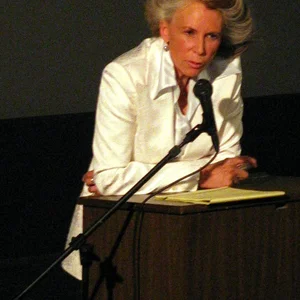

Iranian lawyer and human rights activist, she is the first Muslim woman to receive the Nobel Peace Prize in 2003. She defends the rights of women, children, and political prisoners in Iran, at the risk of her own freedom.
Shirin Ebadi(1947 — ?)
Shirin Ebadi
Iran
8 min read
Frequently asked questions
Famous Quotes
« I am a Muslim. I believe that Islam is compatible with democracy and human rights.»
« Human rights are not a privilege granted by the few. They are a right guaranteed to all.»
Key Facts
- 1947: Born in Hamadan, Iran
- 1975: First female judge in Iran, before being demoted following the Islamic Revolution of 1979
- 1992: Permitted to practice as a lawyer again after years of prohibition
- 2003: Awarded the Nobel Peace Prize, the first Muslim woman to receive this distinction
- 2009: Forced into exile following post-electoral repression in Iran; her office is shut down and her relatives harassed
Works & Achievements
A pioneering legal analysis of Iranian laws as applied to children. This work laid the groundwork for her fight to reform discriminatory provisions affecting minors and women in Iranian law.
A non-governmental organization established in Tehran to provide free legal assistance to victims of human rights violations. Forcibly shut down by the Iranian government in 2008, it remains a symbol of civil resistance.
Delivered in Oslo, this text stands as one of the founding documents of the struggle for human rights in the contemporary Islamic world, weaving together Muslim faith, feminism, and the universalism of human rights.
Memoirs tracing her life from the Islamic Revolution to her exile, translated into numerous languages. A reference work used in human rights training programs around the world.
A narrative exploring the intertwined fates of three Iranian brothers confronted with the political and existential choices imposed by the Islamic Revolution, illuminating the deep fractures within Iranian society.
A reflection on the condition of refugees and displaced people across the globe, seen through the lens of her own experience of exile and her unrelenting fight for human dignity.
Anecdotes
In 1979, following the Islamic Revolution, Shirin Ebadi was demoted from judge to court clerk because the new Islamic Republic considered women unfit to serve on the bench. She refused to accept this humiliation without a fight, and spent years in a determined struggle to win the right to practice as a lawyer — a right she did not obtain until 1992.
In October 2003, Shirin Ebadi learned she had been awarded the Nobel Peace Prize while she was in Paris for a conference. The first Muslim woman and first Iranian to receive the honor, she declared that the prize was an encouragement to all those who were fighting for human rights in the Islamic world.
After the Nobel award ceremony in Oslo in December 2003, Iranian state-aligned media sharply criticized Shirin Ebadi for not wearing the hijab at the official gala, which was held outside Iran. She calmly replied that the veil was an Iranian law, and that abroad she was subject only to the laws of the host country.
In 2009, Iranian authorities physically seized Ebadi's Nobel gold medal and diploma, along with her assets and bank accounts — an unprecedented act in the history of the Nobel Prize. She was abroad at the time and chose not to return, convinced she would be immediately imprisoned.
Shirin Ebadi notably represented the family of Zahra Kazemi, an Iranian-Canadian photographer who died under torture in an Iranian prison in 2003. She took on the case at risk to her own safety, knowing that lawyers who challenged the state could themselves be arrested — a testament to her uncompromising commitment to truth.
Primary Sources
I am Iranian. A Muslim. A woman. I must contend with a world in which fundamentalists use religion as a weapon and where human rights are violated on a daily basis. Yet I firmly believe that Islam is compatible with human rights.
When I was demoted from judge to clerk, I understood that the revolution had decided women had no place in the spheres of power. But this only strengthened my determination to fight from within the system.
The closure of this center is a direct attack on Iranian civil society. We will not be silenced. Repression only proves that our work was necessary.
Being a refugee means losing not only your country, but your dignity. The world must respond to this crisis not with fear, but with humanity and respect for human life.
Key Places
Shirin Ebadi's birthplace, born in 1947 in this ancient historical city in northwestern Iran. It embodies her deep Iranian cultural roots and her attachment to a pluralistic Iran.
It was here that Ebadi studied law in the 1960s, becoming one of the first Iranian women to enter the judiciary upon graduating.
The capital where she served as a judge and later practiced as a lawyer, and where she founded the Defenders of Human Rights Center. The heart of her struggle and the site of repeated persecution by the regime.
The venue for the Nobel Peace Prize award ceremony in December 2003, where Ebadi delivered a landmark speech connecting Islam, feminism, and the universalism of human rights.
Her primary place of exile since 2009, where she continues to advocate for human rights in Iran, meet with political leaders, and collaborate with international organizations.
Typical Objects

Before 1979, Shirin Ebadi wore the robe of Iranian judges, a symbol of hard-won professional equality. This garment was taken from her by the Islamic Revolution, making it an object laden with deep personal and political meaning.

Presented in Oslo in December 2003, this gold medal was physically seized by Iranian authorities in 2009 — an unprecedented act in the history of the Nobel Prize, bearing witness to the regime's relentless persecution of Ebadi.

Ebadi used Iranian law itself to argue on behalf of her clients, demonstrating that the defense of human rights was possible within the existing legal framework — without having to reject it outright.

Thousands of pages of legal proceedings, testimony, and evidence formed the heart of her daily work as a lawyer, in service of dissidents, journalists, religious minorities, and women persecuted by the Iranian state.

The veil and long coat made compulsory for all women in Iran after 1979. Shirin Ebadi wears them in Iran out of legal obligation, while at the same time fighting this requirement as a violation of women's individual freedom.

Her autobiography, published in 2006, became a global educational tool — translated into many languages and used in human rights courses to offer an insider's account of one woman's life and struggle against repression.
School Curriculum
Vocabulary & Tags
Key Vocabulary
Tags
Lieu
Daily Life
Morning
In the 1990s and 2000s, Shirin Ebadi began her day early in Tehran, often reading the press and bulletins from human rights organizations. She prepared her case files — particularly those of political prisoners or women victims of discrimination — before heading to court or her law office.
Afternoon
Her afternoons were devoted to court hearings, free legal consultations at the Defenders of Human Rights Center, or drafting briefs and pleadings. She also met with journalists and members of international NGOs seeking to document the human rights situation in Iran.
Evening
In the evenings, Ebadi returned to her family in their Tehran apartment. She spent part of her evenings writing her books and preparing for international conferences, aware that her work extended far beyond Iran's borders.
Food
Like most Iranians, her diet was based on rice (*polo*), vegetable and meat stews (*khoresh*), lavash bread, and dairy products. Observance of Islamic dietary rules — no alcohol, no pork — was a natural part of her way of life.
Clothing
In Iran, she wore the hijab and a long coat (*rupush*), in compliance with the law in force since 1979. Abroad, at international conferences, she adopted modest dress without a veil, which drew sharp criticism from official Iranian media after her Nobel Prize.
Housing
The Ebadi family lived in a middle-class apartment in Tehran. After 2009, following persecution and the seizure of their assets by the Iranian government, she settled in London, from where she continues her activism in exile.
Historical Timeline
Period Vocabulary
Liens externes & ressources
Références
Œuvres
Les Droits de l'enfant en Iran (ouvrage juridique)
1994
Fondation du Centre des défenseurs des droits humains (CDHR)
2001
Discours de réception du prix Nobel de la paix
10 décembre 2003
Iran Awakening: One Woman's Journey to Reclaim Her Life and Country (autobiographie)
2006
The Golden Cage: Three Brothers, Three Choices, One Destiny
2011
Refuge: Diary of a War Child
2017