
Zulu princess (c. 1750–1843), influential aunt and advisor to King Shaka, and a major figure in Zulu oral tradition. Born among the Zulu people of southern Africa, she wielded considerable political power within the royal household, particularly during royal successions.
Mkabayi kaJama(1750 — 1843)
Mkabayi kaJama
7 min read
Frequently asked questions
Key Facts
- Born around 1750, daughter of chief Jama kaNdaba, an ancestor of the Zulu royal lineage — according to Zulu oral tradition
- Paternal aunt of King Shaka (c. 1787–1828), whose political decisions she greatly influenced as a trusted advisor
- Played a decisive role in Zulu royal successions, most notably during Shaka's rise to power and the reigns of his successors
- According to oral tradition, was involved in the decisions that led to Shaka's assassination in 1828
- Died around 1843, having lived through several reigns and withstood colonial destabilization — her extraordinary age earned her exceptional authority
Works & Achievements
Mkabayi used her authority and political networks to legitimize Shaka's rise to power among hesitant Zulu chiefs. Without this support, the unification of the kingdom under Shaka would have been far more difficult.
Mkabayi led the Qulusi Zulu regiment stationed in the northern territory, exercising direct administrative and political authority over the region. This regional governorship made her a political leader in her own right.
Following Shaka's assassination, Mkabayi helped stabilize the transition to Dingane's reign, preventing open civil war within the royal house. Her dynastic legitimacy as a daughter of Jama allowed her to be recognized by all factions.
Through her exceptional longevity, Mkabayi served as a living keeper of Zulu dynastic memory, passing down stories, genealogies, and royal protocols across several generations. Praise poets (izimbongi) composed songs in her honor that continue to be recited to this day.
Anecdotes
Mkabayi kaJama was born a twin, which was considered a bad omen in Zulu tradition. Her father, chief Jama, refused to have her killed as custom demanded, recognizing in her an extraordinary spiritual power. This exceptional act set the course for her remarkable destiny from the moment of her birth.
Throughout her life, Mkabayi refused to marry, choosing to remain unmarried in order to preserve her independence and political influence. This unusual status for a high-ranking woman allowed her to sit on royal councils and act as a neutral authority figure above rival clans.
During the tense succession that brought Shaka to power around 1816, Mkabayi played a decisive role by supporting her nephew's claim against his half-brothers. Her voice carried great weight in the deliberations of the Zulu royal council, and several chiefs rallied to Shaka's cause thanks to her diplomatic negotiations.
After Shaka's assassination in 1828, some oral tradition accounts claim that Mkabayi had prior knowledge of the plot hatched by Dingane and Mhlangana. Her political longevity — she outlived several kings and witnessed more than nine decades of upheaval — speaks to her exceptional skill at navigating between factions.
Mkabayi lived long enough to witness the arrival of the first European missionaries and settlers in Zulu territory. She died around 1843, leaving behind a reputation as a female king in collective Zulu memory, venerated as a founding ancestor of dynastic stability.
Primary Sources
Informants interviewed by James Stuart between 1897 and 1924 refer to Mkabayi as 'inkosikazi enkulu', a great lady of the royal house, whose word carried the force of law in matters of succession. Several describe her active role in designating Shaka as supreme chief.
The praise songs (izibongo) composed in Mkabayi's honor describe her as 'she who rules over men', highlighting her unique political authority as an unmarried woman holding advisory power over the throne.
Isaacs, who spent time in Natal between 1825 and 1831, mentions influential female figures at Shaka's court, including certain royal aunts who attended deliberations and advised the king on political alliances.
Fynn, a British trader present at the Zulu court from 1824, describes Shaka's royal entourage and the presence of high-ranking women who held recognized authority, distinct from that of ordinary royal wives.
Key Places
A region in the north of present-day KwaZulu-Natal where Mkabayi held authority and resided in her own royal kraal. There she governed the Qulusi, a Zulu regiment placed under her direct command.
Shaka's great royal residence and the political and military heart of the Zulu kingdom. Mkabayi traveled there to take part in royal councils and advise her nephew.
A strategically important river area at the heart of Zulu territory, the site of several major battles and political gatherings in the 19th century. Mkabayi's sphere of influence extended across this region.
A sacred valley where Zulu royal ancestors are buried, including Mkabayi's father, Jama kaNdaba. It served as a site of pilgrimage and dynastic ritual in which Mkabayi took part as guardian of royal memory.
Typical Objects

A headdress woven from plant fibers and adorned with beads, worn by high-ranking Zulu women. As a royal princess, Mkabayi wore such distinctive ornaments during council ceremonies.

A collection of plants with medicinal and spiritual properties used by royal advisors. Mkabayi's reputation was closely tied to her knowledge of rituals and practices for protecting the royal lineage.

A traditional clay vessel used to serve umqombothi, a grain beer consumed during political gatherings and alliance ceremonies. Sharing beer symbolized the sealing of agreements between chiefs.

A ritual bracelet cut from the hide of an animal sacrificed during ancestral ceremonies (amadlozi). Revered as a living ancestor, Mkabayi wore such insignia during rituals invoking the royal lineage.

A short spear with a broad blade, the emblematic weapon of Zulu warriors refined under Shaka's reign. Though reserved for men in combat, it was present throughout every royal kraal and symbolized the military power that Mkabayi helped shape through political means.

Refers both to the royal council and the physical space within the kraal where assemblies are held. Mkabayi wielded exceptional influence there for a woman — her voice carried the same weight as that of a senior elder.
School Curriculum
Vocabulary & Tags
Key Vocabulary
Tags
Daily Life
Morning
Mkabayi rose at dawn to the sound of the herds leaving the kraal for the pastures. She received the first reports from messengers and began her consultations with advisors and clan chiefs who came to present their requests or report on events across the territory.
Afternoon
Afternoons were devoted to political affairs: audiences, arbitration of inter-clan disputes, and receiving emissaries from neighboring kingdoms. Mkabayi also oversaw the management of her own kraal and the economic activities tied to cattle herding and sorghum farming.
Evening
In the evening, she presided over council gatherings around the central fire, where important decisions were made through dialogue among the elders. The izimbongi (praise poets) recited songs honoring the royal ancestors, keeping alive the dynastic memory that Mkabayi embodied.
Food
The staple food was umngqusho (a slow-cooked stew of sorghum and beans), accompanied by beef during ceremonies and feasts. Umqombothi, a fermented beer made from maize and sorghum, was consumed at political and ritual gatherings. Amasi (curdled milk) was a prestigious everyday food.
Clothing
Mkabayi wore tanned cowhide aprons adorned with beadwork in geometric patterns of red, white, and black — visual codes of her royal rank. An isigqoko headdress and bead ornaments on her arms and ankles completed her ceremonial attire. Leopard skins were reserved for solemn political occasions.
Housing
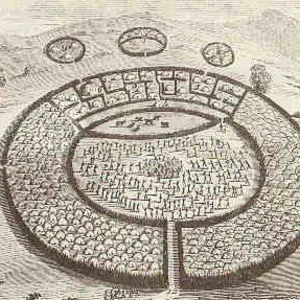
Mkabayi lived in her own umuzi (kraal), a cluster of circular mud-and-thatch huts arranged around a central cattle enclosure called the isibaya. Her main hut, the largest, was decorated with finely woven mats. Mkabayi's kraal had its own attendants, guards, and dependents — a mark of her standing as an autonomous regional chief.
Historical Timeline
Period Vocabulary
Visual Style
Peinture documentaire aux tonalités chaudes de terre et d'ocre, représentant Mkabayi dans sa dignité royale avec ses parures de perles aux motifs géométriques zoulou, dans le cadre d'un grand kraal royal du KwaZulu-Natal.
Sound Ambience
Les sons du kraal royal zoulou au petit matin : bétail, pilonnage du sorgho, feu de conseil, voix des anciens et ululations des femmes rythment la journée politique de Mkabayi.
Liens externes & ressources
Références
Œuvres
Soutien décisif à l'accession de Shaka au trône zoulou
vers 1816
Gouvernement du régiment Qulusi
vers 1816-1843
Rôle de médiatrice lors de la succession de Dingane
1828
Préservation et transmission de la tradition orale royale zouloue
tout au long de sa vie (vers 1750-1843)