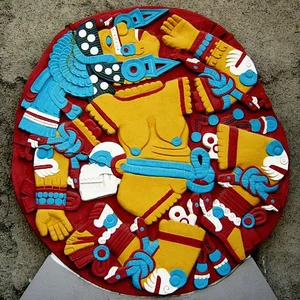

Coyolxauhqui is a lunar deity of Aztec mythology, daughter of the goddess Coatlicue and sister of the solar god Huitzilopochtli. According to the myth, she was beheaded and dismembered by her brother atop Mount Coatepec, becoming the Moon.
Coyolxauhqui
Coyolxauhqui
6 min read
Frequently asked questions
Key Facts
- Aztec lunar goddess, daughter of Coatlicue and sister of the Centzon Huitznahua (the 400 Stars of the South)
- Beheaded and dismembered by her brother Huitzilopochtli at Mount Coatepec according to the founding myth
- A circular monolith depicting her dismembered body was discovered in 1978 at the foot of the Templo Mayor of Tenochtitlan (Mexico City)
- Her cult is attested in the Aztec Empire up until the Spanish conquest of 1521
- Her depiction symbolizes the daily victory of the sun (Huitzilopochtli) over the moon and the stars
Works & Achievements
Masterpiece of Aztec sculpture depicting the dismembered goddess; one of the most famous images in Mesoamerican art.
Monumental sculpture of the goddess's face, adorned with bells, held at the Museo Nacional de Antropología in Mexico City.
The most complete written version of the birth of Huitzilopochtli and the dismemberment of Coyolxauhqui, gathered by Sahagún.
A set of ritual offerings placed around the disk, bearing witness to the cult devoted to the victorious Huitzilopochtli.
Annual ceremony celebrating the birth and victory of Huitzilopochtli, which reenacted the battle against Coyolxauhqui and her brothers.
Anecdotes
The myth of Coyolxauhqui tells how she sought to kill her mother Coatlicue, who had become miraculously pregnant from a ball of feathers. But the unborn child, Huitzilopochtli, sprang from his mother's womb already grown and fully armed to defend her, and cut off his sister's head.
The name Coyolxauhqui means in Nahuatl “she who is adorned with bells” or “she whose cheeks are decorated with little bells,” because the myth describes her with golden bells on her cheeks. On her sculpture, these bells can still be seen carved near her face.
In 1978, workers from Mexico City's electric company digging in the historic center accidentally came upon an immense carved stone disk depicting the dismembered Coyolxauhqui. This chance discovery set off the great excavations of the Templo Mayor, the main temple of the Aztecs.
The disk of Coyolxauhqui was placed at the foot of the staircase of Huitzilopochtli's temple: the bodies of sacrificial victims, thrown from the summit, would roll down to the stone, symbolically re-enacting the dismemberment of the defeated goddess.
According to the Aztecs, the battle between Huitzilopochtli (the Sun) and Coyolxauhqui (the Moon) surrounded by her 400 brothers (the stars, the Centzon Huitznahua) is replayed every day: the rising of the Sun drives the Moon and the stars from the sky, just as the god drove off and defeated his sister.
Primary Sources
And at once [Huitzilopochtli] pierced Coyolxauhqui, then cut off her head, which remained there, on the slope of Coatepetl; her body rolled to the bottom, breaking into pieces, her arms, her legs, her body each falling on its own side.
Account of the birth of Huitzilopochtli on Mount Coatepec and of the confrontation against his brothers and sister led against their mother Coatlicue.
Nahuatl compilation of the deeds of Huitzilopochtli, tutelary god of the Mexica, and of the origin of their people, mentioning the defeat of Coyolxauhqui.
Key Places
Mythical place near Tula where Huitzilopochtli was born and where he beheaded Coyolxauhqui. The Templo Mayor is its symbolic reproduction.
The great twin temple of Mexico-Tenochtitlan; the shrine of Huitzilopochtli reproduced the Coatepec, with the disk of Coyolxauhqui at its foot.
Museum located on the archaeological site where the Coyolxauhqui monolith, discovered in 1978, is preserved and displayed.
Capital of the Aztec empire, built on Lake Texcoco, center of the cult of Huitzilopochtli and site of the great festivals tied to the myth.
Typical Objects

Golden bells that the goddess wears on her cheeks, the source of her name “she who is adorned with bells.” They are engraved on her sculpted representations.

An immense andesite stone disc over three meters across depicting the beheaded and dismembered goddess, carved in bas-relief. It was placed at the foot of the temple of Huitzilopochtli.

On the monolith, the goddess wears a skull ornament and a feather headdress tied to the nocturnal and lunar world. These adornments mark out the defeated and dismembered deities.

At Coyolxauhqui's waist is a belt formed by a two-headed serpent, an attribute common to Aztec earth and lunar deities. The serpent evokes blood and telluric power.

The mythical fire weapon with which Huitzilopochtli struck down and beheaded Coyolxauhqui atop Coatepec. It symbolizes the solar ray triumphant over darkness.

A stone vessel intended to receive the blood and hearts of the sacrifices offered to Huitzilopochtli. The rite at the Templo Mayor reenacted the god's victory over Coyolxauhqui.
School Curriculum
Vocabulary & Tags
Key Vocabulary
Tags
Daily Life
Morning
A mythological figure, Coyolxauhqui has no human daily routine. In the Aztec narrative, dawn corresponds to her defeat: each morning, the rising of the Sun-Huitzilopochtli drives the Moon and stars from the sky, reenacting her dismemberment.
Afternoon
Full daylight belongs to the triumphant Sun. The defeated moon goddess remains invisible while her brother travels across the sky, an image of the cosmic order restored by the Aztecs.
Evening
At dusk, the Moon reappears: according to one reading of the myth, Coyolxauhqui is reborn each night to once again lead her 400 star brothers against the Sun, in an eternally renewed battle.
Food
The myth attributes no diet to the goddess. The Aztecs, however, fed her symbolically through offerings of blood and hearts from the sacrifices laid at the foot of her disk.
Clothing
Sculptures depict her adorned with divine ornaments: golden bells on her cheeks, a feather headdress, ear ornaments, a serpent belt and small bells, attributes of the nocturnal and lunar deities.
Housing
Her “domain” is the night sky and the mythical Mount Coatepec. Within the city, her place of worship is the foot of the Templo Mayor, where her image guarded the staircase of Huitzilopochtli's temple.
Historical Timeline
Period Vocabulary
Liens externes & ressources
Références
Œuvres
Monolithe de Coyolxauhqui du Templo Mayor
vers 1469-1481
Tête de Coyolxauhqui en pierre verte (diorite)
XVe-XVIe siècle
Récit du mythe dans le Codex Florentin
vers 1577
Reliefs et offrandes du Templo Mayor
XVe-XVIe siècle
Fête de Panquetzaliztli
Époque mexica