 flip
flipKandaulos from the Table of Sardis
Kandaulos from the Table of Sardis
Why this dish? The kandaulos is THE dish that Greek authors attribute to the Lydians and their taste for luxury: it even bears the name of a Lydian king, Kandaules. At the table of a king as lavish as Croesus, this opulent sauce of meat, bread, and cheese embodied the tryphè of Sardis.
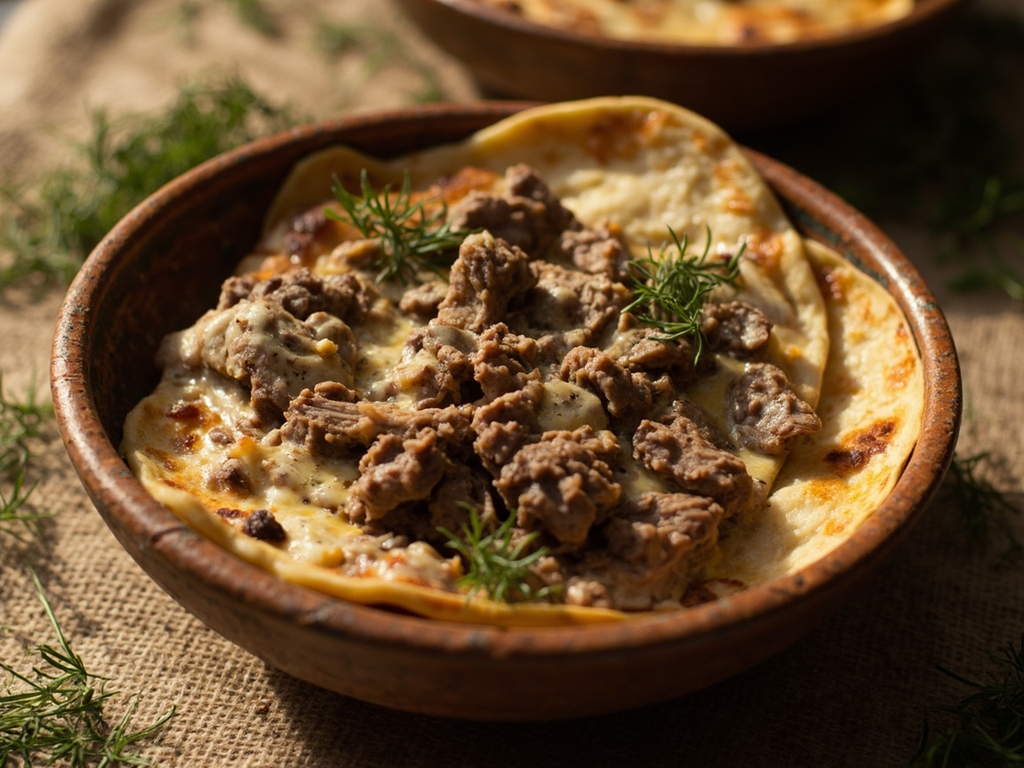
A creamy and filling preparation: boiled shredded meat, bound with breadcrumbs, grated cheese, and a broth perfumed with dill. More than a stew, a royal "relish" spread on bread.
Approach my table, traveler, and fear not abundance: at Sardis, we do not serve scarcity. Here is the kandaulos, this dish my cooks mount as one builds a treasure — tender meat undone at the fingertips, bread reduced to rain, Phrygian cheese and broth where dill sings. I once shared it with an Athenian named Solon, thinking to dazzle him with my gold; he taught me that no man should be called happy before his end. Eat, then, and remember his lesson better than I did.
- •Boiled meat (mutton or game) — a generous portion, shredded (heart of the dish)
- •Stale wheat bread — a few handfuls of crumbs (binder)
- •Fresh sheep cheese (Phrygian type) — generously grated (richness, umami)
- •Meat cooking broth — as needed for desired creaminess (liquid)
- •Fresh dill — one bunch (signature flavor)
- •Salt — to taste (seasoning)
Kandaulos from the Table of Sardis
A creamy and filling preparation: boiled shredded meat, bound with breadcrumbs, grated cheese, and a broth perfumed with dill. More than a stew, a royal "relish" spread on bread.
Why this dish? The kandaulos is THE dish that Greek authors attribute to the Lydians and their taste for luxury: it even bears the name of a Lydian king, Kandaules. At the table of a king as lavish as Croesus, this opulent sauce of meat, bread, and cheese embodied the tryphè of Sardis.
Approach my table, traveler, and fear not abundance: at Sardis, we do not serve scarcity. Here is the kandaulos, this dish my cooks mount as one builds a treasure — tender meat undone at the fingertips, bread reduced to rain, Phrygian cheese and broth where dill sings. I once shared it with an Athenian named Solon, thinking to dazzle him with my gold; he taught me that no man should be called happy before his end. Eat, then, and remember his lesson better than I did.
Ingredients (period version)
- Boiled meat (mutton or game) — a generous portion, shredded (heart of the dish)
- Stale wheat bread — a few handfuls of crumbs (binder)
- Fresh sheep cheese (Phrygian type) — generously grated (richness, umami)
- Meat cooking broth — as needed for desired creaminess (liquid)
- Fresh dill — one bunch (signature flavor)
- Salt — to taste (seasoning)
Ingredients
- Lamb shoulder — 500 g (meat to braise then shred)
- Stale country bread crumbs — 100 g (binder)
- Fresh sheep cheese (or sheep ricotta) — 120 g (richness)
- Lamb cooking broth — 30 cl (to bind the sauce)
- Fresh chopped dill — 4 tbsp (flavor)
- Salt — to taste (seasoning)
Method
- Simmer the lamb shoulder in salted water for 1.5 hours until it falls apart; reserve the broth.
- Shred the meat with a fork, removing hard fat.
- In a saucepan, soak the breadcrumbs with a ladle of hot broth to make a cream.
- Add the shredded meat and sheep cheese, mix over low heat until it melts into a thick, coating sauce.
- Thin with broth if needed, season with salt, then stir in the dill off the heat.
- Serve warm, spread on grilled bread or in a bowl, with a drizzle of broth on top.
How it was made : Athenaeus of Naucratis, in his Deipnosophists, reports that kandaulos (or kandylos) was a Lydian invention and gives several versions according to cited cooks: all combine boiled meat, bread, cheese, and a fatty base, sometimes enriched with dill or cumin. It was a symbol of the costly refinement attributed to Lydia.
The contemporary twist : Served as a generous spread on thick grilled bread, sprinkled with dill and a drizzle of oil: a "royal rillette" to share as an appetizer.
Sources : Athenaeus of Naucratis, Deipnosophists, book XII (on Lydian luxury) and passages on kandaulos · Herodotus, Histories, book I (Croesus, Lydia, Solon)
Croesus of Lydia · Charactorium