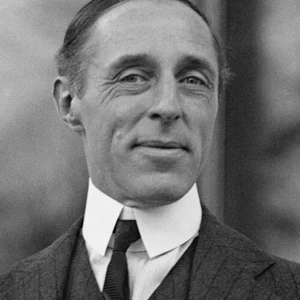

D. W. Griffith (1875-1948) was an American director regarded as one of the fathers of narrative film language. He popularized editing, the close-up, and cross-cutting, but remains a controversial figure because of the racism of his film “The Birth of a Nation” (1915).
D. W. Griffith(1875 — 1948)
D. W. Griffith
États-Unis
7 min read
Frequently asked questions
Key Facts
- 1908: directs his first film, “The Adventures of Dollie,” for the Biograph Company
- 1915: releases “The Birth of a Nation,” a huge success but a deeply racist work glorifying the Ku Klux Klan
- 1916: directs “Intolerance,” an ambitious film interweaving four historical eras
- 1919: co-founds the studio United Artists with Chaplin, Pickford, and Fairbanks
- 1948: dies in Hollywood, largely forgotten by the industry he helped found
Works & Achievements
A short film shot in the slums of New York, often cited as one of the first gangster films in history.
One of his first feature films, adapted from a biblical story, heralding his taste for grand-scale historical epics.
A foundational film for its narrative mastery and editing, but deeply racist: it glorifies the Ku Klux Klan and remains the most controversial work in the history of cinema.
A blockbuster interweaving four eras to denounce intolerance across the ages; an ambitious masterpiece and a costly commercial failure.
An intimate drama about the impossible love between an abused young girl and a Chinese immigrant, praised for its delicacy and its cinematography.
A melodrama famous for its spectacular scene on a frozen river, where Lillian Gish drifts on the ice floes toward the waterfall.
A historical epic set during the French Revolution, Griffith's last great popular success.
Anecdotes
Before becoming a filmmaker, Griffith dreamed of being a writer and playwright. A touring stage actor earning a miserable living, he ended up selling screenplays to the **Biograph** company, then stepped behind the camera almost out of financial necessity in **1908**. He thus directed hundreds of short films before making his great features.
On **February 18, 1915**, *The Birth of a Nation* was screened at the White House before President **Woodrow Wilson**: it was the first film in history shown in the American presidential residence. The film, a huge commercial success, immediately triggered violent protests from the NAACP because of its racist vision of history and its glorification of the Ku Klux Klan.
For *Intolerance* (**1916**), Griffith had a gigantic Babylonian set built in **Hollywood**, one of the largest ever constructed, bristling with columns and sculpted elephants. The film, of insane ambition, was a resounding commercial failure that swallowed up his fortune, and the immense set remained standing in the Hollywood landscape for years.
In **1919**, Griffith founded the company **United Artists** together with the stars **Charlie Chaplin**, **Mary Pickford** and **Douglas Fairbanks**, in order to control the production and distribution of their own films themselves. A studio executive reportedly quipped: “the lunatics have taken over the asylum.”
Griffith often shot without a written script: he kept the plot in his head and directed his actors through a megaphone, experimenting with editing and framing as the shoot went along. Awarded an honorary Oscar in **1936**, he nevertheless died almost forgotten by the industry in **1948**, in a room at the **Knickerbocker Hotel** in Hollywood.
Primary Sources
The censorship of motion pictures is an intolerance comparable to that which once burned men at the stake for their opinions. The freedom of the filmed word must be protected just as much as the freedom of the press.
This presentation of the terrible events of the Civil War and Reconstruction is not meant to reflect on any race or people of today.
This film is a slanderous attack on Black people, disguised as history; its banning in our cities must be demanded.
Out of the cradle endlessly rocking... thus through the ages run the stories of men, alike yet different.
Key Places
Griffith's birthplace, in the American South, where he grew up in a family steeped in nostalgia for the Confederacy. This environment shaped his idealized vision of the Old South.
A Manhattan production company where Griffith directed hundreds of short films between 1908 and 1913. There he developed his cinematic language by experimenting with framing and editing.
The first capital of American cinema, where many studios shot their films on location before the rise of Hollywood. Griffith worked there with Biograph.
The center of the American film industry, where Griffith built the gigantic Babylonian set for *Intolerance*. It is also where he died in 1948.
An independent studio that Griffith set up on the New York State coast in the early 1920s. There he produced films such as *Way Down East*.
Typical Objects

A wood and metal camera operated by hand, which exposed the images onto perforated film stock. The shooting speed depended on how fast the operator turned the crank.

A metal cone used to amplify the director's voice to direct actors and extras across vast sets. Griffith used it heavily, particularly during crowd scenes.

A printed text plate filmed and inserted between shots to convey the dialogue or narration of a silent film. Often hand-lettered and decorated, it guided the viewer's understanding.

A roll of cellulose nitrate film onto which the images were exposed; a feature film was measured by its number of reels. Highly flammable, this medium caused many films of the era to be lost forever.

A workbench where strips of film were cut and spliced back together by hand to build the story. It was here that Griffith popularized cross-cutting between two simultaneous scenes.

An instrument played live in the auditorium during the silent screening to heighten the emotion of the scenes. Larger theaters sometimes had an orchestra or a cinema organ.
School Curriculum
Vocabulary & Tags
Key Vocabulary
Tags
Daily Life
Morning
On a film set, the day began early to take advantage of natural light, essential for the low-sensitivity film stock of the era. Griffith arrived on the set, organized the day's scenes, and reviewed his actors, often without a written script, keeping the plot in his head.
Afternoon
The afternoon was spent filming outdoors or under glass-roofed stages open to the sky, scene after scene, sometimes repeating many takes. For the vast crowd scenes, Griffith directed hundreds of extras through a megaphone.
Evening
In the evening, he watched the “rushes” (footage shot during the day) and worked on the editing, cutting and splicing the film to build the story. It was in this assembly work that he perfected cross-cutting between two actions.
Food
A well-off director at the peak of his career, Griffith ate in the American style of the time: meats, eggs, coffee, and dishes from the hotels and restaurants he frequented. Living for a long time in hotels, he often took his meals away from home.
Clothing
On set, he wore a suit, a collared shirt, and a hat, sometimes a wide-brimmed hat to protect himself from the Californian sun. His polished appearance contrasted with the bustle of the shoot.
Housing
Griffith spent much of his life in hotels and temporary residences, following his shoots between New York, New Jersey, and California. He died, in fact, in a hotel room in Hollywood in 1948.
Historical Timeline
Period Vocabulary
Liens externes & ressources
Références
Œuvres
Intolérance (Intolerance)
1916
Le Lys brisé (Broken Blossoms)
1919
À travers l'orage (Way Down East)
1920