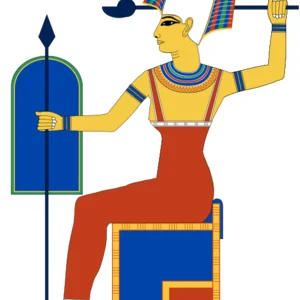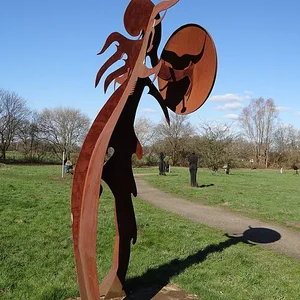

The Dagda is one of the great deities of Irish Celtic mythology, father and chief of the Tuatha Dé Danann. God of fertility, wisdom, and the arts, he owns an inexhaustible cauldron of abundance and a club with magical powers.
Dagda
Dagda
10 min read
Frequently asked questions
Key Facts
- Chief of the Tuatha Dé Danann, the divine people of Irish mythology
- Owns the Cauldron of the Dagda, which feeds all without ever running dry
- His club (*lorg mór*) can kill the living with one end and resurrect the dead with the other
- His magic harp commands the seasons and lulls enemies to sleep
- Father of many Irish deities, including Brigid and Aengus
Works & Achievements
As 'Father of All' (Eochaid Ollathair), the Dagda wielded spiritual and martial sovereignty over the Irish gods. He organized war councils, assigned roles among the deities, and upheld the cosmic order of mythological Ireland.
A decisive contribution to the defeat of the Fomorians, primordial enemies symbolizing chaos and barrenness. Through his club, his cunning, and his alliance with the Morrigan, the Dagda was one of the key architects of the Irish gods' survival.
A feat recounted in the Cath Maige Tuired: alone or accompanied by Lugh and Ogma, the Dagda entered the Fomorians' feasting hall, called his harp by name, and caused it to fly back to him — after it had slain nine enemy warriors.
Through the three melodies of his harp Uaithne, the Dagda was said to regulate the turning of the seasons: his playing maintained the natural order of the world, alternating summer, winter, and the transitional periods in harmony with cosmic cycles.
Father of many major deities: Brigid (goddess of poetry, smithcraft, and healing), Aengus Mac Óg (god of love and youth), Bodb Derg, and Cermait. His lineage shapes the entire Irish pantheon.
Anecdotes
Before the great battle against the Fomorians, they imposed a humiliating ordeal on the Dagda: they dug an enormous pit and poured into it a gigantic porridge mixed with whole goats, sheep, and pigs. The Dagda had to eat everything on pain of death. He scraped the pit clean with his great ladle, then fell asleep with his belly so distended that he could barely walk — but he had survived, and his honor was intact.
The Dagda owned a magic harp named Uaithne, capable of playing by itself and of controlling the emotions of men as well as the cycle of the seasons. During the Second Battle of Mag Tuired, the Fomorians stole the instrument. The Dagda found it in their feasting hall and called out to it aloud; the harp leapt from the wall, killed nine enemy warriors as it went, then returned to its master — before he played the three sacred airs: the lament, the laughter, and the sleep.
On the night before the Second Battle of Mag Tuired, the Dagda met the Morrigan, goddess of war and fate, at the ford of the river Unius. Their ritual union at the river sealed a divine alliance: in exchange, the Morrigan promised to weaken the Fomorian king, Indech, by stealing part of his blood and vitality before the battle. This mystical alliance contributed to the victory of the Tuatha Dé Danann.
The Dagda was tricked by his own son, Aengus Mac Óg, who asked his permission to stay at Brú na Bóinne “a night and a day.” As in Old Irish this phrasing means eternity (since all time is made up of nights and days), Aengus permanently claimed the sacred mound. The Dagda, outwitted by his son's cunning, had to accept the loss of his home and settle elsewhere in the underground realm of the Sídhe.
The Dagda was known for wearing coarse, too-short clothes that left his buttocks exposed, and for dragging a club so colossal it left a deep furrow in the ground — like a ditch dug by eight men. With the living end of this club, he could kill nine warriors in a single blow; with the dead end, he could bring the dead back to life. This contrast between his buffoonish appearance and his absolute power made him at once a comic and terrifying figure in Irish tales.
Primary Sources
The Dagda went to the camp of the Fomorians… They dug a hole the size of a house and poured eighty pints of milk into it along with porridge… He ate it with his ladle, so large that two people could have lain down and slept in it.
The Dagda, son of Elatha, king of the Tuatha Dé Danann, was surnamed Eochaid Ollathair, 'the Father of All'. He was great in wisdom and great in power, and his cauldron never let anyone leave unsatisfied.
Aengus Mac Óg said to his father the Dagda: 'Grant me the dwelling of Brú na Bóinne for a night and a day.' The Dagda granted him this. Then Aengus said: 'Night and day contain all of time, and so you have given it to me forever.'
The Dagda's harp, Uaithne, played by itself the three strains: the *gol-traige* that made people weep, the *gen-traige* that made them laugh, and the *súan-traige* that put all who heard it to sleep.
It is said that the Dagda had his *sídhe* beneath Cnoc Bánne, and that from there he governed the affairs of the Irish gods after the Tuatha Dé Danann had yielded the surface of the island to the sons of Míl.
Key Places
A Neolithic burial mound in County Meath, identified in Irish texts as the Dagda's original home before Aengus Mac Óg tricked him out of it. This astronomical monument (aligned with the winter solstice) was seen as a gateway to the world of the *sídhe*.
The site of the two great mythological battles of the Tuatha Dé Danann — first against the Fir Bolg, then against the Fomorians. It was here that the Dagda unleashed his full warrior might and the fate of mythological Ireland was decided.
The river where the ritual encounter between the Dagda and the Morrigan took place on the eve of the Second Battle of Mag Tuired. This union at the ford symbolizes the alliance between fertility (the Dagda) and prophetic war (the Morrigan).
The symbolic seat of supreme sovereignty in both mythological and historical Ireland, associated with the Stone of Fál (another treasure of the Tuatha Dé Danann) and the assemblies of the gods. The Dagda, as chief of the Tuatha Dé Danann, held his court here.
The Dagda's underground dwelling after the Milesian conquest — one of the many *sídhe* (magical mounds) into which the Tuatha Dé Danann withdrew beneath the earth to continue their existence in a parallel world invisible to ordinary humans.
Typical Objects

The Dagda's colossal weapon, so heavy it left a furrow in the earth as it was dragged along. Its living end killed nine men instantly with a single blow, while its dead end could revive warriors who had fallen in battle.

One of the Four Treasures of the Tuatha Dé Danann, brought from the mythical city of Murias. Inexhaustible, it fed all who came to it and never sent anyone away hungry — a symbol of divine abundance and the generosity of a sovereign.

The Dagda's living harp, which could play by itself and obeyed his voice. It produced three sacred strains: the lament (*gol-traige*) that made people weep, the laughter (*gen-traige*) that brought joy, and the lullaby (*súan-traige*) that lulled listeners to sleep — thus controlling the emotions of gods and men alike.

The enormous ladle with which the Dagda ate his legendary porridge. According to Irish texts, it was large enough for two people to lie side by side inside it — a sign of this god's monstrous appetite and primordial nature.

The Dagda owned a magical pig that was always alive on one side and always roasted on the other, symbolizing his power over the cycles of life and death, as well as the permanent abundance that characterizes the world of the Irish gods.

The Dagda's modest, too-short garment, deliberately at odds with his divine power. This recurring comic detail in Irish texts cast him as a buffoonish god as much as a supreme father — an ambivalent figure typical of Celtic mythologies.
School Curriculum
Vocabulary & Tags
Key Vocabulary
Daily Life
Morning
At dawn, the Dagda roamed the lands of mythological Ireland to watch over the fertility of fields and herds, for his presence guaranteed the fecundity of the earth. He convened the assemblies of the Tuatha Dé Danann to decide on divine matters, presiding as sovereign in the midst of his peers.
Afternoon
The Dagda's afternoons were devoted to the practice of druidic magic and combat training. He wielded his colossal club to maintain his martial prowess, and oversaw the construction and agricultural work that the Irish gods sometimes carried out as heavenly labourers.
Evening
In the evening, the Dagda presided over great feasts within his sídhe, where his inexhaustible cauldron fed all the guests. His harp Uaithne played the airs of the seasons, and he listened to poets celebrating the deeds of the Tuatha Dé Danann before the súan-traige gently lulled the assembly to sleep.
Food
The Dagda's appetite was legendary and immoderately human for a god. He consumed vast quantities of porridge (meat porridge), roasted pork, and ale. His cauldron provided a permanent abundance, and eating heartily was for him an expression of his vital power as much as a comic trait of his personality.
Clothing
The Dagda was described in Irish texts wearing a short, coarse brown tunic that left his buttocks exposed — a deliberately rustic and burlesque outfit for a king of the gods. This intentionally humble attire contrasted with his giant club and immense power, highlighting the paradoxical nature of this deity as both supreme father and cosmic buffoon.
Housing
The Dagda initially resided at Brú na Bóinne (Newgrange), the great Neolithic mound of the Boyne Valley, perceived as a gateway between the world of the living and the underground world of the gods. After being dispossessed of it by his son Aengus, he established his home in another sídhe, a luminous and timeless underground world where the Irish deities lived away from human eyes.
Historical Timeline
Period Vocabulary
Liens externes & ressources
Références
Œuvres
Direction des Tuatha Dé Danann (en tant qu'Ollathair)
Ère mythologique
Victoire à la Deuxième Bataille de Mag Tuired
Ère mythologique
Récupération de la harpe Uaithne
Ère mythologique
Régulation des saisons par la musique
Ère mythologique
Paternité des grandes divinités irlandaises
Ère mythologique