 flip
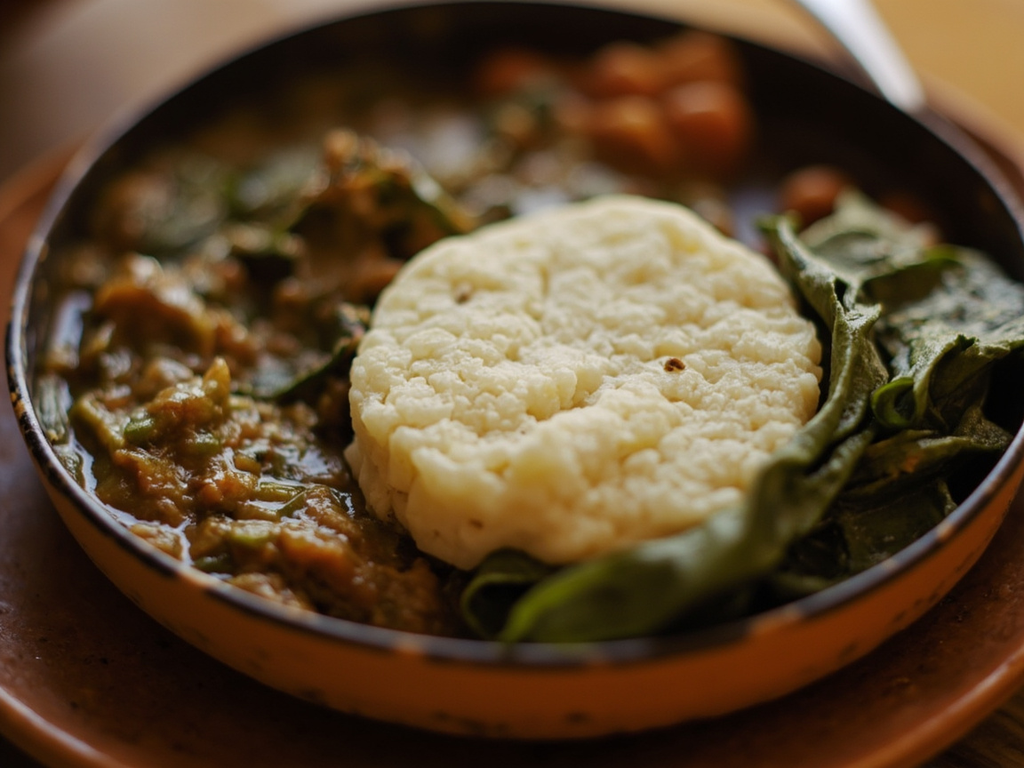
flipInsima ne ifisashi (nshima with peanut sauce leaves)
Insima ne ifisashi (nshima with peanut sauce leaves)
Why this dish? This is the everyday dish in Zambia, the one from Lusaka where Dambisa Moyo grew up before Oxford and Harvard. Ifisashi — green leaves bound with peanut paste — is the popular munani par excellence, the nourishing, cheap family meal known to every Zambian household.
A smooth, firm white maize paste, rolled into balls to scoop up green leaves simmered in a thick sauce of pounded groundnuts. Rustic, filling, deeply Zambian.
You may think Africa only eats what it is given? Think again. At home in Lusaka, we plant, we pound, we cook. Let me show you how my family prepared ifisashi: we roast groundnuts, crush them to powder, and toss them onto green leaves that melt slowly. You shape the nshima with a firm hand, dip it into the sauce, and you understand that an economy always begins with what a people can grow and cook themselves.
- •White maize meal (mealie-meal) — as needed (base, the nshima)
- •Green leaves (chibwabwa/pumpkin leaves, or spinach, chard) — one large bunch (the munani)
- •Roasted pounded groundnuts — a good handful (binder and signature)
- •Onion — one (aromatic base)
- •Tomato — two (sauce)
- •Salt — to taste (seasoning)
Insima ne ifisashi (nshima with peanut sauce leaves)
A smooth, firm white maize paste, rolled into balls to scoop up green leaves simmered in a thick sauce of pounded groundnuts. Rustic, filling, deeply Zambian.
Why this dish? This is the everyday dish in Zambia, the one from Lusaka where Dambisa Moyo grew up before Oxford and Harvard. Ifisashi — green leaves bound with peanut paste — is the popular munani par excellence, the nourishing, cheap family meal known to every Zambian household.
You may think Africa only eats what it is given? Think again. At home in Lusaka, we plant, we pound, we cook. Let me show you how my family prepared ifisashi: we roast groundnuts, crush them to powder, and toss them onto green leaves that melt slowly. You shape the nshima with a firm hand, dip it into the sauce, and you understand that an economy always begins with what a people can grow and cook themselves.
Ingredients (period version)
- White maize meal (mealie-meal) — as needed (base, the nshima)
- Green leaves (chibwabwa/pumpkin leaves, or spinach, chard) — one large bunch (the munani)
- Roasted pounded groundnuts — a good handful (binder and signature)
- Onion — one (aromatic base)
- Tomato — two (sauce)
- Salt — to taste (seasoning)
Ingredients
- Fine white maize meal (mealie-meal or fine white polenta) — 300 g (nshima)
- Water — about 1 L (nshima cooking)
- Spinach or chard — 500 g (leaves)
- Unsweetened peanut butter (or blended roasted groundnuts) — 4 tbsp (peanut sauce)
- Onion — 1 (aromatic)
- Tomatoes — 2 (sauce)
- Salt — 1 tsp (seasoning)
Method
- Wash and chop the green leaves; chop the onion and tomatoes.
- Sweat the onion in a little water or oil, add the tomatoes and let reduce for 5 minutes.
- Add the leaves, a glass of water, salt, and let simmer for 10 minutes.
- Dilute the peanut butter in a ladle of hot water, then stir it into the leaves; let thicken for 5 minutes without stirring vigorously.
- For the nshima: bring water to a boil, gradually pour in half the flour while whisking to make a porridge, cook for 5 minutes.
- Add the remaining flour, working with a wooden spoon until a smooth, firm dough that pulls away from the pot; cook another 5 minutes.
- Serve the nshima in mounds next to the ifisashi; eat with your hands, pinching the leaves with the paste.
How it was made : Before maize (introduced to Africa after 1492), the base paste was made from millet and sorghum — the traditional ubwali. White maize became dominant in the 20th century, and nshima became the national emblem. Leaves picked from the garden and groundnuts pounded in a mortar were the most common munani in households.
The contemporary twist : Serve the nshima molded into a neat dome using a ring, the ifisashi as a green mirror, and a few crushed roasted groundnuts on top, in a pan-African bistro style.
Dambisa Moyo · Charactorium