 flip
flipCauldron-Boiled Mutton with Roots and Barley
Cauldron-Boiled Mutton with Roots and Barley
Why this dish? The Cauldron of the Dagda — a typical object linked to Dana and the Tuatha Dé Danann — is said never to let a hungry guest leave unsatisfied. At the Samhain feasts given in honor of the mother goddess, meats from the herd were boiled in this great cauldron with the harvest grain: the symbolic dish of the abundance she bestows.
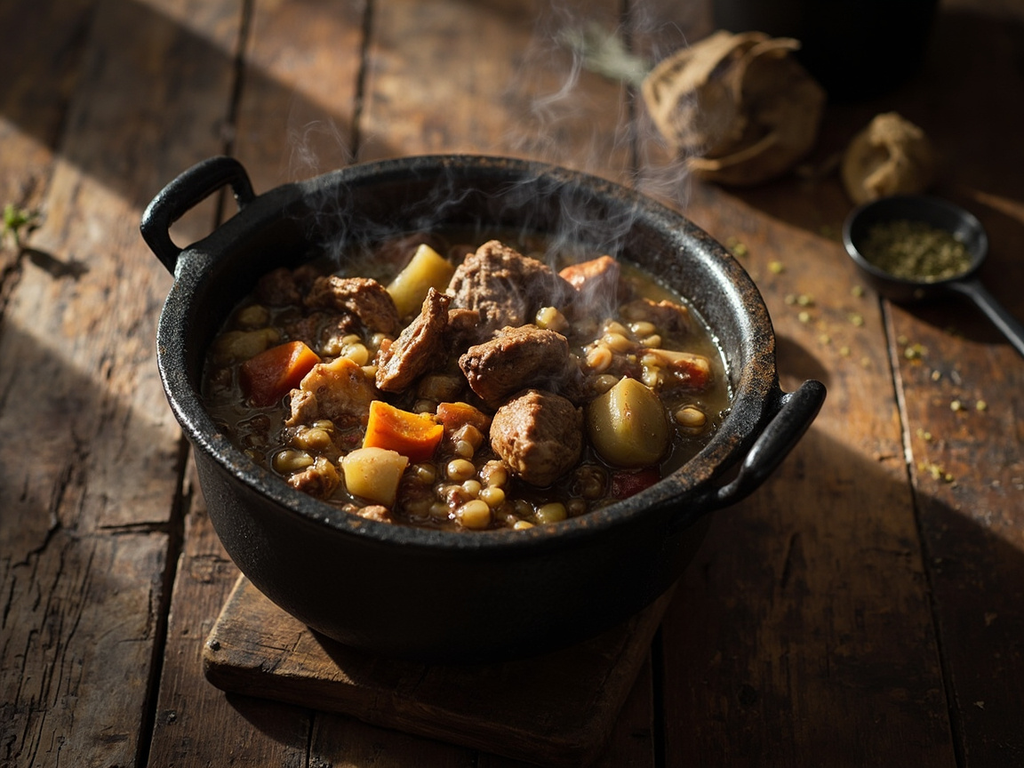
A long-simmered mutton and root stew thickened with barley, turning into a hearty pottage. It is the heart of the feast: a single pot from which each serves according to rank.
Approach the fire, child of the earth. This cauldron never empties as long as a mouth calls: I plunge into it the flesh of the ram fattened on my hills, the barley of the harvest, and the roots pulled from my black soil. Let the broth sing for half a day, without haste — haste is the enemy of flavor. When the champion has received his portion, then only do you hold out your bowl, and you will know that I feed my own to the last.
- •Mutton shoulder on the bone — a good piece (meat, broth base)
- •Hulled barley — two handfuls (thickener and starch)
- •Leeks and wild onions — a bunch (aromatics)
- •Turnips and parsnips — according to the harvest (roots)
- •Ramsons (wild garlic) — a few leaves (flavoring)
- •Sea salt — a pinch (seasoning)
Cauldron-Boiled Mutton with Roots and Barley
A long-simmered mutton and root stew thickened with barley, turning into a hearty pottage. It is the heart of the feast: a single pot from which each serves according to rank.
Why this dish? The Cauldron of the Dagda — a typical object linked to Dana and the Tuatha Dé Danann — is said never to let a hungry guest leave unsatisfied. At the Samhain feasts given in honor of the mother goddess, meats from the herd were boiled in this great cauldron with the harvest grain: the symbolic dish of the abundance she bestows.
Approach the fire, child of the earth. This cauldron never empties as long as a mouth calls: I plunge into it the flesh of the ram fattened on my hills, the barley of the harvest, and the roots pulled from my black soil. Let the broth sing for half a day, without haste — haste is the enemy of flavor. When the champion has received his portion, then only do you hold out your bowl, and you will know that I feed my own to the last.
Ingredients (period version)
- Mutton shoulder on the bone — a good piece (meat, broth base)
- Hulled barley — two handfuls (thickener and starch)
- Leeks and wild onions — a bunch (aromatics)
- Turnips and parsnips — according to the harvest (roots)
- Ramsons (wild garlic) — a few leaves (flavoring)
- Sea salt — a pinch (seasoning)
Ingredients
- Mutton or lamb shoulder on the bone — 1 kg (meat, broth base)
- Pearl barley — 120 g (thickener and starch)
- Leeks — 2 (aromatics)
- Onion — 1 large (aromatics)
- Turnips — 3 (roots)
- Parsnips — 2 (roots)
- Ramsons (or 2 cloves of garlic) — 1 handful (flavoring)
- Salt — 1 tsp (seasoning)
Method
- Put the mutton in a large pot, cover with cold water, bring to a simmer and skim.
- Add the rinsed pearl barley, lightly salt, and simmer covered for 1 hour 30 minutes.
- Meanwhile, cut leeks, onion, turnips and parsnips into large chunks.
- Add the roots and onion, continue cooking for 45 minutes until the meat falls off the bone.
- Remove the bone, shred the meat and return it to the broth.
- Off the heat, stir in the chopped ramsons, adjust salt and serve hot with a ladle.
How it was made : Excavations at sites like Navan Fort show the use of large bronze cauldrons suspended over a central hearth. Boiling water cooking (sometimes in a fáulacht fiadh, a pit filled with water heated by hot stones) dominated for meats; barley was the staple grain before oats.
The contemporary twist : Presented in a black cast-iron pot placed at the center of the table with a single ladle: it recreates the gesture of the shared cauldron.
Dana · Charactorium