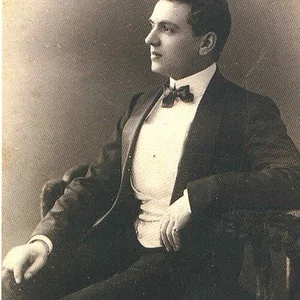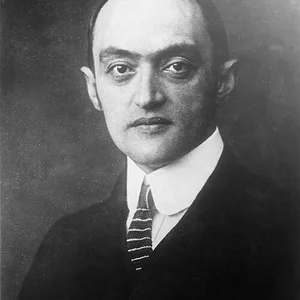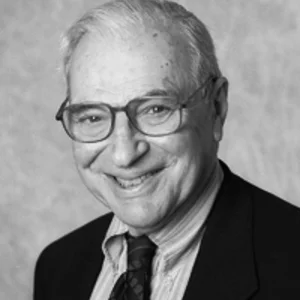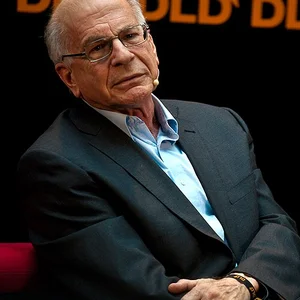

Daniel Kahneman was an Israeli-American psychologist and economist, a pioneer of behavioral economics. His work on cognitive biases and decision-making under uncertainty earned him the Nobel Prize in Economics in 2002.
Daniel Kahneman(1934 — 2024)
Daniel Kahneman
États-Unis, Israël
6 min read
Frequently asked questions
Famous Quotes
« Nothing in life is as important as you think it is while you are thinking about it.»
Key Facts
- Born in 1934 in Tel Aviv, died in 2024
- Developed the “prospect theory” with Amos Tversky in 1979
- Received the Nobel Prize in Economics in 2002 for his work integrating psychology into economic science
- Published “Thinking, Fast and Slow” in 2011
- Considered one of the founders of behavioral economics
Works & Achievements
A foundational article, co-authored with Tversky, demonstrating that the human mind relies on shortcuts (heuristics) that are a source of systematic errors.
A model of decision-making under risk that earned him the Nobel Prize; it shows that we fear a loss more than we value an equivalent gain.
Experimental work demonstrating that individuals overvalue what they already own, challenging classical economic rationality.
An award honoring the integration of insights from psychology into economic science, especially regarding judgment and decision-making.
A global bestseller synthesizing his life's research around two modes of thought, one fast and intuitive, the other slow and deliberate.
An essay written with Sibony and Sunstein about “noise,” the unwanted variability in human judgments within justice, medicine, or business.
Anecdotes
During the Six-Day War and his service in the Israeli army, the young Kahneman was tasked with evaluating recruits. He discovered that his confident judgments about their future leadership potential had virtually no predictive value: he called this “the illusion of validity,” a realization that shaped his entire career.
As a Jewish child in Paris during the Occupation, Daniel was caught in the street one evening after curfew, his yellow star hidden beneath his sweater. An SS soldier picked him up in his arms, showed him a photo of his own son, and gave him some money. This encounter fed his conviction that people are “infinitely complicated and interesting.”
His collaboration with Amos Tversky was so seamless that they wrote their papers sitting side by side, one sentence at a time, and flipped a coin to decide the order of the authors' names. Kahneman said that together they formed a mind better than either of them alone.
When he received the Nobel Prize in Economics in 2002, Kahneman pointed out that he had never taken a single economics course in his life: he was a psychologist. He sadly dedicated his prize to Amos Tversky, who had died in 1996 and could not share it (the Nobel is not awarded posthumously).
Kahneman liked to say that he knew every cognitive bias by heart yet still kept falling for them himself. He compared the mind to an optical illusion: even knowing that two lines are the same length, you cannot help but see them as different.
Primary Sources
People rely on a limited number of heuristic principles which reduce the complex tasks of assessing probabilities to simpler judgmental operations. In general, these heuristics are quite useful, but sometimes they lead to severe and systematic errors.
We present a critique of expected utility theory as a descriptive model of decision making under risk, and develop an alternative model, which we call prospect theory.
System 1 operates automatically and quickly, with little or no effort and no sense of voluntary control. System 2 allocates attention to the effortful mental activities that demand it.
The idea that the human mind is not perfectly rational has always seemed obvious to me. The project of my life has been to understand how people actually judge and decide, not how they ideally should.
Key Places
Kahneman's birthplace, where he was born in 1934 during his mother's stay in Mandatory Palestine. His family normally lived in France at the time.
The city of his childhood, where he experienced the fear and persecution of the Nazi Occupation. These years deeply shaped his view of human nature.
The site of his early research and of his meeting with Amos Tversky in 1969. Their collaboration there laid the foundations of behavioral economics.
He earned his doctorate in psychology here in 1961. His American training in experimental psychology shaped his rigorous method.
He taught psychology here from 1993 and carried out his work on happiness and decision-making. He remained a professor emeritus here until the end of his life.
The site of the Nobel Prize in Economics ceremony in December 2002. Kahneman gave a now-famous lecture there on the two systems of thinking.
Typical Objects

Kahneman and Tversky recorded their thought experiments and their subjects' answers in notebooks. This is where their questionnaires on risk and probability were born.

A central tool of experimental psychology, these series of carefully crafted questions revealed participants' judgment biases. The famous “Linda” problem is one example.

Awarded in 2002 for his work in behavioral economics, it marks the breakthrough of psychology into economic science. Kahneman was the first psychologist to receive it.

His 2011 popular book, sold in millions of copies worldwide. It makes decades of research on the two modes of thinking of the human mind accessible to everyone.

To process the answers of hundreds of subjects, Kahneman relied on computing and statistics. The measurable regularities gave strength to the discoveries about biases.
School Curriculum
Vocabulary & Tags
Key Vocabulary
Tags
Daily Life
Morning
An academic, Kahneman often began his day with reading and writing, the moments when the mind is freshest for the effort-demanding “System 2.” He liked to walk while discussing ideas, a habit inherited from his long strolls with Amos Tversky.
Afternoon
His afternoons were divided between teaching, mentoring students, and designing experiments. He spent hours crafting precise questionnaires, convinced that a good question was worth more than a hasty answer.
Evening
In the evening, he often continued his intellectual exchanges over dinner or on the phone, extending his work into conversation. Curious and skeptical, he kept debating his own theories, ready to call them into question.
Food
A city dweller in an international academic milieu, he ate the ordinary diet of a twentieth-century researcher, with no particular known regimen. For him, meals were above all occasions to talk and think aloud.
Clothing
Kahneman wore the plain, understated attire of a university professor: simple shirts and jackets, with no concern for show. His elegance lay more in his words than in his clothing.
Housing
He lived in apartments and houses in university towns—in Jerusalem, in California, then in Princeton and New York. His living environment reflected that of a mobile intellectual, divided between several continents.
Historical Timeline
Period Vocabulary
Liens externes & ressources
Références
Œuvres
Judgment under Uncertainty: Heuristics and Biases
1974
Théorie des perspectives (Prospect Theory)
1979
Recherches sur l'aversion à la perte et l'effet de dotation
1990
Prix Nobel d'économie
2002
Système 1 / Système 2 : Les deux vitesses de la pensée
2011
Noise: A Flaw in Human Judgment (Bruit)
2021