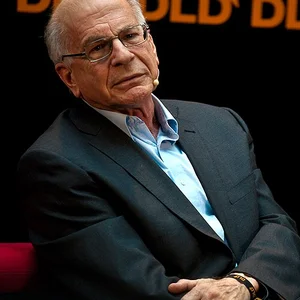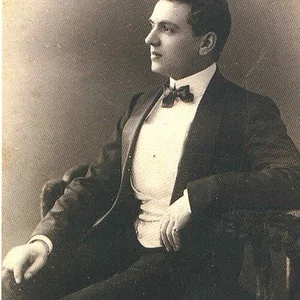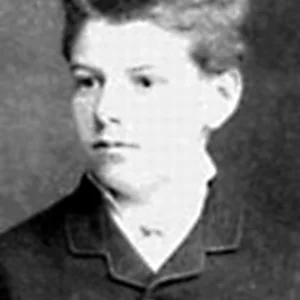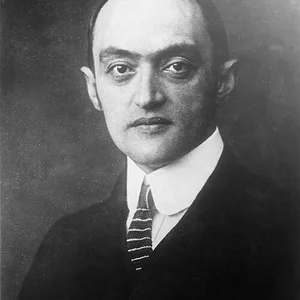

Austrian economist and political scientist, naturalized American, Joseph Schumpeter is one of the major thinkers of 20th-century economics. He is famous for his analyses of innovation, the entrepreneur, and business cycles.
Joseph Schumpeter(1883 — 1950)
Joseph Schumpeter
États-Unis, Autriche, Allemagne, Cisleithanie
7 min read
Frequently asked questions
Key Facts
- Born in 1883 in Triesch (Moravia, then Austria-Hungary).
- Published in 1911 his *Theory of Economic Development*, placing the entrepreneur-innovator at the heart of capitalist dynamics.
- Briefly served as Austria's Minister of Finance in 1919.
- Published in 1942 *Capitalism, Socialism and Democracy*, where he coined the concept of **creative destruction**.
- Professor at Harvard University from 1932 until his death in 1950.
Works & Achievements
Foundational work introducing the concept of the innovator as the driving force of the economy. Schumpeter argues that it is not capital accumulation or population growth, but entrepreneurial innovation that creates economic growth.
Masterful analysis of cycles of expansion and contraction in capitalism. Schumpeter explains how innovations created by entrepreneurs generate periods of overproduction, followed by recurring market adjustments.
Major synthesis in which Schumpeter prophesies the inevitable decline of capitalism due to its very success. The work analyzes the incompatibilities between mass democracy and the functioning of the capitalist system.
Collection of his scientific articles and reflections on the history of economic thought. These essays complete his intellectual project by showing the evolution of his thinking over several decades.
Encyclopedic work in which Schumpeter traces the development of economic thought from Adam Smith to his own time. It is his major contribution to intellectual history, revealing his convictions about what constitutes a true economic science.
Anecdotes
Schumpeter had a surprising mix of passions: a great Austrian horseman, he jokingly said his three ambitions in life were to become the best economist, the best horseman in Austria, and to win the heart of a beautiful woman. He admitted failing in all three areas, which allowed him to keep his humor in the face of personal and academic defeats.
At Harvard in the 1940s, this Austrian professor had remarkable eccentricities: he arrived at class wearing sumptuous ties and impeccable suits, creating a striking contrast with the usual image of the bohemian scholar. His students wondered whether this dandyism was intellectual provocation or simply the mark of an aristocracy of the mind.
In 1919, at just 35, Schumpeter became finance minister of the young Austrian Republic, but his tenure ended in fiasco after only a few months. This brief foray into politics confirmed his calling as a theorist rather than a man of action.
He founded the Econometric Society in 1930, a major institution that professionalized the use of mathematics in economics. This choice transformed economics into a quantifiable scientific discipline, marking a decisive turning point in the history of economic thought.
Primary Sources
"The entrepreneur is the one who carries out new combinations of factors of production. His role is not to discover new economic situations, but to realize them."
"The success of capitalism is the cause of its decline... socialism, by becoming necessary, becomes possible, not as it was in the past, but because capitalism would have created the necessary material and mental conditions."
"Economic cycles are not accidental phenomena but intrinsic manifestations of the capitalist economy based on innovation."
"In equilibrium, there is neither profit nor loss. The entrepreneur makes profits precisely because he breaks this equilibrium through innovation."
Key Places
Schumpeter's birthplace in 1883. This small town in Moravia (now Czech Republic) gave him his Central European roots, shaped by Austro-Hungarian culture and the early stages of regional industrialization.
Cultural and economic capital of the Austro-Hungarian Empire where Schumpeter received his university education and held his first academic posts. Vienna was the heart of early 20th-century Central European economic thought.
University where Schumpeter taught political economy before World War I. This Styrian city was a secondary but important intellectual center of the Austro-Hungarian Empire.
Prestigious university where Schumpeter held a professorship in the 1920s-1930s. Bonn represented the peak of his European career before forced emigration due to the rise of Nazism.
Schumpeter's final and most important academic refuge from 1937. At Harvard, he wrote his most influential works and founded the economic school of thought that still dominates theory today.
City where Schumpeter lived during his American exile, directly observing American capitalism in action and the effects of the Great Depression. New York represented the modern embodiment of the capitalist economy he studied.
Typical Objects

Schumpeter daily documented his observations on markets, businesses, and economic innovations. These notebooks became the raw material for his major theories on cycles and entrepreneurship.

The economist analyzed historical data by drawing charts showing the alternation of expansion and contraction phases. These visual representations were central to his scientific approach to economics.

He regularly read the English economic press to follow businesses, innovations, and capital movements. These newspapers provided him with concrete data to validate his theories.

An essential work tool for writing his articles and major books. Schumpeter was a prolific writer, using typing to transform his thoughts into influential texts.

A distinctive accessory of his Austro-Hungarian elegance, symbolizing his commitment to intellectual rigor and a polished appearance. His Harvard colleagues noticed him for these sophisticated clothing details.

A major personal passion of Schumpeter, horseback riding represented a balance to his intense intellectual work. He saw in the elegance of horsemanship a form of aristocracy compatible with modern economics.

A rich library including the great classics (Adam Smith, David Ricardo, Karl Marx) that he reread and annotated. These books bore the traces of his dialectical reflection between capitalism and socialism.
School Curriculum
Vocabulary & Tags
Key Vocabulary
Tags
Daily Life
Morning
Schumpeter rises early according to Austro-Hungarian tradition, between 6 and 7 a.m. After a thorough wash, he dresses carefully—a three-piece suit, matching silk tie—before having a light breakfast of strong coffee and bread. He devotes the early morning hours to reading economic and financial newspapers.
Afternoon
In the afternoon, Schumpeter teaches his courses at Harvard, where he captivates students with his impressive knowledge and distinctive Austro-Hungarian accent. Between classes, he receives colleagues in his office, discusses economic theory, and writes his major articles. He sets aside time for intellectual correspondence with other economists in Europe and the United States.
Evening
Evenings are devoted to writing, reading manuscripts and academic papers, or horseback riding if conditions permit. Schumpeter dines modestly, often alone in his Cambridge apartment, then retires to work on his writing projects until a relatively late hour.
Food
Classic European diet adapted to America: light breakfast (coffee, bread, jam), substantial lunch with meat and vegetables, lighter dinner. Schumpeter appreciated traditional Viennese cuisine but adapted to American habits. He was temperate, rarely drinking alcohol, prioritizing mental clarity for his work.
Clothing
Daily formal wear: three-piece suit in charcoal gray or black, matching vest, gold pocket watch, silk tie (often brightly colored and sophisticated), over-the-calf socks, impeccably polished shoes. For horseback riding, he wore traditional Austrian riding clothes with leather boots. Bowler hat or felt hat in winter.
Housing
In Vienna and Bonn, Schumpeter occupied university apartments or prestigious professors' residences. In Cambridge, his lodging was comfortable but functional, furnished with an imposing library, a spacious desk, and a few pieces of Austrian furniture reminding him of his lost homeland. The atmosphere was that of a scholar attached to his books and thoughts more than to material comfort.
Historical Timeline
Period Vocabulary
Visual Style
Style visuel empreint d'austérité austro-hongroise raffinée et de rigueur académique anglo-saxonne. Schumpeter incarne l'intellectuel de haut rang : costume trois pièces impeccable, cravate de soie, silhouette élégante et réservée. Son environnement de travail reflète une dualité : la sophistication viennoise (bois précieux, ornements dorés) tempérée par la simplicité universitaire américaine (bibliothèques austères, graphiques complexes sur les murs).
Sound Ambience
Sons d'une vie académique intense mêlant rigueur viennoise et environnement universitaire américain : le cliquetis régulier de la machine à écrire composant ses grandes théories, le froissement de papiers statistiques, le silence concentré des bibliothèques savantes, et en arrière-plan, les sonorités des villes qu'il a habités—Vienne aristocratique, Bonn universitaire, Cambridge intensément intellectuelle.
Liens externes & ressources
Références
Œuvres
The Theory of Economic Development (Théorie de l'évolution économique)
1912
Business Cycles (Les Cycles économiques)
1939
Capitalism, Socialism and Democracy (Capitalisme, socialisme et démocratie)
1942
Essays (Essais)
1951 (posthume)
History of Economic Analysis (Histoire de l'analyse économique)
1954 (posthume)