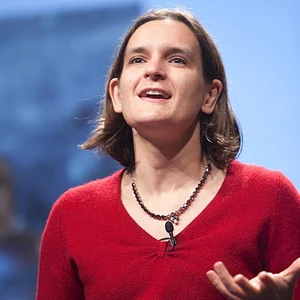

French-American economist born in 1972, a specialist in development economics. She reshaped the fight against poverty by relying on rigorous field experiments. In 2019, she became the youngest person ever to win the Nobel Prize in Economics.
Esther Duflo(1972 — ?)
Esther Duflo
États-Unis, France
5 min read
Frequently asked questions
Key Facts
- Born in Paris in 1972
- Co-founds the Abdul Latif Jameel Poverty Action Lab (J-PAL) at MIT in 2003
- Receives the John Bates Clark Medal in 2010
- Receives the Nobel Prize in Economics in 2019, together with Abhijit Banerjee and Michael Kremer, for her experimental approach to fighting poverty
- Youngest laureate (aged 47) and second woman to receive the Nobel Prize in Economics
Works & Achievements
With Abhijit Banerjee and Sendhil Mullainathan, she founded a laboratory at MIT that scientifically tests anti-poverty policies.
An award given to the best American economist under the age of 40, cementing the recognition of her work.
A book co-written with Abhijit Banerjee, translated worldwide, showing how field experiments are transforming the fight against poverty.
A book that applies evidence-based economic analysis to today's major debates: inequality, immigration, and climate.
An award received for her experimental approach to reducing global poverty, shared with Banerjee and Kremer.
Teaching dedicated to bringing scientific methods for fighting poverty to the general public.
Anecdotes
In 2019, at age 46, Esther Duflo became the youngest person ever to receive the Nobel Prize in Economics, and only the second woman to win it. She shared the award with Abhijit Banerjee, who is also her husband, and with American economist Michael Kremer.
To find out whether a policy truly helps the poor, Duflo borrows a method from doctors: the randomized trial. A group that receives aid (free mosquito nets, for example) is compared to a control group, exactly the way a medicine is tested, in order to measure what actually works.
As a young student, Esther Duflo was torn between history and economics. A ten-month stay in Russia at age 24, working as a research assistant, convinced her that economics could be a concrete tool for changing people's lives, rather than just an abstract theory.
In 2003, together with Abhijit Banerjee, she founded J-PAL (the Abdul Latif Jameel Poverty Action Lab) at MIT, a laboratory that has since carried out hundreds of field experiments around the world to fight poverty.
In 2010, she received the John Bates Clark Medal, awarded to the best American economist under the age of 40, a distinction often seen as a stepping stone to the Nobel Prize.
Primary Sources
It is tempting to believe that there is a miracle cure for poverty. But the battle is won instead through an accumulation of small advances, each one carefully tested in the field.
Our work consists in understanding the deep roots of poverty, in listening to poor people themselves, and in rigorously testing which policies actually improve their lives.
The economist must accept being wrong and measuring their results, rather than imposing certainties about what is good for the poor.
The great questions of our age — immigration, inequality, growth, climate — deserve answers grounded in facts, not in prejudice.
Key Places
Esther Duflo's birthplace, where she grew up and received her early education.
Elite institution where she studied history and economics in the 1990s.
American university where she earned her doctorate, then became a professor and co-founded the J-PAL laboratory.
Prestigious institution where she held the “Knowledge Against Poverty” chair starting in 2009.
Capital where she received the Nobel Prize in Economics in December 2019.
Typical Objects

An object at the heart of several of Duflo's experiments, in which she studied whether it was better to distribute them for free or charge for them to fight malaria.

A form filled out by surveyors with families to gather numerical data on their income, health, or schooling.

An indispensable tool for processing the thousands of survey responses and calculating whether a policy truly had an effect.

An award received in 2019, a symbol of the worldwide recognition of her experimental method in development economics.

A book written with Abhijit Banerjee that explains to the general public how field experiments shed light on the fight against poverty.

Tools of the MIT classroom where she teaches, drawing curves and equations to train future economists.
School Curriculum
Vocabulary & Tags
Key Vocabulary
Tags
Daily Life
Morning
As a professor at MIT, Esther Duflo often begins her day by reading survey data and preparing her courses. Her mornings are also punctuated by team meetings to follow up on experiments underway in several countries.
Afternoon
Her afternoons are devoted to teaching, mentoring young researchers, and statistically analyzing results. During her field missions, she travels on-site, to villages in India or Africa, to directly observe living conditions.
Evening
In the evening, she writes scientific papers and books for general audiences, or prepares lectures. Her professional life blends with her family life, shared with Abhijit Banerjee, an economist like herself.
Food
An economist living between the United States and France, she shares the ordinary diet of a contemporary academic. During her field stays, she samples the local cuisine of the regions she studies, particularly in India.
Clothing
She dresses simply and practically, suited to the life of a researcher: professional attire for teaching and lectures, simple and comfortable clothes for field surveys.
Housing
She lives mainly in Cambridge, near Boston, where MIT is located, in an urban university setting. Her research regularly takes her to stay in rural villages of developing countries.
Historical Timeline
Period Vocabulary
Liens externes & ressources
Références
Œuvres
Cofondation du laboratoire J-PAL
2003
Médaille John Bates Clark
2010
Repenser la pauvreté (Poor Economics)
2011
Économie utile pour des temps difficiles (Good Economics for Hard Times)
2019
Prix Nobel d'économie
2019
Chaire « Savoirs contre pauvreté » au Collège de France
2008-2009