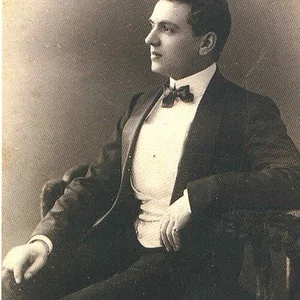

Ernest Beaux (1881–1961) was a Franco-Russian perfumer who created the legendary Chanel N°5 in 1921, revolutionizing the art of perfumery with his innovative use of aldehydes. He is considered one of the greatest noses of the twentieth century.
Ernest Beaux(1881 — 1961)
Ernest Beaux
France
8 min read
Frequently asked questions
Key Facts
- Born in 1881 in Moscow into a family of French perfumers established in Russia
- Created Chanel N°5 in 1921 for Gabrielle Chanel — the first perfume to use synthetic aldehydes
- Worked for the Rallet house in Saint Petersburg before fleeing the Russian Revolution in 1919
- Joined the Bourjois-Chanel house in Paris after his exile
- Died in 1961, leaving a foundational legacy in the modern perfumery industry
Works & Achievements
The first major perfume to use synthetic aldehydes in high concentration, it revolutionized perfumery worldwide and became the most famous and best-selling fragrance in history.
The second major aldehydic creation by Beaux for Chanel, more floral and powdery than No. 5. It is considered an unsung masterpiece of interwar perfumery.
A white floral perfume created for Chanel, evoking the gardenia without exactly reproducing its scent — a technical feat that illustrates Beaux's genius for olfactory composition.
A tribute by Beaux to his Russian origins, this perfume with its leathery, smoky, and floral notes evokes hides tanned in the Russian manner. It remains a reference in high-end niche perfumery.
An oriental and woody fragrance created for Chanel, featuring notes of sandalwood and vetiver, reflecting the era's fascination with exotic scents carried by Art Déco aesthetics.
One of Beaux's first major creations, made for the house of Rallet & Co in Moscow. This perfume was intended for the Russian imperial court and foreshadows certain techniques later used in Chanel N°5.
Anecdotes
Ernest Beaux was the son of a Frenchman who directed the perfume house Rallet & Co in Moscow, the most renowned in Russia. From adolescence, he was immersed in the world of precious materials and learned the perfumer's craft alongside Russian and French master perfumers, inheriting an exceptional dual olfactory culture that would shape his entire career.
During the First World War, Beaux served as an officer in the Imperial Russian Army. An expedition near the Arctic Circle revealed to him an unforgettable sensation: the smell of lakes and rivers in spring, a clean and luminous freshness that he would later seek to recreate in his perfumes through synthetic aldehydes.
In 1920, Coco Chanel asked Ernest Beaux to create an original fragrance. He presented her with two series of samples numbered 1 to 5 and 20 to 24. Without hesitation, Chanel chose the bottle bearing the number 5, and decided to keep that figure as its name. Launched on May 5, 1921 — the 5th of the 5th month — the perfume became a worldwide legend.
Ernest Beaux's major innovation was incorporating high doses of synthetic aldehydes into Chanel N°5. These artificial molecules, only recently known at the time, gave the perfume a wholly new airy and abstract dimension: the goal was no longer to imitate an existing flower, but to create an imaginary fragrance — like a flower that does not exist in nature.
After the Bolshevik Revolution of 1917, Beaux was forced to flee Russia, where he had built his career. He settled in Grasse, the world capital of perfumery, in Provence. This forced exile brought him closer to Provence's floral resources and allowed him to establish a lasting place in French haute parfumerie, while retaining throughout his life the mark of his dual Russian-French culture.
Primary Sources
Beaux describes the presentation of his numbered samples to Gabrielle Chanel and the selection of number 5, recounting how the use of aldehydes made it possible to achieve a fresh, abstract note previously unknown in perfumery.
These letters document the technical discussions between the perfumer and the couturière, covering formulas, raw material suppliers, and the evolution of the olfactory collections over the years.
Beaux's notebooks record his experiments with synthetic aldehydes and trace the gradual development of the Chanel No. 5 formula from the numbered trials carried out in 1920–1921.
These registers document Beaux's earliest creations for the house of Rallet, notably the Bouquet de Catherine (Rallet No. 1), a fragrance intended for the Russian imperial court, which foreshadows certain techniques later used in Chanel No. 5.
Key Places
The birthplace and training ground of Ernest Beaux. He grew up within the Rallet & Co. house, learned his craft there, and produced his first major creations before being forced into exile by the Revolution of 1917.
Having settled in Grasse after his exile from Russia, Beaux found there the floral raw materials — rose, jasmine, mimosa — essential to his creations. It was in this world capital of perfumery that he developed the formula for Chanel No. 5.
The headquarters of Maison Chanel, where Beaux presented his numbered samples to Coco Chanel, forging an artistic and commercial partnership that gave birth to the most celebrated perfumes of the twentieth century.
During the Allied military expedition of 1918–1919, Beaux discovered the Arctic landscapes of the White Sea. The pure, icy air of those remote lands inspired the distinctive fresh note that defines Chanel No. 5.
Typical Objects

Ernest Beaux presented his creations in small, hand-numbered glass vials. It was by choosing the vial bearing the number 5 that Coco Chanel gave the legendary perfume its name.

An indispensable tool for any perfumer, the balance allowed Beaux to measure raw materials and synthetic molecules — including the aldehydes that would revolutionize perfumery — with extraordinary accuracy.

These chemical molecules, rarely used before Beaux, form the innovative signature of Chanel N°5. Applied in high concentration, they give the fragrance its airy, abstract character — something entirely unprecedented at the time.

Like all perfumers, Beaux meticulously recorded the exact proportions of each ingredient in notebooks. These documents, preserved in the Chanel archives, are an exceptional technical record of the creation of N°5.

This cabinet of drawers organized by olfactory families brings together hundreds of raw materials. The perfumer's organ was Beaux's central workstation, from which he assembled and compared his compositions.

The understated rectangular bottle with its cut-glass stopper, conceived jointly by Beaux and Chanel, broke away from the ornate flacons of the Belle Époque and perfectly embodied the Art Deco aesthetic.
School Curriculum
Vocabulary & Tags
Key Vocabulary
Daily Life
Morning
Ernest Beaux began his day very early in his laboratory in Grasse, with a fresh mind and a rested nose — olfactory fatigue sets in quickly as the day progresses, making morning the ideal time to evaluate new compositions. He spent his first hours smelling the samples prepared the evening before and adjusting the dosages in his formula notebooks.
Afternoon
Afternoons were devoted to chemical work: blending raw materials, preparing new macerations, and selecting the finest floral essences alongside Grasse suppliers. He corresponded regularly with the House of Chanel in Paris to coordinate launches and refine formulas based on commercial feedback.
Evening
In the evenings, Beaux led a discreet and cultivated life, shaped by his years in the aristocratic circles of Saint Petersburg. He enjoyed music, intellectual conversation, and reading scientific chemistry journals, keeping abreast of new synthetic molecules to continually expand his creative repertoire.
Food
Like any professional perfumer, Beaux was particularly mindful of what he ate, avoiding heavily spiced dishes, garlic, and strong flavors that might dull his olfactory sensitivity. He followed a traditional, bourgeois French cuisine, with a preference for delicate flavors that preserved the acuity of his primary working tool: his nose.
Clothing
Ernest Beaux dressed with the understated elegance of a man from a respectable Franco-Russian family: a well-tailored three-piece suit, white shirt, and a restrained tie. Close to the world of fashion through his association with Chanel, he took care in his appearance without ever seeking to compete with the splendor of his illustrious clients.
Housing
Settled first in Grasse and later in Cannes, Beaux lived in bourgeois houses along the Côte d'Azur, surrounded by gardens fragrant with jasmine, rose, and lavender — constant sources of inspiration. This Provençal setting nourished his creativity and evoked, through its light and scents, the vast natural landscapes of his Russian youth.
Historical Timeline
Period Vocabulary
Liens externes & ressources
Références
Œuvres
Chanel N°5
1921
Chanel N°22
1922
Gardénia
1925
Cuir de Russie
1924
Bois des Îles
1926
Bouquet de Catherine (Rallet N°1)
vers 1913