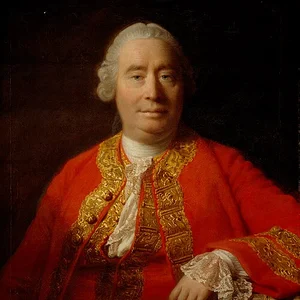

Scottish Enlightenment philosopher (1711-1776), David Hume is one of the foremost thinkers of modern empiricism. He grounded his philosophy in observation and sensory experience, challenging rational certainties and developing a sceptical approach to knowledge.
David Hume(1711 — 1776)
David Hume
royaume de Grande-Bretagne
7 min read
Frequently asked questions
Famous Quotes
« If we take in our hand any volume of divinity or school metaphysics, for instance, let us ask: Does it contain any abstract reasoning concerning quantity or number? No. Does it contain any experimental reasoning concerning matter of fact and existence? No. Commit it then to the flames, for it can contain nothing but sophistry and illusion.»
« Philosophy can never go beyond human nature.»
Key Facts
- 1739-1740: Publication of A Treatise of Human Nature, a landmark work laying out the principles of empiricism
- 1748: Publication of An Enquiry Concerning Human Understanding, a revised and more accessible presentation of his thought
- 1750s: Publication of his Essays, Moral and Political, which brought him to the attention of the educated public
- 1776: Death in Edinburgh, having fundamentally challenged the concepts of causality and substance
- Rejection of dogmatic metaphysics and advocacy of systematic doubt in philosophical inquiry
Works & Achievements
Hume's foundational philosophical work, in which he analyzes understanding, passions, and morality drawing solely on experience. The work went unnoticed upon publication but is today considered a masterpiece.
A collection of essays that brought Hume his first public recognition, addressing questions of politics, economics, and society with clarity and elegance.
An accessible reformulation of the first book of the Treatise, containing the famous critique of causality and the argument against miracles.
A work that Hume himself considered the best of all his writings, grounding morality in the sentiment of sympathy rather than reason.
A monumental work in six volumes that brought Hume fame during his lifetime. It remained the standard history of England for nearly a century.
Published after his death according to his wishes, these dialogues examine the arguments for the existence of God with a skeptical rigor that lastingly influenced the philosophy of religion.
Anecdotes
When David Hume traveled to Paris in 1763 as embassy secretary, he was welcomed as a genuine celebrity by the Parisian salons. High-society ladies competed for his company, which greatly amused this portly and jovial philosopher, unaccustomed to such social attention.
Hume and Jean-Jacques Rousseau had a famous friendship that ended in disaster. In 1766, Hume generously welcomed Rousseau to England to protect him from his persecutors, but the Genevan philosopher, paranoid by nature, publicly accused him of plotting against him, triggering a resounding scandal throughout intellectual Europe.
On his deathbed in 1776, Hume remained true to his religious skepticism with remarkable calm. His friend Adam Smith reported that he joked with Charon, the ferryman of the Underworld, imagining the excuses he might offer to delay crossing the Styx. This serenity in the face of death without religious consolation deeply shocked British society.
As a young man, Hume was rejected for a professorship at the University of Edinburgh in 1745, largely because of his ideas deemed irreligious. The man considered today the greatest philosopher in the English language was never able to obtain a university chair in his own country.
Hume was renowned for his stoutness and his love of food. A French countess nicknamed him 'fat David' and he readily accepted this nickname with good humor. He was also known to be an excellent cook and enjoyed preparing dishes himself for his philosopher friends.
Primary Sources
Reason is, and ought only to be, the slave of the passions, and can never pretend to any other office than to serve and obey them.
If we take in our hand any volume; of divinity or school metaphysics, for instance; let us ask, Does it contain any abstract reasoning concerning quantity or number? No. Does it contain any experimental reasoning concerning matter of fact and existence? No. Commit it then to the flames: for it can contain nothing but sophistry and illusion.
The whole is a riddle, an enigma, an inexplicable mystery. No system, no hypothesis can resolve the difficulties that arise when applying our limited concepts to a universe so vast and so majestic.
I was born the 26th of April 1711, old style, at Edinburgh. I am of a good family, both by father and mother. I was seized very early with a passion for literature, which has been the ruling passion of my life, and the great source of my enjoyments. I had a disposition to mildness and openness, sociability and cheerfulness, capable of attachment but little susceptible of enmity.
Key Places
Hume's birthplace and centre of the Scottish Enlightenment. He lived there for most of his life, including in his house at James Court and later in the street that now bears his name (St David Street).
Hume stayed near La Flèche between 1735 and 1737, in the quiet of the French countryside, to write his Treatise of Human Nature, not far from the Jesuit college where Descartes had studied.
Hume stayed there as embassy secretary from 1763 to 1766. He frequented the salons of the Enlightenment and formed close ties with Diderot, d'Alembert, and the Encyclopédistes.
The Hume family estate in the Scottish Borders, where the philosopher spent his childhood and many writing retreats throughout his life.
A major intellectual hub of the Scottish Enlightenment where his friend Adam Smith taught. Hume maintained regular philosophical exchanges there.
Typical Objects

Essential writing instruments with which Hume drafted his philosophical treatises and his abundant correspondence with the great minds of Europe.

A common accessory among Scottish gentlemen of the 18th century, often used during philosophical conversations in Edinburgh's taverns and clubs.

The typical white wig worn by men of letters and polite society in the 18th century, which Hume wore in Parisian salons and fashionable circles.

Hume, as librarian of the Faculty of Advocates, had access to one of the largest book collections in Scotland, which nourished his historical and philosophical work.

A typical cabinet object of the Enlightenment, symbolising the universal curiosity and openness to the world that characterised Hume's thought.

Tea had become the favourite drink of British polite society. Hume frequently received his philosopher friends over a cup of tea.
School Curriculum
Vocabulary & Tags
Key Vocabulary
Tags
Époque
Daily Life
Morning
Hume rose relatively late, around nine o'clock, a habit he kept throughout his life. He had a simple breakfast of tea and bread, then settled in his study to read and reflect. The morning was devoted to reading and correspondence with his many intellectual friends across Europe.
Afternoon
In the afternoon, Hume often went to the taverns and clubs of Edinburgh to meet his friends, notably Adam Smith, Adam Ferguson, and William Robertson. These lively conversations on philosophy, history, and politics nourished his thinking. He also frequented the Advocates' Library.
Evening
In the evening, Hume enjoyed hosting dinners at home, sometimes cooking himself, as he had a reputation as a good cook. Discussions would go on late over a glass of claret (Bordeaux wine). He also devoted his evenings to writing his works, making use of the quiet of the night.
Food
Hume appreciated good food and was known for his hearty appetite. His typical diet included Scottish mutton, haggis, porridge, wheaten bread, seasonal vegetables, and fish. He was particularly fond of Bordeaux wine, imported to Scotland through the longstanding Franco-Scottish trading relations.
Clothing
As an eighteenth-century Scottish gentleman, Hume wore French-style dress consisting of a coat, waistcoat, and knee breeches, with silk stockings and buckled shoes. He wore a powdered wig on formal occasions. In Paris, he adopted more elegant attire to attend the salons.
Housing
Hume first lived in modest apartments in Edinburgh's Old Town, notably at James Court, a typical multi-storey tenement of the Old Town. Towards the end of his life, he had a house built in the New Town, Edinburgh's new Georgian quarter, on the corner of St Andrew Square and the street that would bear his name.
Historical Timeline
Period Vocabulary
Visual Style
Un style visuel inspiré des portraits à l'huile du XVIIIe siècle écossais, entre intérieurs chaleureux éclairés à la bougie et les ruelles brumeuses d'Édimbourg, dans des tons ambrés et profonds.
Sound Ambience
L'ambiance sonore d'Édimbourg au XVIIIe siècle, entre le calme studieux d'un cabinet de philosophe et l'animation des ruelles pavées de la vieille ville, bercée par le crépitement du feu et le son des cloches.
Liens externes & ressources
Références
Œuvres
Traité de la nature humaine
1739-1740
Essais moraux et politiques
1741-1742
Enquête sur l'entendement humain
1748
Enquête sur les principes de la morale
1751
Histoire de l'Angleterre
1754-1762
Dialogues sur la religion naturelle
1779 (posthume)