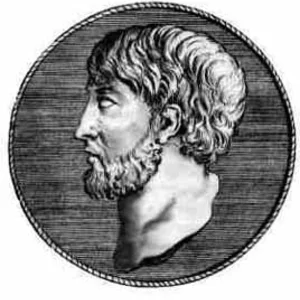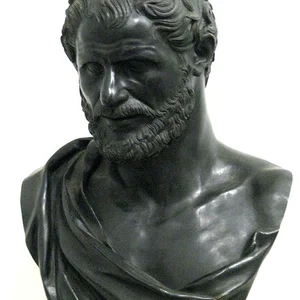

A Greek philosopher of the 5th century BC, Democritus is the father of atomic theory: he proposed that all matter is made up of indivisible particles called atoms. A student of Leucippus, he developed a materialist and rationalist philosophy that would have a lasting influence on scientific thought.
Democritus(460 av. J.-C. — 360 av. J.-C.)
Democritus
Grèce
9 min read
Frequently asked questions
Famous Quotes
« Nothing comes from nothing.»
« Poverty in a democracy is better than prosperity under tyrants.»
« Happiness resides not in herds or gold; the soul is the dwelling place of genius.»
Key Facts
- Born around 460 BC in Abdera, Thrace
- Developed atomic theory alongside Leucippus around 430 BC
- Proposed that the void exists and that atoms move freely within it
- Author of an encyclopedic body of work covering physics, mathematics, ethics, and music
- Died around 370–360 BC, after a life of travel and research
Works & Achievements
Democritus's masterwork, in which he sets out the formation of the universe from the movement of atoms in the void. He develops the idea of innumerable worlds coming into being and perishing within an infinite cosmos.
A companion treatise devoted to cosmology and the formation of the Earth, the stars, and living beings. Democritus explains life as a particular arrangement of atoms, including the human soul.
A treatise on physics in which Democritus presents his theory of atoms and the void as the fundamental principles of all reality. He argues that sensory qualities — color, taste, heat — are mere conventions, and that only atoms and the void truly exist.
A collection of moral reflections in which Democritus develops the concept of euthymia (serenity, the well-being of the soul). This ethics of moderate happiness would go on to directly influence Epicurus and Epicureanism.
Mathematical texts in which Democritus is said, according to Archimedes, to have anticipated the volume formulas for the cone and the pyramid. In doing so, he opened a path toward integral calculus, two centuries before Archimedes.
Democritus wrote texts on medicine, botany, and zoology grounded in empirical observation. His practice of animal dissection reflects a scientific approach well ahead of his time.
Anecdotes
Democritus is said to have spent his entire fortune traveling across the ancient world — Egypt, Persia, Babylon, and perhaps even India — to learn from foreign scholars and priests. Returning to Abdera penniless, his fellow citizens reportedly put him on trial for squandering his inheritance, but he defended himself by reading his writings aloud before the court and was acquitted to great applause.
The Ancients nicknamed Democritus the 'Laughing Philosopher' because, unlike Heraclitus who wept over human misery, he laughed at the vanity and foolishness of mankind. According to some accounts, he even gouged out his own eyes voluntarily so as not to be distracted by appearances and to focus more deeply on thought — an anecdote likely legendary, but telling of his reputation as an intellectual ascetic.
Democritus was one of the most prolific thinkers of antiquity: more than seventy works are attributed to him, covering physics, mathematics, music, ethics, and medicine. Yet none of his texts has survived intact — only fragments quoted by other authors remain, making his loss one of the great losses of ancient thought.
Democritus is said to have met Hippocrates, the famous physician of Cos. According to a well-known apocryphal letter, the citizens of Abdera had called upon Hippocrates because they believed their fellow citizen was mad — he spent his days dissecting animals and laughing to himself. Hippocrates, after a lengthy conversation with him, reportedly concluded that he was the sanest man he had ever met.
Democritus is said to have lived with extreme frugality, often sleeping in tombs to meditate far from the noise of the world. He reportedly lived to well over a hundred years old, attributing his longevity to a simple diet of honey and the constant exercise of the mind. This image of the austere, laughing sage helped make him a philosophical model for generations to come.
Primary Sources
"Atoms and the void are the only realities; everything else is mere opinion." (Fragment B9) "Poverty in a democracy is as much to be preferred to what is called prosperity under tyrants as freedom is to slavery." (Fragment B251)
"Leucippus and his associate Democritus hold that the elements are the full and the void… They assert that these atoms are in perpetual motion through the infinite void, and that from their aggregation arise composite things."
"Democritus was the son of Hegesistrates… He was a pupil of Leucippus and, according to some, of Anaxagoras as well… It is said that he spent his entire fortune on travels… He wrote on everything: physics, ethics, mathematics, music, and the arts."
"In truth, the primary bodies are solid and simple in nature; they are packed with minimal particles and are not composed of an aggregation of parts, but are endowed with an everlasting solidity."
"Democritus — whom I have no wish to disparage, a man whom his admirers, not always without reason, rank above all other philosophers — believed that the soul, like fire, was composed of smooth and round atoms."
Key Places
Greek city in Thrace where Democritus was born and died. Although mocked in antiquity for the supposed stupidity of its inhabitants, it was in fact an intellectual center that also produced the sophist Protagoras.
Democritus is said to have visited Athens to meet with philosophers, yet he reportedly declared, with some bitterness, that he had passed through the city without anyone recognizing him. His materialism stood in opposition to the dominant philosophical currents there.
Democritus is said to have spent several years in Egypt, studying under Egyptian priests and geometers. This journey fed his encyclopedic curiosity and his interest in mathematics and astronomy.
He is also said to have studied under the Chaldeans of Babylon, renowned for their knowledge of astronomy and divination. These eastern encounters enriched his vision of an infinite cosmos populated by countless worlds.
The birthplace of Greek philosophy and the probable place of activity of Leucippus, Democritus's teacher. Atomism grew out of the Milesian tradition of seeking natural causes for natural phenomena.
Typical Objects

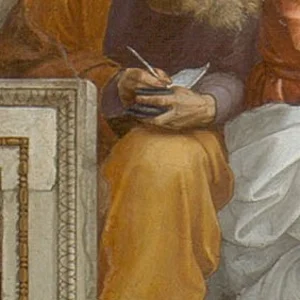
Democritus recorded his observations and theories on wax tablets or papyrus scrolls. More than seventy works are attributed to him, covering every field of ancient knowledge.

Democritus dissected animals to understand the structure of living bodies. This empirical approach reflected his belief that reality is made of organized matter, not divine forms.

Used by Greek scholars to measure time and the angles of the sun, the gnomon was a standard tool for astronomers and geometers. Democritus had a keen interest in geometry and cosmology.

Greek philosophers used the clepsydra to measure time during discussions and lectures. It also symbolizes Democritus's reflections on time, motion, and infinity.

Democritus was known for his frugal diet: he lived mainly on honey, figs, and simple foods. According to tradition, he credited this austere regimen for his extraordinary longevity.

Democritus was also a mathematician: according to Archimedes, he discovered the volume formulas for the cone and the pyramid. The abacus was the fundamental calculation tool of Greek mathematicians.
School Curriculum
Vocabulary & Tags
Key Vocabulary
Daily Life
Morning
Democritus rose at dawn, before the heat of the day. He would begin with a solitary walk through the still-deserted streets of Abdera or along the city's outskirts, meditating on the thoughts he had formed the day before. This morning habit, he said, allowed him to clarify his ideas before committing them to wax tablets.
Afternoon
In the afternoon, Democritus devoted himself to his research: dissecting animals, making astronomical observations, writing his treatises, or conversing with students and passing travelers. The Mediterranean summer heat often made intellectual work difficult, and he may have worked in the cool shade of a stoa or in an underground room.
Evening
In the evenings, Democritus sometimes attended the symposium — the intellectual banquet typical of educated Greeks — where philosophy, wine diluted with water, and music intermingled. Naturally temperate, he drank in moderation and preferred philosophical discussion to excess. Before sleeping, he would mentally review the ideas of the day.
Food
Democritus was renowned for his frugality: he lived mainly on honey, dried figs, olives, and vegetables. He avoided meat and excessive wine, believing that a simple diet promoted clarity of mind. According to tradition, he credited this regimen with his exceptional longevity.
Clothing
Like any Greek citizen of his standing, Democritus wore a chiton — a white or natural linen tunic fastened at the shoulders — and, in cooler weather or when going out, a himation (a draped woolen cloak). His clothes were plain and functional, without adornment, reflecting his disdain for luxury and outward appearances.
Housing
Democritus most likely lived in a typical Greek house in Abdera: a central courtyard (aulos) surrounded by rooms, with a dedicated study containing papyrus scrolls and writing tablets. Although born into a wealthy family, he is said to have gradually simplified his lifestyle in order to devote himself entirely to philosophy.
Historical Timeline
Period Vocabulary
Visual Style
Style céramique grec à figures rouges, tons ocre et terre cuite, lumière méditerranéenne chaude ; atmosphère contemplative d'un savant dans sa stoa, avec la mer Égée en arrière-plan.
Sound Ambience
L'ambiance sonore d'Abdère au Ve siècle av. J.-C. : mêlant les sons du port égéen, de l'agora animée et du cabinet de travail du philosophe, avec le bruit de la mer en toile de fond permanente.
Liens externes & ressources
Références
Œuvres
Le Grand Diacosmos (La grande organisation du monde)
Vers 430-420 av. J.-C.
Le Petit Diacosmos
Vers 420 av. J.-C.
Sur la Nature (Peri Physeos)
Ve siècle av. J.-C.
Traités d'éthique (Thria, Peri Euthumies)
Ve-IVe siècle av. J.-C.
Traités de mathématiques (Sur la différence entre le gnomon et le contact du cercle et de la sphère)
Ve siècle av. J.-C.
Traités de médecine et de biologie
Ve-IVe siècle av. J.-C.