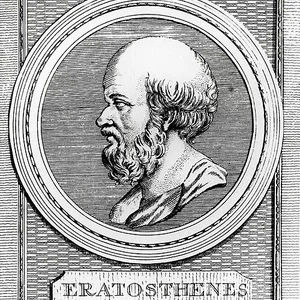

Greek scholar of the 3rd century BC and director of the Library of Alexandria. He measured the circumference of the Earth with remarkable accuracy and laid the foundations of scientific geography.
Eratosthenes(275 av. J.-C. — 193 av. J.-C.)
Eratosthenes
7 min read
Frequently asked questions
Key Facts
- Around 275 BC: born in Cyrene (present-day Libya)
- Around 245 BC: appointed director of the Library of Alexandria by Ptolemy III
- Around 240 BC: measured the circumference of the Earth by comparing the angles of shadows in Alexandria and Syene, obtaining a result close to the actual value (~40,000 km)
- Invented the 'Sieve of Eratosthenes', a method for finding prime numbers
- Around 193 BC: died in Alexandria, probably around the age of 80
Works & Achievements
The first systematic treatise on mathematical geography, in which Eratosthenes describes the inhabited world, calculates the circumference of the Earth, and introduces a system of geographical coordinates. The original work is lost but known through quotations in Strabo.
A treatise describing his geodesic method for measuring the Earth's circumference using the angle of sunlight between Alexandria and Syene, yielding an estimate of approximately 40,000 km.
A foundational work in Greek historical chronology, in which Eratosthenes attempted to establish precise dates for major events from the Trojan War onward, laying the groundwork for history as a science.
A mythological collection linking constellations to Greek legends, which had a lasting influence on astronomical nomenclature. Its attribution to Eratosthenes remains debated but plausible.
An algorithm for identifying all prime numbers below a given number by successively eliminating multiples. It is one of the oldest known algorithmic methods and is still used in computer science today.
Anecdotes
To measure the circumference of the Earth, Eratosthenes used an ingenious method: in Syene (modern-day Aswan), the sun shone directly down to the bottom of wells at noon on the summer solstice, while in Alexandria, about 800 km to the north, it cast a shadow. By measuring this angle of approximately 7.2°—one-fiftieth of a full circle—he calculated Earth's circumference at roughly 40,000 km, a remarkably accurate result.
Eratosthenes was nicknamed 'Beta' by his contemporaries because he excelled across many disciplines without ever being considered the greatest in any single one. Some saw this as a criticism, but others interpret the nickname as recognition of exceptional versatility: he was a mathematician, geographer, astronomer, poet, and philosopher all at once.
He invented the 'Sieve of Eratosthenes,' a method for finding all prime numbers up to a given value by successively eliminating the multiples of each number. This simple and elegant technique is still taught today in mathematics classrooms around the world.
Eratosthenes was appointed by King Ptolemy III as director of the famous Library of Alexandria, the largest collection of knowledge in the ancient world. There he gathered and organized papyrus scrolls from across the Mediterranean, personally overseeing the creation of a monumental catalogue known as the Pinakes.
Primary Sources
Eratosthenes says that the Earth is a sphere, not perfectly round like a ball, but presenting certain irregularities. He estimated its circumference at 252,000 stades, based on the observation that Syene and Alexandria are 5,000 stades apart.
Eratosthenes measured the size of the Earth using a mathematical method and obtained a result of 250,000 stades. He assumed that Syene lies on the Tropic of Cancer, and that in Alexandria, at the same hour, the sun casts a shadow at an angle of one-fiftieth of a circle.
Eratosthenes established a chronology of events from the Trojan War to his own time, setting the date of the fall of Troy at 1183 BC, thereby laying the foundations of Greek historical chronology.
He drew a map of the inhabited world (oikoumene) drawing on the accounts of travelers and navigators, introducing for the first time a system of parallel lines and meridians to locate places.
Key Places
Eratosthenes' birthplace, a prosperous Greek colony on the North African coast renowned for its philosophers and scholars. He received his early intellectual education there before moving to Athens.
Eratosthenes studied in Athens at the great philosophical schools of the time, notably under the philosopher Arcesilaus at the Academy, before being invited to Alexandria.
The intellectual capital of the Hellenistic world, where Eratosthenes spent most of his life directing the famous Library and the Mouseion, the great center of ancient knowledge.
A city located on the Tropic of Cancer, where Eratosthenes observed that the sun stood directly overhead at noon on the summer solstice. This geographical reference point was crucial to his measurement of the Earth.
Liens externes & ressources
Références
Œuvres
Geographica
Vers 240-220 av. J.-C.
Sur la mesure de la Terre
Vers 240 av. J.-C.
Chronographies
Vers 220-200 av. J.-C.
Catastérismes
IIIe siècle av. J.-C.
Le Crible d'Ératosthène (méthode arithmétique)
IIIe siècle av. J.-C.
See also
Related Characters
Alexander II of Macedon
Anaxagoras of Clazomenae
499 av. J.-C. — 427 av. J.-C.
Anaximander
609 av. J.-C. — 545 av. J.-C.
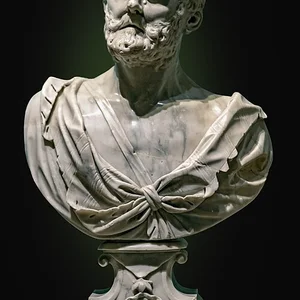
Heraclitus
534 av. J.-C. — 470 av. J.-C.
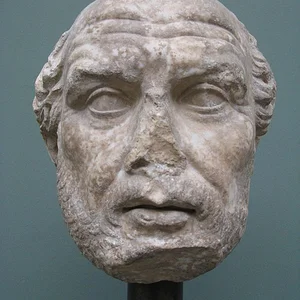
Phidias
499 av. J.-C. — 429 av. J.-C.
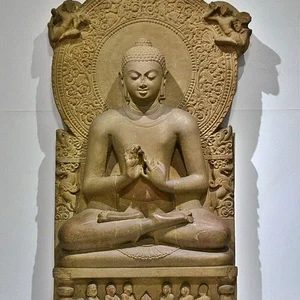
Siddhartha Gautama
500 av. J.-C. — 500 av. J.-C.