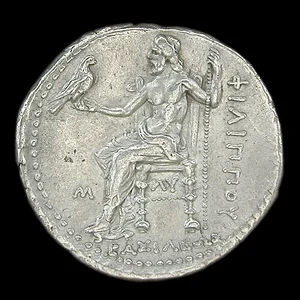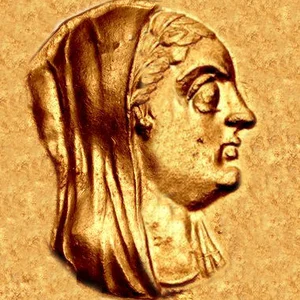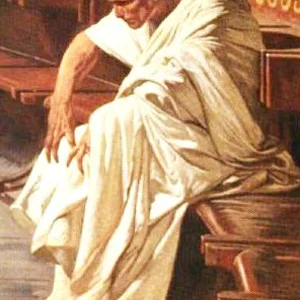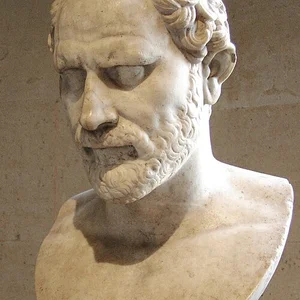

Demosthenes (384–322 BC) was the greatest orator of ancient Greece. An Athenian statesman, he vigorously opposed the expansion of Philip II of Macedon through his famous speeches, the Philippics.
Demosthenes(383 av. J.-C. — 321 av. J.-C.)
Demosthenes
Athènes
8 min read
Frequently asked questions
Famous Quotes
« Nothing is so easy as to deceive one's self; for what we wish, we readily believe.»
« Opportunities wait for no one.»
Key Facts
- Born in 384 BC in Athens, he overcame a speech impediment to become the greatest Greek orator
- From 351 BC onward, he delivered the Philippics to warn Athens against the threat of Philip II of Macedon
- He played a central role in the Greek coalition defeated at the Battle of Chaeronea in 338 BC
- After the death of Alexander the Great (323 BC), he attempted to rally Greece against Macedon during the Lamian War
- Condemned to death by the Macedonians, he poisoned himself in 322 BC at Calauria to avoid capture
Works & Achievements
A series of four political speeches denouncing the threat posed by Philip II of Macedon to Greek freedom. These texts became synonymous with speeches of resistance against a powerful enemy, and the word "philippic" entered all languages to describe a vehement denunciation.
Three speeches urging Athens to come to the aid of the city of Olynthus, threatened by Philip. They illustrate Demosthenes' method: precise strategic analysis, a call for concrete action, and a critique of civic disengagement.
Considered the masterpiece of ancient oratory, this speech defends the entirety of Demosthenes' political record against the accusations of Aeschines. His plea was so brilliant that Aeschines, having failed to secure the required quorum of votes, was forced into exile, while Demosthenes was honored with a crown.
A prosecutorial speech against Aeschines, accused of betraying Athens during the negotiations of the Peace of Philocrates by accepting Macedonian bribes. A valuable document on Greek diplomacy in the 4th century BC.
A legal speech against a wealthy Athenian who had struck Demosthenes in the face during a religious festival (the Dionysia). This case shows Demosthenes defending the dignity of the citizen against the arrogance of the powerful.
Demosthenes' first major speeches, written to prosecute his own guardians who had squandered his paternal inheritance. These pleas allowed him to recover part of his fortune and launch his career as an orator.
Anecdotes
According to the tradition recorded by Plutarch, Demosthenes suffered in his youth from a speech impediment and a weak voice. To correct these flaws, he trained himself to speak with pebbles in his mouth on the seashore, projecting his voice over the crashing waves. This relentless discipline allowed him to become the greatest orator of his time.
Demosthenes was so obsessed with his work that he shaved half his head to prevent himself from going out in public, forcing himself to stay home to study and write his speeches. Plutarch reports that he spent entire months in seclusion, venturing out only at night so as not to be distracted.
At the Battle of Chaeronea in 338 BC, where Philip II crushed the Greek forces, Demosthenes fought as an ordinary soldier. Defeated, he fled the battlefield — his political rivals, including Aeschines, bitterly condemned this desertion, but Demosthenes never abandoned his political fight against Macedonian domination.
After the death of Alexander the Great in 323 BC, Demosthenes was recalled from exile by the Athenians, who hoped to seize the opportunity to rise up against Macedonia. But the revolt failed. Hunted by the forces of Antipater, he took refuge in the temple of Poseidon at Calauria and poisoned himself in 322 BC rather than fall alive into the hands of his enemies.
Primary Sources
"Athenians, if you had been willing in this assembly to give your attention to what is truly useful, rather than to what is pleasing, you would have deliberated differently."
"I maintain that my policy has always been just and in the interest of Athens. I never yielded to fear, never betrayed the cause of freedom."
"If you wish your affairs to go well, you must fight yourselves, serve in the army, pay your contributions, and go to the defense of your allies."
"Aeschines betrayed Athens during the embassy to Philip. He received money from the enemy and counseled peace at the very moment when resistance could have saved Greece."
Key Places
A hill at the foot of the Acropolis where the Athenian people's Assembly (Ekklesia) convened. It was from this platform that Demosthenes delivered his Philippics and most of his major political speeches.
The political and judicial heart of Athens, where Demosthenes pleaded his first cases as a logographer (professional speechwriter) and built his reputation as an exceptional orator.
Site of the decisive battle of 338 BC, where Philip II of Macedon defeated the allied Athenian and Theban forces. This defeat marked the end of the Greek city-states' independence and the failure of Demosthenes' political vision.
An island in the Saronic Gulf home to a sanctuary of Poseidon. It was here that Demosthenes took refuge after the defeat in the Lamian War and poisoned himself in 322 BC to escape capture by Macedonian soldiers.
Capital of the Macedonian kingdom and residence of Philip II, then Alexander the Great. Demosthenes was sent there on a diplomatic mission in 346 BC; the visit deepened his fears about Macedonian expansionist ambitions.
Typical Objects

A common writing tool in ancient Athens, Demosthenes tirelessly drafted and revised his speeches on wax tablets before committing them to papyrus. Plutarch notes that he copied Thucydides several times in a row to perfect his style.

Demosthenes was renowned for working late into the night by the light of an oil lamp. His rivals mocked this habit by saying his speeches 'smelled of the lamp,' implying they lacked spontaneity.

To master his gestures and expressions during his pleadings, Demosthenes trained in front of a large bronze mirror. This work on his physical delivery was just as important to him as mastering his words.

The medium on which speeches were recorded once composed and memorized. The scrolls contained texts by Thucydides that Demosthenes copied as a stylistic exercise, as well as his own works intended for preservation.

A central element of the Demosthenic legend: he trained his diction by placing pebbles in his mouth to strengthen his tongue and correct his stammer. This exercise is reported by Plutarch in the Life of Demosthenes.

An outer garment worn by Athenian citizens in public and at the Assembly (Ekklesia). As an orator and statesman, Demosthenes wore this traditional civic dress when he addressed the crowd on the Pnyx.
School Curriculum
Vocabulary & Tags
Key Vocabulary
Tags
Daily Life
Morning
Demosthenes rose early and devoted the first hours of the day to study and the drafting of his speeches. He would copy passages from Thucydides to refine his style, working alone in his Athenian home by the first light of dawn. Unlike idle citizens, he refused to be distracted by the conversations of the Agora.
Afternoon
His afternoons were given over to political and judicial affairs: attending sessions of the Ekklesia on the Pnyx, consulting with political allies, or pleading cases before the popular law courts (the heliastic courts). Demosthenes would walk the Agora to take the pulse of public opinion and prepare his next speeches.
Evening
Evening was his time of intense work. By the light of an oil lamp, he revised, corrected, and memorized his speeches. His contemporaries mocked this nocturnal habit, but Demosthenes believed that every word spoken before the Assembly had to be prepared with the rigor of a general planning a battle.
Food
Like any wealthy Athenian citizen, Demosthenes followed a Mediterranean diet: barley or wheat bread, olives and olive oil, goat or sheep's cheese, pulses (lentils, chickpeas), figs, and grapes. Meat was eaten only occasionally, mainly at religious sacrifices and the banquets (symposia) that followed civic festivals.
Clothing
Demosthenes wore the chiton (a linen or wool tunic) and the himation (a large draped woolen cloak), the standard dress of an Athenian citizen. At the Assembly, his attire was plain and dignified, free of ostentatious ornament. He wore leather sandals and was always clean-shaven, in keeping with the Attic fashion of his time.
Housing
Demosthenes lived in a traditional Athenian house (oikos) built around an inner courtyard. His father had left him a comfortable home in the deme of Paeania. His study — stocked with writing tablets, scrolls, and lamps — was the heart of his daily life, transformed into a veritable scriptorium by a man consumed by the pursuit of rhetorical perfection.
Historical Timeline
Period Vocabulary
Visual Style
Style céramique grec à figures rouges et statuaire hellénistique tardive, lumière méditerranéenne chaude sur fond de ciel attique et de marbre blanc de l'Acropole.
Sound Ambience
Ambiance sonore d'Athènes au IVe siècle av. J.-C. : l'Assemblée sur la Pnyx, le ressac de la mer où Démosthène s'entraînait, et le calme studieux du travail nocturne à la lampe.
Liens externes & ressources
Références
Œuvres
Les Philippiques (I, II, III, IV)
351–341 av. J.-C.
Les Olynthiennes (I, II, III)
349–348 av. J.-C.
Sur la Couronne (De Corona)
330 av. J.-C.
Sur la Fausse Ambassade (De Falsa Legatione)
343 av. J.-C.
Contre Midias (In Midiam)
vers 346 av. J.-C.
Contre Aphobos (I, II, III)
363–362 av. J.-C.