 flip
flipGudeg Yogya
Gudeg Yogya
Why this dish? Gudeg is the emblematic dish of Yogyakarta, heart of the sultanate where Diponegoro grew up. This stew of young jackfruit in coconut milk and palm sugar embodies the cuisine of the kraton of Tegalrejo, where the prince lived before the war. A daily dish in both wealthy and modest households, it accompanied rice at lunch and kept well thanks to its long cooking.
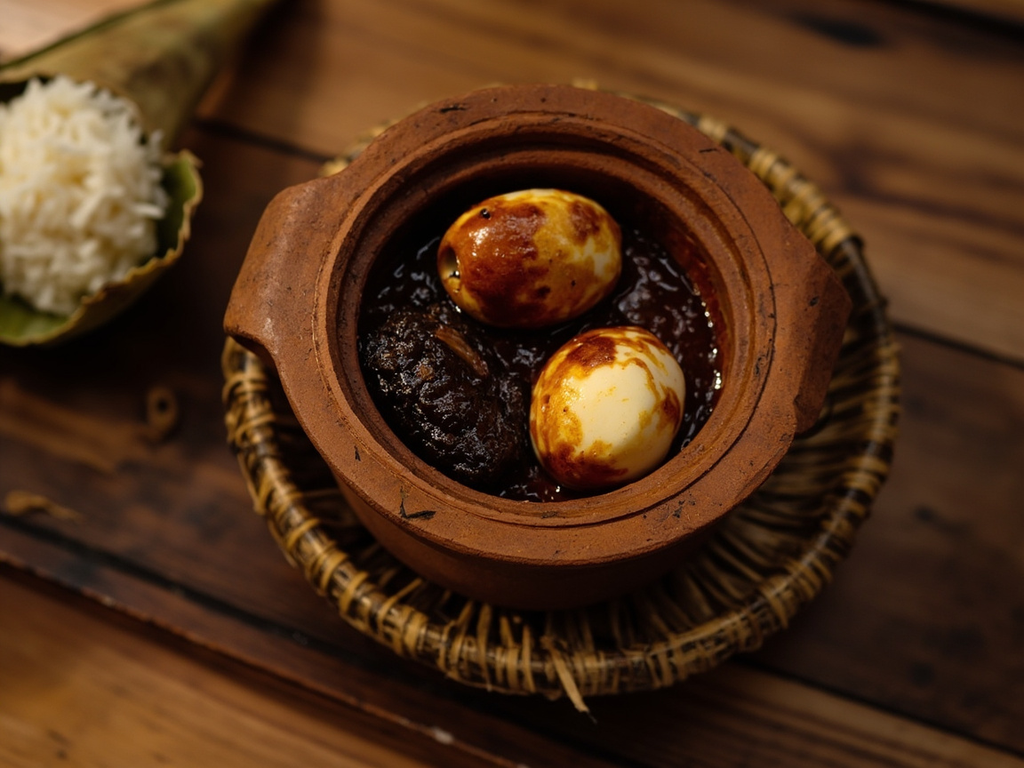
Young jackfruit (nangka muda) slowly simmered in coconut milk, palm sugar, and Javanese spices. The hours-long cooking gives a mahogany-brown color and a melting, almost candied texture. Sweet-savory and fragrant with galangal and salam leaves, it has been Yogyakarta's signature dish for centuries.
At Tegalrejo, we would set the gudeg to cook from nightfall, in large earthenware pots over a coconut-wood fire. By morning, when the call to prayer rang out, the jackfruit had taken on the color of precious wood and melted on the tongue like a blessing from the Most High. I ate this gudeg with white rice, a bit of areh — the thickened coconut milk from the bottom of the pot — and a hard-boiled egg bathed in the sauce. It was the food of my land, simple and nourishing, which I shared as much with the scholars of the pesantren as with the peasants of my domains. Even on campaign, when we could, my men prepared gudeg: it sticks to the belly and does not spoil quickly.
- •Young jackfruit (nangka muda) — One young fruit, cut into pieces (Base of the dish)
- •Fresh coconut milk (santan) — Pressed from two grated coconuts (Cooking liquid, creaminess)
- •Gula Jawa (palm sugar) — A generous block (Sweetness and characteristic color)
- •Galangal (laos) — A piece the size of a thumb (Woody fragrance)
- •Salam leaves — A few leaves (Typical Javanese herbaceous aroma)
- •Teak leaves (jati) — Several leaves (Natural brown-red colorant)
- •Garlic and shallots — To taste (Aromatic base)
- •Coriander seeds — A handful, pounded (Base spice)
- •Salt — To taste (Seasoning)
Gudeg Yogya
Young jackfruit (nangka muda) slowly simmered in coconut milk, palm sugar, and Javanese spices. The hours-long cooking gives a mahogany-brown color and a melting, almost candied texture. Sweet-savory and fragrant with galangal and salam leaves, it has been Yogyakarta's signature dish for centuries.
Why this dish? Gudeg is the emblematic dish of Yogyakarta, heart of the sultanate where Diponegoro grew up. This stew of young jackfruit in coconut milk and palm sugar embodies the cuisine of the kraton of Tegalrejo, where the prince lived before the war. A daily dish in both wealthy and modest households, it accompanied rice at lunch and kept well thanks to its long cooking.
At Tegalrejo, we would set the gudeg to cook from nightfall, in large earthenware pots over a coconut-wood fire. By morning, when the call to prayer rang out, the jackfruit had taken on the color of precious wood and melted on the tongue like a blessing from the Most High. I ate this gudeg with white rice, a bit of areh — the thickened coconut milk from the bottom of the pot — and a hard-boiled egg bathed in the sauce. It was the food of my land, simple and nourishing, which I shared as much with the scholars of the pesantren as with the peasants of my domains. Even on campaign, when we could, my men prepared gudeg: it sticks to the belly and does not spoil quickly.
Ingredients (period version)
- Young jackfruit (nangka muda) — One young fruit, cut into pieces (Base of the dish)
- Fresh coconut milk (santan) — Pressed from two grated coconuts (Cooking liquid, creaminess)
- Gula Jawa (palm sugar) — A generous block (Sweetness and characteristic color)
- Galangal (laos) — A piece the size of a thumb (Woody fragrance)
- Salam leaves — A few leaves (Typical Javanese herbaceous aroma)
- Teak leaves (jati) — Several leaves (Natural brown-red colorant)
- Garlic and shallots — To taste (Aromatic base)
- Coriander seeds — A handful, pounded (Base spice)
- Salt — To taste (Seasoning)
Ingredients
- Young jackfruit, canned or fresh — 500 g (drained if canned) (Base of the dish)
- Coconut milk — 800 ml (Cooking liquid)
- Palm sugar (gula Jawa) — 100 g, grated (Sweetness and color)
- Fresh galangal — 3 cm, crushed (Woody fragrance)
- Indonesian bay leaves (salam) or European bay leaves — 3 leaves (Aroma)
- Dried teak leaves (optional) — 2 leaves (Natural color)
- Garlic — 4 cloves (Aromatic base)
- Shallots — 6 small (Aromatic base)
- Ground coriander — 1 tsp (Base spice)
- Salt — 1 tsp (Seasoning)
- Hard-boiled eggs (traditional garnish) — 4 (Accompaniment)
Method
- Pound or blend garlic, shallots, and coriander into a smooth paste (bumbu).
- If using fresh jackfruit, cut into 4 cm pieces and boil for 15 minutes to remove the milky sap. If canned, drain and rinse.
- In a large heavy-bottomed pot, pour in the coconut milk, add the bumbu, crushed galangal, salam leaves, grated palm sugar, and teak leaves if available.
- Bring to a gentle boil, stirring to dissolve the palm sugar.
- Add the jackfruit pieces, stir, then reduce heat to very low.
- Simmer uncovered for 3 to 4 hours, stirring every 30 minutes to prevent sticking. The liquid should reduce significantly.
- Add peeled hard-boiled eggs halfway through cooking so they absorb the sauce.
- Gudeg is ready when the jackfruit is very tender, dark brown, and the sauce is thick and nearly dry.
- Serve with hot white rice and a spoonful of areh (thick coconut cream from the bottom of the pot, or obtained by separately reducing 200 ml coconut milk with a pinch of salt).
How it was made : Gudeg in Diponegoro's time was cooked all night in earthenware pots (kuali) over a wood fire, often coconut or teak. Teak leaves, abundant in Java, gave the brown color without other coloring. The very long cooking also allowed better preservation in the tropical climate; the dish could keep for two to three days without refrigeration. Every household in Yogyakarta had its own recipe, passed from mother to daughter.
The contemporary twist : Serve the gudeg in a small individual earthenware pot (kendil) to evoke traditional cooking pots, accompanied by a melinjo cracker (emping) for a crunchy-bitter contrast.
Sources : Sri Owen, “Indonesian Food and Cookery”, 1986 — recipes from Yogyakarta · Denys Lombard, “Le carrefour javanais”, vol. 3, EHESS, 1990 — daily life and food in Java
Diponegoro · Charactorium