 flip
flipKenchin-jiru — clear vegetable and tofu soup
Kenchin-jiru — clear vegetable and tofu soup
Why this dish? Legend attributes this soup to Dōgen's Kamakura Zen temples: crumbled tofu that a monk supposedly dropped, rescued, and tossed into the vegetable broth rather than wasted. It embodies two principles dear to Dōgen: waste nothing, and feed the community from a single pot.
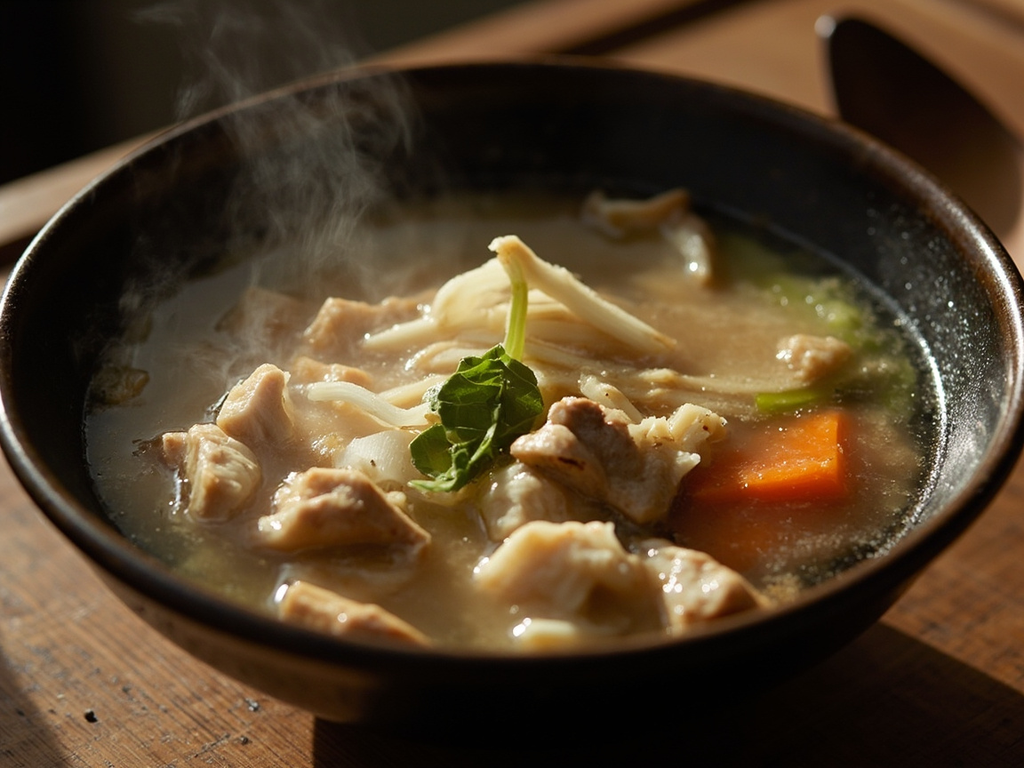
A clear, fragrant soup where root vegetables (daikon, burdock), crumbled sesame-sautéed tofu, and mushrooms simmer in a kombu broth. The shared dish that gathers the whole community around a single gesture.
Know that even a fragment of tofu fallen to the ground is worth bending down to save: to throw it away would be to throw away the work of the earth and hands. Heat a little sesame oil, crumble the tofu into it, add burdock root and radish, then flood everything with seaweed broth. One pot, and the whole assembly eats from the same gesture. When you serve, do not look at who is great or small: pour each the same portion, that is the Way of the cauldron.
- •Soy tofu — one block (crumbled protein)
- •Daikon radish — one section (sweet root)
- •Burdock root (gobō) — one root (earthy fragrance)
- •Konnyaku — one piece (texture)
- •Shiitake mushrooms — a few (umami)
- •Kombu seaweed — one piece (broth)
- •Sesame oil — a drizzle (fragrant sauté)
- •Soy sauce and salt — to taste (seasoning)
Kenchin-jiru — clear vegetable and tofu soup
A clear, fragrant soup where root vegetables (daikon, burdock), crumbled sesame-sautéed tofu, and mushrooms simmer in a kombu broth. The shared dish that gathers the whole community around a single gesture.
Why this dish? Legend attributes this soup to Dōgen's Kamakura Zen temples: crumbled tofu that a monk supposedly dropped, rescued, and tossed into the vegetable broth rather than wasted. It embodies two principles dear to Dōgen: waste nothing, and feed the community from a single pot.
Know that even a fragment of tofu fallen to the ground is worth bending down to save: to throw it away would be to throw away the work of the earth and hands. Heat a little sesame oil, crumble the tofu into it, add burdock root and radish, then flood everything with seaweed broth. One pot, and the whole assembly eats from the same gesture. When you serve, do not look at who is great or small: pour each the same portion, that is the Way of the cauldron.
Ingredients (period version)
- Soy tofu — one block (crumbled protein)
- Daikon radish — one section (sweet root)
- Burdock root (gobō) — one root (earthy fragrance)
- Konnyaku — one piece (texture)
- Shiitake mushrooms — a few (umami)
- Kombu seaweed — one piece (broth)
- Sesame oil — a drizzle (fragrant sauté)
- Soy sauce and salt — to taste (seasoning)
Ingredients
- Firm tofu — 1 block (300 g) (protein)
- Daikon — 150 g (root)
- Burdock (gobō) — 1 root (fragrance)
- Konnyaku — 100 g (texture)
- Shiitake (fresh or rehydrated) — 4 (umami)
- Carrot — 1 (color and sweetness)
- Kombu — 1 piece (dashi)
- Sesame oil — 1 tbsp (sauté)
- Soy sauce + salt — to taste (seasoning)
Method
- Prepare a dashi by soaking the kombu (and dried shiitake) in 1.2 L of water, then heat without boiling and remove the kombu.
- Drain and press the tofu, then crumble it coarsely by hand.
- Cut daikon, carrot, burdock, konnyaku, and shiitake into small pieces.
- Heat the sesame oil in a pot, sauté the crumbled tofu and then the roots for a few minutes.
- Pour in the dashi, bring to a simmer and let cook for 20 minutes until the roots are tender.
- Season with soy sauce and salt, serve piping hot in large bowls.
How it was made : The name may come from Kenchō-ji temple in Kamakura (“kenchō-jiru”). A fish- and meat-free soup, it was cooked in large quantities to feed the entire monastic community on ceremonial days, each receiving an equal portion.
The contemporary twist : Served in a black bowl with a drizzle of toasted sesame oil and a few yuzu zest strips: a comforting, 100% plant-based “zen” soup for winter evenings.
Sources : Kenchin-jiru tradition, Zen temples of Kamakura · Dōgen, Tenzo Kyōkun
Dogen · Charactorium