 flip
flipPayesh — rice pudding of the offerings
Payesh — rice pudding of the offerings
Why this dish? Milk, rice and sugar are the purest offerings placed before the Great Goddess: a creamy rice pudding appears on almost every altar of Durga, and in Bengal payesh is THE bhog dish presented to her before being shared as prasad.
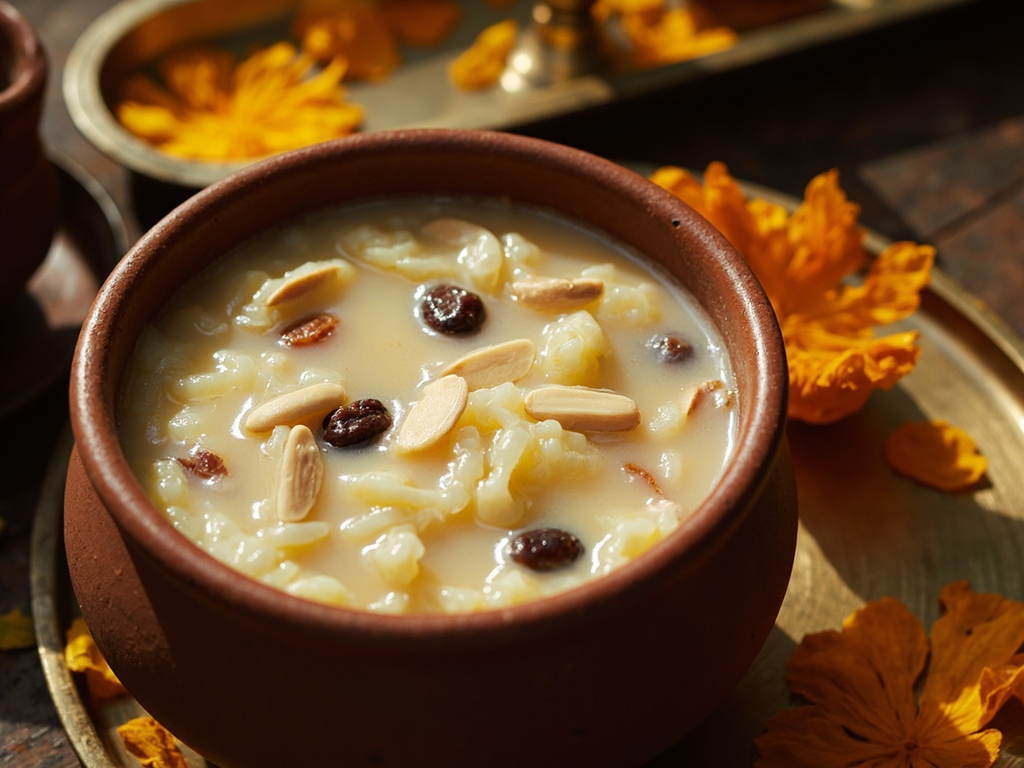
Rice slowly simmered in milk until creamy, sweetened with gur and perfumed with cardamom, with a few raisins and almonds. Sweet, comforting, and charged with auspice.
Approach, mortal, and fear not Her who vanquishes demons. Before you present me the blood of battle, present me the milk — for I am also the Mother who nourishes the worlds. Boil long, very long, until the milk thickens and embraces every grain; sweeten it with the juice of the cane, perfume it with the small green seed that breathes of the forest. What you place at my feet, you will eat afterward: thus my blessing will pass into your body.
- •Fragrant short-grain rice — a generous handful (base)
- •Whole cow's milk — in abundance (cooking liquid)
- •Gur (unrefined palm or cane sugar) — to taste (auspicious sweetener)
- •Green cardamom — a few crushed pods (perfume)
- •Raisins and almonds — a small handful (garnish)
- •Ghee — a drizzle (ritual richness)
Payesh — rice pudding of the offerings
Rice slowly simmered in milk until creamy, sweetened with gur and perfumed with cardamom, with a few raisins and almonds. Sweet, comforting, and charged with auspice.
Why this dish? Milk, rice and sugar are the purest offerings placed before the Great Goddess: a creamy rice pudding appears on almost every altar of Durga, and in Bengal payesh is THE bhog dish presented to her before being shared as prasad.
Approach, mortal, and fear not Her who vanquishes demons. Before you present me the blood of battle, present me the milk — for I am also the Mother who nourishes the worlds. Boil long, very long, until the milk thickens and embraces every grain; sweeten it with the juice of the cane, perfume it with the small green seed that breathes of the forest. What you place at my feet, you will eat afterward: thus my blessing will pass into your body.
Ingredients (period version)
- Fragrant short-grain rice — a generous handful (base)
- Whole cow's milk — in abundance (cooking liquid)
- Gur (unrefined palm or cane sugar) — to taste (auspicious sweetener)
- Green cardamom — a few crushed pods (perfume)
- Raisins and almonds — a small handful (garnish)
- Ghee — a drizzle (ritual richness)
Ingredients
- Basmati rice (or gobindobhog) — 60 g (base)
- Whole milk — 1 litre (cooking liquid)
- Jaggery / palm gur (or brown sugar) — 80 g (sweetener)
- Green cardamom — 4 pods (perfume)
- Raisins + slivered almonds — 2 tbsp (garnish)
- Ghee — 1 tsp (richness)
Method
- Rinse the rice, sauté it for 1 min in ghee with the crushed cardamom pods.
- Pour in the milk, bring to a simmer then lower the heat.
- Let reduce over low heat for 40–50 min, stirring often, until the rice is tender and the milk thickened.
- Off the heat (milk barely warm), stir in the grated gur so it doesn't curdle the milk.
- Add raisins and almonds, let rest; serve warm or cool.
How it was made : Sweetened rice pudding (kshira / payasam / payesh) is attested in ancient Indian cuisine as the quintessential offering food; it was sweetened with gur long before refined sugar appeared, and the milk + rice + sugar triad is ritually "pure" in Vedic and Puranic tradition.
The contemporary twist : A touch of date palm jaggery (nolen gur) in winter gives an amber payesh with a smoky caramel scent — the signature of Bengali festivals.
Sources : K. T. Achaya, Indian Food: A Historical Companion, Oxford University Press, 1994 · Chitrita Banerji, Life and Food in Bengal, 1991
Durga · Charactorium