
Echidna is a creature from Greek mythology, half-woman and half-serpent, known as the "Mother of All Monsters." Mate of the giant Typhon, she gave birth to the most terrifying creatures of the ancient Greek world.
Echidna
Echidna
8 min read
Frequently asked questions
Key Facts
- Daughter of Phorcys and Ceto (or of Tartarus and Gaia, depending on the source)
- Mate of the giant Typhon, enemy of the Olympian gods
- Mother of Cerberus, the hound that guards the Underworld
- Mother of the Lernaean Hydra, slain by Heracles during his Twelve Labors
- Mother of the Sphinx of Thebes and the Chimera, creatures defeated by Greek heroes
Works & Achievements
Echidna and Typhon gave birth to Cerberus, the multi-headed dog that guards the entrance to the Underworld. This creature became one of the most powerful symbols of death and the afterlife throughout the entire Greek and Roman tradition.
The Hydra, a water serpent with multiple heads that grew back each time they were cut off, is one of Echidna's most famous offspring. It became the obstacle of Heracles' second labor.
The Chimera — a fire-breathing monster with the head of a lion, the body of a goat, and the tail of a serpent — is a daughter of Echidna. She was defeated by the hero Bellerophon riding Pegasus, in one of the founding heroic tales of Lycia.
The Sphinx of Thebes, with the body of a lion and the head of a woman, posed a deadly riddle to travelers. Her defeat by Oedipus is one of the key moments in Greek tragedy, immortalized by Sophocles in Oedipus Rex.
Orthrus, a two-headed dog, guarded the herd of the giant Geryon. He was slain by Heracles during the tenth labor, once again illustrating the role of Echidna's children as adversaries of heroes.
The eagle that devoured the liver of Prometheus each day as he was chained to the Caucasus is sometimes attributed to Echidna. This creature symbolizes eternal torment and divine punishment — a central theme of Aeschylus's tragedy.
Anecdotes
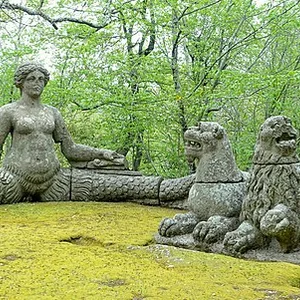
Echidna is described by Hesiod as an immortal being — half beautiful woman with a radiant face, half enormous serpent with dark scales. She dwelled in a deep cave, far from gods and men, devouring any careless travelers who ventured too close to her lair. Her immortality made her a unique figure among monsters: neither gods nor heroes could kill her.
Together with her mate Typhon, the most fearsome of all giants, Echidna gave birth to a terrifying brood: Cerberus (the three-headed dog who guards the Underworld), the Lernaean Hydra, the Chimera, the Sphinx, the Caucasian Eagle that gnawed at Prometheus's liver, and many others besides. She is known as the 'Mother of All Monsters' because nearly every monstrous creature in Greek mythology is traced back to her.
According to a version recorded by Herodotus, Heracles, during a journey through Scythia, encountered a creature that was half woman, half serpent, who had stolen his mares. She agreed to return them in exchange for a union, from which the Scythian people were born. Some scholars see in this tale a regional form of the Echidna myth, adapted to the traditions of the northern Black Sea region.
Echidna was eventually killed in her sleep by Argus Panoptes, the hundred-eyed giant, on the orders of Hera. This late resolution in the sources reflects the ambivalence the Greeks felt toward this character: too powerful to be defeated while awake, she could only be eliminated by cunning — as though even the gods feared facing her head-on.
In Hesiod's Theogony, Echidna is presented not as an enemy of the gods, but as a necessary element of the cosmic order. Her monstrous children serve as 'trials' for Greek heroes: without the Chimera, there is no Bellerophon; without the Sphinx, no Oedipus; without the Hydra, no Heracles. In this sense, she is the mother of the ordeals that forge great men.
Primary Sources
Echidna, half nymph with bright eyes and fair cheeks, half monstrous serpent, terrible, huge and swift, beneath the depths of the sacred earth. There she has her cave under a hollow rock, far from the immortal gods and mortal men.
Typhon united with Echidna, who bore Cerberus, the fifty-headed dog, the Lernaean Hydra, the Chimera who breathed fire, and Orthrus, the two-headed dog.
In that land, it is said, there lived a creature of dual nature, half woman and half viper, whose upper body down to the hips was that of a woman, and the rest a serpent.
The broad-winged eagle, sent by Zeus, will come each day to tear your liver with its ravenous beak — daughter of monstrous Echidna.
Key Places
Hesiod places Echidna's cave 'beneath the depths of the sacred earth', in a place called Arima by some sources, generally located in Cilicia (southern present-day Turkey). It was there that she dwelt immortal, guardian of the depths.
Lerna, in the Argolid, is the swamp where the Lernaean Hydra — one of Echidna's daughters — made its home. It was here that Heracles completed his second labor by slaying the creature whose heads kept growing back.
Thebes was terrorized by the Sphinx, a child of Echidna, who devoured travelers unable to solve its riddle. It was at Thebes that Oedipus overcame the creature and freed the city.
Tartarus, the deepest abyss of the Underworld, is the dwelling place of the primordial creatures linked to Echidna. Her companion Typhon is chained there, and her descendants Cerberus and the Furies hold sway within its depths.
According to tradition, Typhon, Echidna's companion, was hurled down and imprisoned beneath Mount Etna by Zeus after their battle. The Greeks interpreted volcanic eruptions as the convulsions of the chained giant.
Typical Objects

The lower half of Echidna's body is that of a great serpent covered in dark, gleaming scales. These scales symbolize her chthonic nature and her connection to the underworld.

Echidna dwells in a cave hollowed out beneath a great rock, far from the world of mortals and gods. This cavern represents her domain, on the boundary between the land of the living and the depths of the earth.

Hesiod specifies that Echidna feeds on raw flesh in her cave. She devours unwary mortals, making her an archaic predator who predates the rules of Greek hospitality.

Her mate Typhon was chained beneath Mount Etna by Zeus. These mythical chains recall the defeat of the monstrous pair at the hands of the Olympian order, while underscoring the immense power that had to be contained.

In certain Orphic traditions, primordial monsters are born from a cosmic egg. Echidna, as a primordial mother, is associated with this image of chaos and monstrousness gestating within the universe.

Some later depictions associate Echidna with subterranean fire, linking her to her offspring the Chimera (who breathes fire) and her mate Typhon (whose eyes shoot flames).
School Curriculum
Vocabulary & Tags
Key Vocabulary
Tags
Daily Life
Morning
Echidna is not subject to the cycle of the sun: in her underground cave, there is neither dawn nor dusk. According to Hesiod, she dwells there immortal and imperishable, removed from the time of mortals. Her mythic 'morning' is perhaps the moment when her monstrous offspring are conceived, carried in the depths of the earth before being unleashed upon the world.
Afternoon
Echidna prowls the tunnels of her cave, waiting for unwary travelers who venture near her lair. She feeds on their raw flesh, without fire or cooking — the opposite of civilized humans who cook their food, marking her bestial and primordial nature.
Evening
Night is no different from day for Echidna. In the permanent darkness of her subterranean home, she nestles among the folds of damp rock, her long serpent tail coiled around her. It is in this silence and stillness that Argus Panoptes will catch her sleeping and slay her.
Food
Echidna is described as devouring mortals raw, without preparation or ritual. She thus embodies the antithesis of Greek civilization, which was founded on ritual sacrifice and cooked food. Her sustenance is untransformed human flesh — a symbol of the chaos that preceded cultural order.
Clothing
Echidna is not clothed in any human sense. Her upper half is that of a beautiful nymph with a radiant face, but she has no need of garments since her serpentine lower half serves as her 'body.' In artistic depictions, her human portion is often shown unclothed, a symbol of uncivilized nature.
Housing
Echidna lives in a deep cave beneath a hollow rock, far from both gods and mortals. This subterranean space — damp, dark, and unreachable — is her natural habitat. It symbolizes the chthonic depths, the womb of the Earth, from which all the primordial and monstrous forces of the Greek cosmos emerge.
Historical Timeline
Period Vocabulary
Visual Style
Esthétique inspirée de la céramique grecque archaïque (figures noires et rouges), opposant la beauté classique du visage féminin d'Échidna à la puissance menaçante de sa partie serpentine.
Sound Ambience
Ambiance souterraine oppressante, avec échos de caverne humide, sifflements serpentins et grondements telluriques évoquant les profondeurs du monde chthonien habité par Échidna.
Liens externes & ressources
Références
Œuvres
Engendrement de Cerbère
Époque mythique
Engendrement de l'Hydre de Lerne
Époque mythique
Engendrement de la Chimère
Époque mythique
Engendrement du Sphinx
Époque mythique
Engendrement d'Orthros
Époque mythique
Engendrement de l'Aigle du Caucase
Époque mythique