 flip
flipBoiled taro with sweet coconut milk
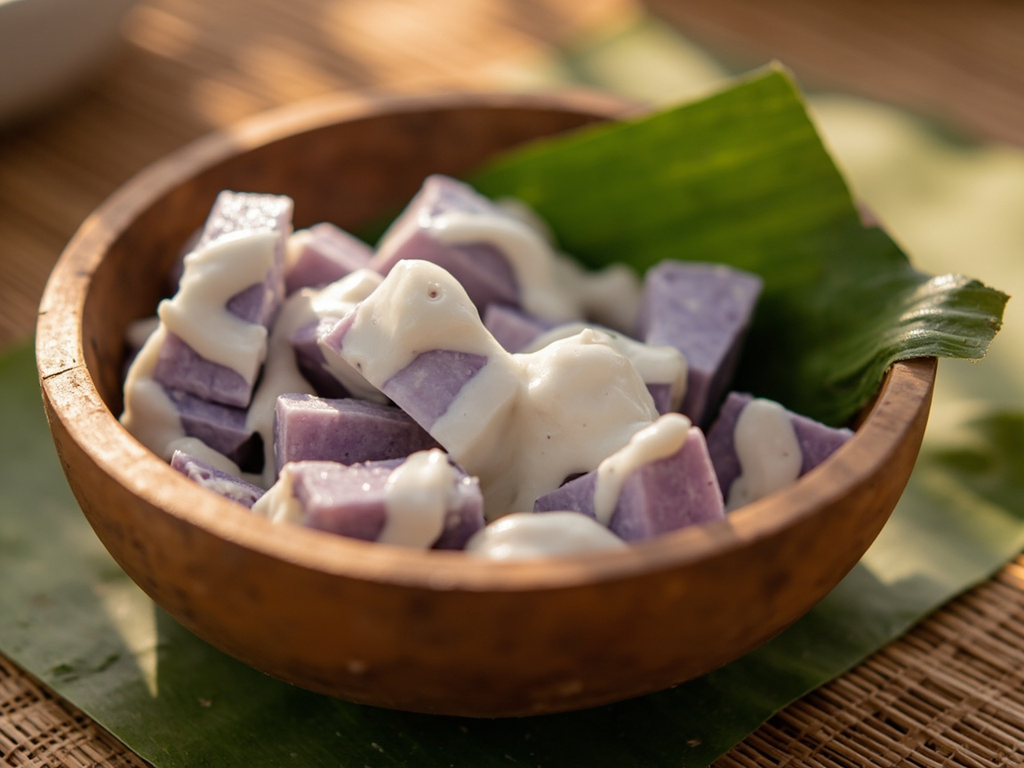
Boiled taro with sweet coconut milk
Why this dish? Eddie Mabo was a gardener — it was by cultivating a garden of taro and yam at James Cook University in Townsville that he realized his land rights on Mer were denied. Taro was the key crop of the family gardens on the island, demarcated by stone walls inherited from generation to generation.
Boiled taro pieces then drizzled with sweetened coconut milk, a nourishing and sweet snack that accompanied islanders' daily life. Simple, comforting, tied to the cultivated land.
Taro is not just a vegetable for us. Each family has its plots, demarcated by the stone walls our ancestors built. My father showed me our garden, he said: this land is ours since forever. When I grew taro in Townsville, in the university garden, people didn't understand why it mattered so much. But every tuber you plant is an act of ownership. You drench the taro with fresh coconut, and there you go, it's good, it's home.
- •Garden taro — several tubers (starchy base)
- •Fresh coconut — 1 nut, grated and pressed (sweet sauce)
- •Cane sugar (if available) — a little (sweetness)
Boiled taro with sweet coconut milk
Boiled taro pieces then drizzled with sweetened coconut milk, a nourishing and sweet snack that accompanied islanders' daily life. Simple, comforting, tied to the cultivated land.
Why this dish? Eddie Mabo was a gardener — it was by cultivating a garden of taro and yam at James Cook University in Townsville that he realized his land rights on Mer were denied. Taro was the key crop of the family gardens on the island, demarcated by stone walls inherited from generation to generation.
Taro is not just a vegetable for us. Each family has its plots, demarcated by the stone walls our ancestors built. My father showed me our garden, he said: this land is ours since forever. When I grew taro in Townsville, in the university garden, people didn't understand why it mattered so much. But every tuber you plant is an act of ownership. You drench the taro with fresh coconut, and there you go, it's good, it's home.
Ingredients (period version)
- Garden taro — several tubers (starchy base)
- Fresh coconut — 1 nut, grated and pressed (sweet sauce)
- Cane sugar (if available) — a little (sweetness)
Ingredients
- Taro — 500 g (starchy base)
- Coconut milk — 250 ml (sauce)
- Brown cane sugar — 2 tbsp (sweetness)
- Pinch of salt — 1 pinch (enhancer)
- Water — enough to cover (cooking)
Method
- Peel the taro with gloves (the sap can irritate the skin), cut into 3 cm pieces.
- Boil the taro pieces in salted water for 20-25 minutes until tender (a knife tip should slide in easily).
- Drain the taro and arrange in a serving dish.
- In a small saucepan, heat the coconut milk with the sugar over low heat, stirring until dissolved. Do not boil.
- Drizzle the taro pieces with the warm sweetened coconut milk.
- Serve immediately as a snack or side.
How it was made : Taro (colocasia) was the staple crop of the Torres Strait Islands. Gardens were organized into hereditary family plots, demarcated by stone walls — it was precisely the transmission of these plots that Mabo defended in court. Boiled taro with coconut was a staple food, eaten at any time of day.
The contemporary twist : Present in individual verrines, taro pieces cut into regular cubes, coconut cream poured at the table — like a contemporary Australian dessert.
Sources : Shnukal, Anna, 'Pacific Islanders and the Queensland Labour Trade', Aboriginal and Torres Strait Islander Studies Unit, University of Queensland, 2001 · Loos, Noel & Mabo, Koiki, 'Edward Koiki Mabo: His Life and Struggle for Land Rights', University of Queensland Press, 1996
Eddie Mabo · Charactorium