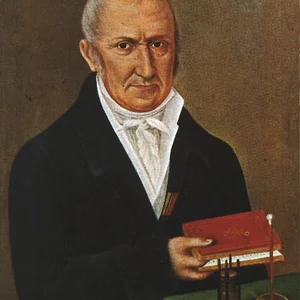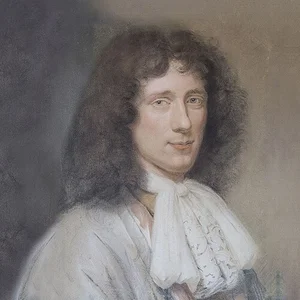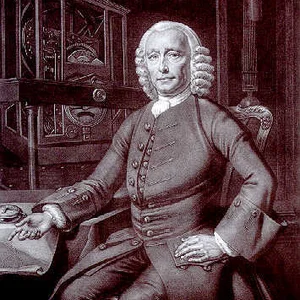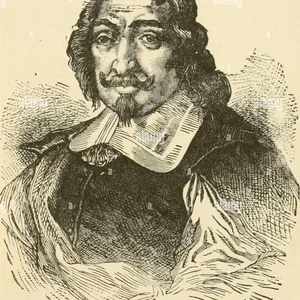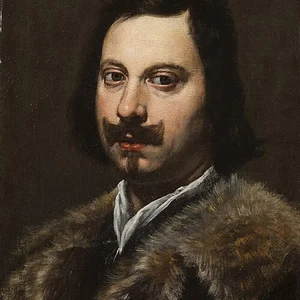

Italian physicist and mathematician of the 17th century, student of Galileo. He invented the mercury barometer in 1643 and demonstrated the existence of atmospheric pressure, paving the way for modern experimental physics.
Evangelista Torricelli(1608 — 1647)
Evangelista Torricelli
grand-duché de Toscane
7 min read
Frequently asked questions
Key Facts
- 1608: born in Faenza (Italy)
- 1641: becomes Galileo's assistant in Florence
- 1643: invents the mercury barometer and demonstrates the existence of a vacuum (Torricelli's experiment)
- 1644: publishes Opera Geometrica, his work in mathematics
- 1647: dies in Florence at the age of 39
Works & Achievements
The first instrumental measurement of atmospheric pressure, carried out in Florence. This invention founded instrumental meteorology and opened the way for the scientific study of the atmosphere.
The empty space above the mercury in the barometric tube constitutes the first attested artificial vacuum. This discovery refuted the Aristotelian maxim “nature abhors a vacuum” and sparked a wide-ranging philosophical debate across Europe.
His only work published during his lifetime, it contains original theorems on fluid motion (including Torricelli’s theorem on flow rate), projectile trajectories, and the properties of solids of revolution derived from the cycloid.
A mathematical demonstration that the speed at which a liquid flows through an orifice is proportional to the square root of the height of the liquid above that orifice. This result, contained in the *Opera Geometrica*, is still taught in fluid physics today.
In his final years, Torricelli devoted himself to crafting very high-quality lenses for telescopes, contributing to the growth of observational astronomy across Europe.
A correspondent of Bonaventura Cavalieri, Torricelli independently developed methods for computing areas and volumes using “indivisibles,” foreshadowing the integral calculus of Newton and Leibniz.
Anecdotes
In 1643, Torricelli filled a long glass tube with liquid mercury, turned it upside down in a basin, and observed that the mercury did not fall completely: a column remained suspended at around 76 centimetres. He had just invented the barometer and measured atmospheric pressure for the first time.
Above the mercury in his tube, Torricelli noticed an empty space — the first artificial vacuum ever produced by human hands. This “Torricellian vacuum” caused a scandal: the Church and Aristotelian philosophers claimed that nature abhorred a vacuum. Torricelli had just proved the opposite.
Torricelli became the secretary and assistant to Galileo in the final months of his life, in 1641, when the elderly scholar was blind and under house arrest by the Inquisition. Upon Galileo's death in January 1642, Grand Duke of Tuscany Ferdinando II appointed Torricelli official court mathematician, as a sign of intellectual continuity.
Inspired by Torricelli's letters, the Frenchman Blaise Pascal organised in 1648 the famous Puy-de-Dôme experiment: his brother-in-law Florin Périer carried a barometer to the summit of the volcano and found that the mercury column was shorter than at the bottom. The proof was clear that it is the weight of the air that holds the mercury up — and not some mysterious 'active vacuum'.
Torricelli died at only 39, carried off by typhoid fever in October 1647, just days after his birthday. He left behind thousands of pages of unpublished notes on mathematics, physics, and optics. His friends and colleagues had to compile his work posthumously.
Primary Sources
We live submerged at the bottom of a sea of elementary air, which undeniable experiments show to have weight... On the surface of the mercury in the basin, it bears the weight of a column of air approximately fifty miles high.
Torricelli proves theorems on the motion of projectiles, the cycloid, and the geometric properties of solids of revolution, extending and surpassing the work of Archimedes and Galileo.
I maintain that a vacuum is produced inside the tube, and that this vacuum is not what holds the mercury up, but that the mercury is held up by the external pressure of the air.
These lectures delivered at the Accademia della Crusca present his research on geometry, motion, and the properties of air, bearing witness to the richness of his scientific thought.
Key Places
A town in Romagna where Torricelli was born in 1608. Orphaned of his father at a very young age, he received his early education there with the Franciscans before being sent to Rome.
Torricelli studied here from 1627 to 1641 under Benedetto Castelli, mathematician to the Pope and friend of Galileo. It was here that he was trained in the cutting-edge physics and mathematics of his era.
A village on the hills south of Florence where Galileo spent his final days under house arrest. Torricelli worked alongside the old, blind scholar during the last months of his life, in 1641–1642.
The Medici capital where Torricelli lived and worked from 1642 until his death in 1647, serving as official mathematician to the Grand Duke. It was here that he conducted his barometer experiment and produced his most important works.
Although Torricelli never went there, this volcanic peak in Auvergne is inseparable from his legacy: it was here that Pascal arranged for the verification in 1648 that atmospheric pressure decreases with altitude, brilliantly confirming Torricelli's theory.
Typical Objects

A long glass tube closed at one end, about one meter in length, which Torricelli filled with mercury before inverting it into a basin. This is the central instrument of his landmark 1643 experiment.

A metal that is liquid at room temperature, chosen by Torricelli for its very high density, which made it possible to keep the tube to a manageable length — unlike water, which would have required a tube of 10 meters.

A drawing instrument used daily by Torricelli in his geometry work. He used it to construct figures, measure angles, and prove his theorems on solids of revolution.

Building on Galileo's work, the telescope was a familiar tool in Torricelli's circle. Late in his life, he himself contributed to improving the quality of optical lenses.

Torricelli was a dedicated correspondent: his letters to fellow scholars such as Ricci, Cavalieri, and Roberval are the primary record of his discoveries. The quill was his instrument of scientific communication par excellence.

Measuring instruments essential to his physics experiments, particularly for precisely recording the height of the mercury column in his successive barometers.
School Curriculum
Vocabulary & Tags
Key Vocabulary
Daily Life
Morning
Torricelli rose early in his Florentine home, devoting the first hours of the day to mathematical research — writing out calculations and correspondence by natural light. As mathematician to the Grand Duke, he also kept his measuring instruments in order and checked his barometers every day.
Afternoon
In the afternoons, Torricelli often made his way to the Medici palace for lectures and scholarly discussions with other court scientists. He also oversaw his physics experiments — testing tubes, taking mercury measurements — and occasionally received glassblowers to commission optical lenses.
Evening
In the evenings, Torricelli attended meetings of the Accademia della Crusca and other Florentine intellectual circles, where he presented his discoveries. He also kept up an active correspondence with scholars in other Italian and European cities, weaving the networks of the Republic of Letters.
Food
Like most Italian scholars of the seventeenth century, Torricelli's diet centered on pasta, bread, vegetables, pulses, olive oil, and fish. Meat was reserved for feast days; wine diluted with water accompanied meals. Sugar and spices imported from the colonies were luxury goods available to members of the court.
Clothing
As a court scientist, Torricelli wore a dark doublet with a white collar, breeches, and a long coat — sober attire befitting his rank as the Grand Duke's mathematician. During experiments, he likely put on a leather apron to protect himself from mercury splashes.
Housing
Torricelli lived in Florence in lodgings provided or subsidized by the Medici, close to the palace. His quarters included a study fitted with a writing table, books on mathematics and physics, and space for his scientific instruments — glass tubes, basins, and lenses.
Historical Timeline
Period Vocabulary
Liens externes & ressources
Références
Œuvres
Invention du baromètre à mercure
1643
Démonstration du vide torricellien
1643
Opera Geometrica
1644
Théorème de Torricelli sur l'écoulement des fluides
1644
Perfectionnement des lentilles optiques
1645-1647
Travaux sur la géométrie des indivisibles
1641-1647