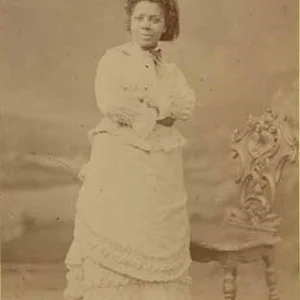

Edmonia Lewis was an American sculptor of African-American and Native American (Ojibwe) descent. The first sculptor of color to gain international recognition, she worked marble in the neoclassical style and set up her studio in Rome.
Edmonia Lewis(1844 — 1907)
Edmonia Lewis
États-Unis
6 min read
Frequently asked questions
Key Facts
- Born around 1844 in New York State, to an African-American father and a mother of Ojibwe (Native American) descent
- Studied at Oberlin College, one of the first American institutions to admit women and Black students
- Settled in Rome around 1866, where she joined the community of neoclassical sculptors
- Created 'The Death of Cleopatra' around 1876, a major work shown at the Centennial Exposition in Philadelphia
- Died in 1907 in London, rediscovered in the 20th century as a pioneer of African-American art
Works & Achievements
Portrait of the white officer who died leading a regiment of Black soldiers; the copies that were sold funded Lewis's departure for Europe.
A marble group depicting a man and a woman freed from their chains, a tribute to the emancipation of enslaved people.
A scene inspired by Longfellow's poem *The Song of Hiawatha*, evoking the artist's Native American roots.
A statue depicting the biblical servant abandoned in the desert, read as an evocation of the plight of oppressed women.
Her most ambitious sculpture, exhibited in Philadelphia in 1876, lost for nearly a century before being rediscovered and restored.
Portrait of the president associated with the abolition of slavery, a testament to Lewis's commitment to the cause of emancipation.
Anecdotes
While studying at Oberlin College, one of the few American institutions that then admitted both women and students of color, Edmonia Lewis was accused in 1862 of poisoning two classmates. Before her trial she was abducted and savagely beaten by a mob. Defended by the Black lawyer John Mercer Langston, she was acquitted for lack of evidence.
To fund her move to Europe, Lewis sculpted a bust of Colonel Robert Gould Shaw, a white officer killed while leading a regiment of Black soldiers. She sold around a hundred plaster copies of it, which allowed her to pay for her journey and settle in Rome around 1866.
In Rome, Lewis carved the marble herself instead of entrusting the cutting to Italian craftsmen, as was the custom. She said she wanted to avoid having her talent credited to others, because some doubted that a woman of color could truly create such works.
Her largest sculpture, *The Death of Cleopatra*, was exhibited at the 1876 Centennial Exposition in Philadelphia before thousands of visitors. The work then vanished for nearly a century, at one point serving as a grave marker for a racehorse, before being rediscovered and restored in the 20th century.
For a long time no one knew where or when Edmonia Lewis had died. It was only in the 2010s that researchers found her death certificate: she passed away in London, in the Hammersmith district, in 1907.
Primary Sources
On entering the studio, one is surprised to find a young woman of color wielding the chisel on the marble herself, refusing the customary help of the Italian craftsmen.
This young girl, with neither fortune nor protection, has by her will alone made a name for herself among the sculptors of Rome.
Lewis, Edmonia — “The Death of Cleopatra”, marble, displayed in the fine arts gallery.
Key Places
Edmonia Lewis was born around 1844 in upstate New York, to an African American father and an Ojibwe mother.
A pioneering college open to women and people of color where Lewis studied beginning in 1859. There she faced an accusation and an assault before being acquitted.
The city where Lewis learned sculpture under Edward Brackett and created her first busts of abolitionists.
Lewis set up her studio there around 1866 and spent most of her career as a neoclassical marble sculptor.
Site of the 1876 World's Fair where The Death of Cleopatra was presented to a wide audience.
The London district where Edmonia Lewis spent her final years and died in 1907.
Liens externes & ressources
Références
Œuvres
Buste de Robert Gould Shaw
1864
Forever Free (A jamais libre)
1867
The Old Arrow Maker (Le vieux fabricant de fleches)
vers 1866-1872
Buste d'Abraham Lincoln
vers 1870