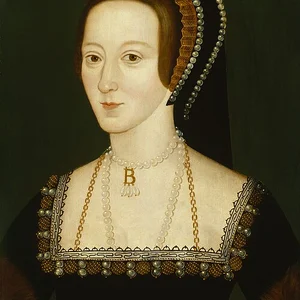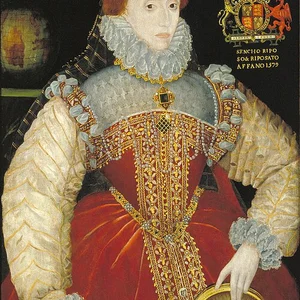

Elizabeth I (1533–1603) was Queen of England and Ireland for 45 years. The daughter of Henry VIII and Anne Boleyn, she consolidated Protestantism in England and led her kingdom to exceptional prominence in Europe. Her reign, known as the "Elizabethan era," was marked by the defeat of the Spanish Armada and a flourishing of arts and literature.
Elizabeth I of England(1533 — 1603)
Elizabeth I of England
royaume d'Angleterre
8 min read
Frequently asked questions
Famous Quotes
« I know I have the body of a weak and feeble woman, but I have the heart and stomach of a king.»
« I would rather be a beggar and single than a queen and married.»
Key Facts
- Crowned Queen of England in 1558, following the reign of her Catholic half-sister Mary I.
- Enacted the Act of Supremacy (1559), reaffirming the break of the Church of England from Rome.
- Ordered the execution of Mary, Queen of Scots, in 1587, after holding her prisoner for 19 years.
- Defeat of the Spanish Armada in 1588, cementing England's naval supremacy.
- Reigned for 45 years without ever marrying, earning the nickname "Virgin Queen".
Works & Achievements
Founding texts of the Elizabethan Church of England, establishing Elizabeth as Supreme Governor of the Church of England. This 'Elizabethan Settlement' sought to reconcile moderate Catholics and Protestants.
Elizabeth was an accomplished woman of letters, author of lyric poems in English and translations from Latin, Greek, French, and Italian. Her poem 'On Monsieur's Departure' bears witness to her literary sensibility.
Founding document granting the East India Company a monopoly on trade with the East. This charter laid the groundwork for British commercial and colonial expansion over the following two centuries.
Iconic portrait of Elizabeth commissioned to celebrate the victory over the Spanish Armada, depicting her with her hand resting on a globe. This painting illustrates the elaborate royal propaganda that Elizabeth masterfully wielded.
Elizabeth's last major parliamentary address, considered a masterpiece of political eloquence. In it she declares that the greatest wealth of her reign is the love of her people.
Elizabeth patronised and funded the Lord Chamberlain's Men, the company to which Shakespeare belonged. Her patronage enabled the flourishing of one of the greatest periods in Western theatre.
Anecdotes
Elizabeth I was born on 7 September 1533 at Greenwich, daughter of Henry VIII and Anne Boleyn. Her mother was beheaded when she was just two and a half years old, and Elizabeth was declared illegitimate. She would nonetheless overcome all these obstacles to become one of the most powerful sovereigns in Europe.
At her coronation in 1559, Elizabeth received the Bible in English — not in Latin — symbolising the Protestant turn of her reign. She embraced the book and held it to her chest, a gesture interpreted by the crowd as a solemn commitment to the Anglican Reformation.
Faced with pressure from Parliament urging her to marry in order to secure a succession, Elizabeth responded with a now-famous phrase: 'I am already married to England.' Until her death, she cultivated the image of the 'Virgin Queen', turning her celibacy into a formidable political weapon.
On 19 August 1588, Elizabeth delivered her famous speech at Tilbury before her troops assembled to face the Spanish Armada. She declared: 'I have the body of a weak and feeble woman, but the heart and stomach of a king.' The Spanish fleet was ultimately scattered by storms and the English ships.
Elizabeth was a woman of great culture: she spoke six languages fluently (Latin, Greek, French, Spanish, Italian, and English), played the lute and the virginal, and danced with virtuosity. She encouraged the arts and theatre, fostering the rise of the Elizabethan stage where Shakespeare performed his first plays.
Primary Sources
I know I have the body of a weak, feeble woman; but I have the heart and stomach of a king, and of a king of England too.
Though God hath raised me high, yet this I account the glory of my crown, that I have reigned with your loves.
Like a shipman in stormy weather, plucks down the sails tarrying for better wind.
I am already bound unto a husband, which is the Kingdom of England.
Be it enacted by authority of this present Parliament, that the Queen's Highness is the only supreme governor of this realm.
Key Places
Elizabeth's birthplace, situated on the banks of the Thames. It was here that she was born on 7 September 1533 and grew up under the benevolent supervision of her humanist tutors.
Fortress where Elizabeth was imprisoned in 1554 during the reign of her half-sister Mary I. She spent two months there in fear of being executed, an experience that durably shaped her political character.
The principal royal palace during Elizabeth's reign, the centre of government and court life. It was here that royal audiences, diplomatic ceremonies, and the elaborate festivities of the Elizabethan court were held.
Royal residence where Elizabeth stayed regularly, particularly for hunting. She held many Privy Council sessions there and received foreign ambassadors.
Site of Elizabeth's famous speech to her troops on 9 August 1588, at the time of the threat from the Spanish Armada. This fort on the Thames is one of the most iconic sites of the Elizabethan reign.
Elizabeth's favourite palace in her later reign, where she died on 24 March 1603. She spent her final years there surrounded by her court, refusing to name her successor until her last moments.
Typical Objects

A starched and pleated lace collar worn around the neck, emblematic of Elizabethan fashion. Elizabeth owned hundreds of ruffs of extravagant richness, symbols of her power and refinement.

A keyboard instrument from the harpsichord family, very fashionable at the Tudor court. Elizabeth played it with great mastery and owned several virginals adorned with ivory and ebony.

A large gilt-framed mirror, a prestigious object in the royal apartments. Elizabeth, deeply concerned with her public image, made it a tool of power representation — portraitists were required to paint an idealized likeness, never a realistic one.

The Great Seal of Elizabeth I depicting the queen in majesty upon her throne. Affixed to all official acts, it embodied Elizabeth's absolute sovereignty over her kingdoms.

Elizabeth wore elaborate red wigs, constructing a royal myth around her hair. After her hair fell out due to old age, wigs became a central element of her imposed public appearance.

A richly adorned four-wheeled horse-drawn vehicle used during the annual royal progresses. Each summer, Elizabeth traveled through her counties to show herself to her people and reinforce her legitimacy.
School Curriculum
Vocabulary & Tags
Key Vocabulary
Tags
Daily Life
Morning
Elizabeth rose early, around six o'clock, and took part in the rising ceremony in the presence of her ladies-in-waiting. The royal toilette was a long and codified ritual: application of white lead-based ceruse makeup, fitting of the wig, and dressing in boned bodice gowns fastened with numerous hooks.
Afternoon
Afternoons were devoted to diplomatic audiences, Privy Council sessions and the signing of official documents. Elizabeth placed great importance on hunting on horseback with hounds, a practice she maintained into old age in the royal parks of Windsor and Hampton Court.
Evening
Court evenings were marked by masques, theatrical performances, concerts and balls. Elizabeth danced enthusiastically to pavanes and galliards, and played the virginal herself for her guests. Banquets brought together up to several hundred guests in the great hall of the palace.
Food
The royal table was abundant: roasted meats (swan, peacock, venison), fish, elaborate pastries and sugar confections of which Elizabeth was particularly fond — which left her with blackened teeth in later life. She drank light ale, wine diluted with water, and had a fondness for Eastern spices that were very fashionable at the time.
Clothing
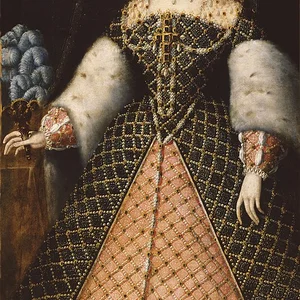
Elizabeth owned more than two thousand gowns listed in her inventories: velvet, silk and satin embroidered with pearls, rubies and gold thread. The starched ruff was indispensable, as were the farthingales (hooped petticoats) that gave skirts their characteristic conical shape. Each outfit was a carefully calculated political statement.
Housing
Elizabeth resided in some ten royal palaces, which she had renovated and decorated at great expense. The royal apartments included a throne room, a state bedchamber, galleries for indoor walking and formal French-style gardens. In summer, she undertook 'progresses' — itinerant tours staying with her nobles to display her power while shifting the cost of her court onto them.
Historical Timeline
Period Vocabulary
Visual Style
Style portrait Tudor élisabéthain : composition formelle et symbolique, palette dorée et cramoisie, richesse des textiles brodés de perles, clair-obscur à la bougie, dans la veine de Nicholas Hilliard et Marcus Gheeraerts.
Sound Ambience
Ambiance sonore de la cour Tudor au XVIe siècle : musique de chambre au luth et au clavecin, bruissement des robes de soie, plumes sur parchemin, cloches d'église et crépitement de feu dans les grandes cheminées de pierres.
Liens externes & ressources
Références
Œuvres
Acte de Suprématie et Acte d'Uniformité
1559
Poèmes et traductions
1544-1600
Charte royale de la Compagnie des Indes orientales
31 décembre 1600
Portrait Armada (Marcus Gheeraerts l'Ancien)
vers 1588
Discours au Parlement (Golden Speech)
30 novembre 1601
Soutien au théâtre élisabéthain et au Globe Theatre
1576-1603