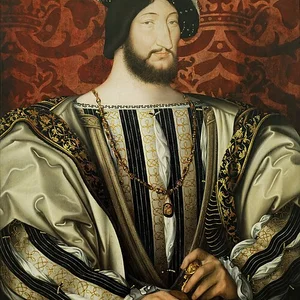

Francis I (1494–1547) was one of the greatest kings of France and an iconic figure of the Renaissance. A great patron of the arts, he brought Leonardo da Vinci to France and transformed the royal court into a vibrant center of art and intellectual life. His reign was shaped by the Italian Wars and his rivalry with Charles V.
Francis I(1494 — 1547)
Francis I of France
royaume de France
6 min read
Frequently asked questions
Famous Quotes
« A woman often changes; very foolish is he who trusts her.»
« All is lost save honour.»
Key Facts
- Crowned King of France in 1515, he won the Battle of Marignano that same year against the Swiss.
- He invited Leonardo da Vinci to France around 1516, cementing his reputation as a great Renaissance patron.
- He founded the Collège de France in 1530 to promote humanism and new intellectual disciplines.
- He signed the Edict of Villers-Cotterêts in 1539, establishing French as the official language of administration and law.
- His rivalry with Emperor Charles V shaped European politics throughout his entire reign.
Works & Achievements
Major legislative text imposing French in official acts, establishing civil registration and reforming justice. Still partially in force today.
The largest château of the Loire Valley, an architectural masterpiece of the French Renaissance blending Italian influences with French traditions.
Educational institution founded to promote humanist learning (Greek, Hebrew, mathematics) in opposition to the conservatism of the Sorbonne.
Major transformation of the château with the creation of the Gallery of Francis I, decorated by Italian artists, giving birth to the School of Fontainebleau.
Creation of the obligation to deposit a copy of every printed work in the royal library, forerunner of the modern legal deposit system.
First diplomatic alliance between a Christian kingdom and the Ottoman Empire of Suleiman the Magnificent, upending the European diplomatic balance of power.
Anecdotes
Francis I was crowned king at Reims on January 25, 1515, at the age of twenty. A few months later, he won the Battle of Marignano against the Swiss — a victory so significant that it remains one of the most famous dates in French history.
A great admirer of Leonardo da Vinci, Francis I invited him to France in 1516 and installed him at the Clos Lucé manor, near Amboise. The king visited him regularly and appointed him "first painter, engineer and architect of the king." Leonardo spent his last three years there.
In 1539, Francis I signed the Ordinance of Villers-Cotterêts, which mandated the use of French instead of Latin in all official and legal documents of the kingdom. This founding text is still partially in force today.
At the Battle of Pavia in 1525, Francis I was taken prisoner by the troops of Charles V. Imprisoned in Madrid for more than a year, he reportedly wrote to his mother Louise of Savoy the famous phrase: "Of all things, nothing remains to me but honor and life, which is saved."
Francis I was a passionate builder king. He had the Château de Chambord transformed and expanded, whose famous double-helix staircase is sometimes attributed to a design by Leonardo da Vinci. The construction lasted nearly twenty years and mobilized thousands of workers.
Primary Sources
We wish and ordain that they be made and written so clearly that there may be neither ambiguity nor uncertainty, nor any occasion to seek interpretation.
Madam, to inform you of the state of my misfortune, nothing remains to me but honour and life, which is safe.
We have ordained that of all books put up for sale in our kingdom, one copy shall be deposited in our library at the château de Blois.
The Most Christian King renounces all his claims to the Duchy of Burgundy, the County of Flanders, and the Lordship of Naples.
Key Places
Masterpiece of the French Renaissance, commissioned by Francis I in 1519. Its double-helix staircase and 440 rooms make it a symbol of royal power.
Francis I's favourite residence, which he had transformed by Italian artists such as Rosso Fiorentino and Primaticcio, giving rise to the School of Fontainebleau.
Royal residence where Francis I spent part of his youth. The nearby Clos Lucé welcomed Leonardo da Vinci from 1516 to 1519.
Birthplace of Francis I, born on 12 September 1494 at the Château de Cognac. He spent his early years there before being raised at Amboise.
Site of Francis I's famous defeat on 24 February 1525 against the forces of Charles V. The king was captured there and sent as a prisoner to Madrid.
Site of the magnificent meeting between Francis I and Henry VIII of England in June 1520, renowned for its extraordinary splendour.
Typical Objects

François I's personal emblem, accompanied by the motto "Nutrisco et extinguo" (I nourish it and I extinguish it). It adorns the walls of his castles, notably Chambord and Blois.

François I, a great bibliophile, possessed a rich collection of manuscripts. He assembled the royal library of Fontainebleau, forerunner of the Bibliothèque nationale.

The king was an accomplished knight who frequently took part in tournaments. He wore richly decorated armour, reflecting his taste for the arts.

Medals and portraits of François I, often produced by Benvenuto Cellini or Jean Clouet, spread the image of the patron sovereign throughout Europe.

François I launched major building projects: Chambord, the renovation of Fontainebleau, the construction of Paris City Hall. Plans and scale models were part of his daily life.

Diplomatic correspondence held a central place in François I's government, notably with Suleiman the Magnificent and the Pope.
School Curriculum
Vocabulary & Tags
Key Vocabulary
Tags
Époque
Daily Life
Morning
Francis I rose early and attended Mass in the royal chapel. He then received his privy council to deal with affairs of the kingdom. The king's lever was a ritual attended by his closest courtiers.
Afternoon
Afternoons were often devoted to hunting, the king's consuming passion, in the game-rich forests surrounding his residences. He might also visit his construction sites, examine works of art, or receive foreign ambassadors.
Evening
Court evenings were enlivened by lavish banquets, musical concerts, theatrical performances, and balls. Francis I enjoyed surrounding himself with poets, artists, and cultured women who took part in the intellectual life of the court.
Food
The royal table was abundant: game (deer, boar, pheasant), freshwater fish, meat pies in pastry, candied fruits, and imported spices. The king favored wines from the Loire and Burgundy. Banquets often comprised several dozen courses.
Clothing
Francis I wore doublets of silk and velvet with slashed sleeves, fitted hose, and berets adorned with feathers and precious stones. His garments were embroidered with gold and silver thread, reflecting the influence of Italian fashion.
Housing
The king resided in sumptuous châteaux he had continually embellished: Fontainebleau, Chambord, Blois, Saint-Germain-en-Laye. The court was itinerant, moving regularly from one residence to another, accompanied by thousands of courtiers and servants.
Historical Timeline
Period Vocabulary
Visual Style
Un style visuel Renaissance français mêlant l'élégance des châteaux de la Loire, les influences italiennes et le faste de la cour royale, dans une palette de bleu roi, d'or et de pierre blanche.
Sound Ambience
L'univers sonore de François Ier mêle la musique raffinée de la cour Renaissance, le brouhaha des chantiers de ses châteaux et les sons de la chasse royale dans les forêts du Val de Loire.
Liens externes & ressources
Références
Œuvres
Ordonnance de Villers-Cotterêts
1539
Château de Chambord
1519-1547
Collège des lecteurs royaux (Collège de France)
1530
Rénovation du château de Fontainebleau
1528-1540
Édit de Fontainebleau (dépôt légal)
1537
Alliance franco-ottomane
1536