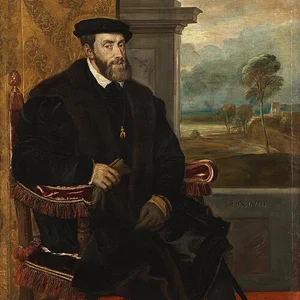

Born in 1500 in Ghent, Charles V inherited a vast empire spanning Spain, the Netherlands, Austria, and much of Italy. King of Spain as Charles I, then elected Holy Roman Emperor in 1519, he ruled the largest European empire of the Renaissance. He abdicated in 1556 and retired to the monastery of Yuste, where he died in 1558.
Charles V(1500 — 1558)
Charles V
Saint-Empire romain germanique
8 min read
Frequently asked questions
Famous Quotes
« I speak Spanish to God, Italian to women, French to men, and German to my horse.»
« I came, I saw, and God conquered.»
Key Facts
- 1500: Born in Ghent (Flanders)
- 1516: Becomes King of Spain (Charles I) upon the death of Ferdinand of Aragon
- 1519: Elected Holy Roman Emperor
- 1521: Condemns Luther at the Diet of Worms
- 1556: Abdicates and divides the empire between his son Philip II and his brother Ferdinand I
Works & Achievements
Imperial decree placing Martin Luther under the ban of the Empire and forbidding the spread of his writings. A founding act of Charles V's religious policy, it reflects his determination to preserve the Catholic unity of Christendom.
Although signed after his death, this peace treaty ended the Italian Wars that Charles V had waged throughout his reign against France. It established Spanish dominance over Italy, which had been a central strategic goal of his rule.
Treaty officially recognizing Lutheranism within the Empire under the principle of "Cuius regio, eius religio" (each prince determines the religion of his territory). A reluctant Charles left the negotiation of this peace to his brother Ferdinand.
A body of legislation aimed at reforming the administration of the American colonies and protecting indigenous peoples, drafted under the influence of Bartolomé de las Casas. They stand as a landmark document in colonial history.
A Renaissance palace commissioned by Charles V in Granada, designed by Pedro Machuca. A symbol of Habsburg authority over reconquered Spain, it is one of the great architectural monuments of the Spanish Renaissance.
Anecdotes
Charles V was born in Ghent in 1500 and did not speak Spanish when he arrived in Spain in 1517, which provoked deep mistrust among his new subjects. He had to learn the language of his kingdom while governing an empire that spanned four continents.
Charles V is credited with the famous quip: "I speak Spanish to God, Italian to women, French to men, and German to my horse." This anecdote, most likely apocryphal, nonetheless captures the reality of a multilingual ruler who had to govern peoples of vastly different languages and cultures.
Before his abdication in 1556, Charles V organized a ceremony of extraordinary solemnity in Brussels, before the States General of the Netherlands. Worn down by gout and years of war, he wept as he reflected on his life of toil, and had to lean on the arm of the young William of Orange just to remain standing.
Retired to the monastery of Yuste in Spain after his abdication, Charles V spent his days regulating clocks and watches — his new passion. He reportedly confided to those close to him that he could not understand how he had ever presumed to govern an entire empire when he was unable to make two identical clocks run in harmony.
In 1520, the Comuneros — Castilian nobles and townspeople — rose up against Charles V, whom they considered too Flemish and surrounded by foreign advisors. Charles crushed the revolt at the Battle of Villalar in 1521, thereby consolidating his authority in Spain.
Primary Sources
"I was born here in these Low Countries... I made nine journeys to Germany, six to Spain, seven to Italy, ten to Flanders... I have done nothing out of hatred or passion, but always for the good of my subjects."
"Never allow heresy to take root in your states. Uphold justice and heed your counselors, but let the final decision always be yours."
"It was not by my will that this calamity befell Rome. I call God to witness that I have always honored the Holy See and that I shall ensure that reparation is made."
"We declare the said Martin Luther an enemy of the Christian faith, a disturber of the public peace, and place him under the ban of the Empire. No one shall give him shelter or assistance."
Key Places
Charles V's birthplace, born on February 24, 1500, at the Prinsenhof. Ghent was at the time one of the most prosperous cities in the Burgundian Netherlands.
Charles V had a Renaissance palace built at the heart of the Moorish Alhambra. The building symbolizes the layering of cultures and Charles's determination to assert Habsburg power in Spain.
The city where the Diet of 1521 condemned Martin Luther. Charles V made clear his determination to defend the Catholic unity of the Empire against the Reformation.
Charles V's main residence in the Netherlands, and the site of his solemn abdication in 1555 before the States General. The palace is now in ruins but has been partially excavated.
The retreat chosen by Charles V following his abdication in 1556. He spent his final two years there in prayer and contemplation, surrounded by a small circle of devoted servants, before dying on September 21, 1558.
Typical Objects

A symbol of the Emperor's universal power, the orb topped with a cross represented Charles's spiritual and temporal dominion over the known world. It was carried during coronation ceremonies.

A parade armor crafted by Koloman Helmschmid around 1544, worn by Charles V at the Battle of Mühlberg in 1547. It is preserved at the Prado Museum and stands as a masterpiece of Renaissance armory.

A passionate horology enthusiast, Charles V collected dozens of clockwork mechanisms in the final years of his life. Retired to Yuste, he spent his days adjusting and comparing his timepieces, fascinated by mechanical precision.

An emblem of imperial office, the scepter accompanied Charles at his coronations and official audiences. It symbolized supreme authority over the princes of the Empire.

A man of deep faith, Charles V owned several richly illuminated religious manuscripts. His uncompromising Catholic beliefs shaped all of his policies, particularly in response to the rise of Protestantism.

A document sealed with the Emperor's seal, the imperial letter patent allowed orders, pardons, or condemnations to be transmitted across all territories of the Empire. It embodied the reach and complexity of the imperial bureaucracy.
School Curriculum
Vocabulary & Tags
Key Vocabulary
Tags
Daily Life
Morning
Charles V rose early and attended daily Mass, an essential act of piety that structured his day. He would then receive his secretaries to work through the imperial correspondence — often written in several languages — arriving from every corner of the Empire.
Afternoon
Afternoons were devoted to audiences, councils, and diplomatic negotiations. Charles personally took part in strategic deliberations, mediating between his many Spanish, Flemish, and German advisors. On military campaigns, he inspected the troops and contributed to tactical decisions.
Evening
In the evenings, Charles typically dined with close companions and a few advisors. Despite the gout that caused him constant suffering, he enjoyed hearty meals and chamber music. At Yuste, withdrawn from the world, his evenings were spent in prayer, spiritual reading, and contemplating his collection of clocks.
Food
Charles V was renowned for his extraordinary appetite: he consumed vast quantities of meat, smoked fish, pastries, and Flemish beer. His chronic gout, worsened by this rich diet, caused him increasing pain over the years and eventually limited his ability to travel.
Clothing
Charles wore garments of calculated magnificence: silk and velvet doublets embroidered in gold, fur-lined cloaks, and finely engraved ceremonial armor. As he aged, he adopted darker clothing — blacks and grays — in keeping with the restrained elegance of Spanish fashion, a stark contrast to the flamboyance of the French court.
Housing
Charles resided in numerous palaces across the Empire: the Coudenberg in Brussels, the Alcázar of Toledo, the Palace of Granada. These residences reflected his power: vast audience halls, private apartments richly decorated with Flemish tapestries, and formal gardens. At Yuste, he chose a modest dwelling adjoining the monastery — a symbol of his voluntary renunciation of worldly power.
Historical Timeline
Period Vocabulary
Visual Style
Le style visuel de l'univers de Charles Quint s'inspire de la peinture flamande et des portraits de Titien : tons profonds et sombres, ors et pourpres impériaux, armures ciselées et décors architecturaux mêlant gothique flamboyant et Renaissance.
Sound Ambience
L'ambiance sonore de la cour impériale de Charles Quint mêle le cliquetis des armures, le murmure multilingue des conseillers, les cloches d'église et le chant des moines, évoquant un pouvoir à la fois militaire, bureaucratique et profondément religieux.
Liens externes & ressources
Références
Œuvres
Édit de Worms
1521
Paix de Cateau-Cambrésis (négociée sous Philippe II, héritière des guerres de Charles)
1559
Paix d'Augsbourg
1555
Organisation des Indes espagnoles — Lois Nouvelles
1542
Construction du Palais de Charles Quint à l'Alhambra
1527–1637