 flip
flipHāngī, the earth-oven feast
Hāngī, the earth-oven feast
Why this dish? During his long years among the Tūhoe, in the mists of Te Urewera, Best attended many hākari and recorded in detail the technique of the earth oven. The hāngī is the great-occasion dish he saw gather an entire village.
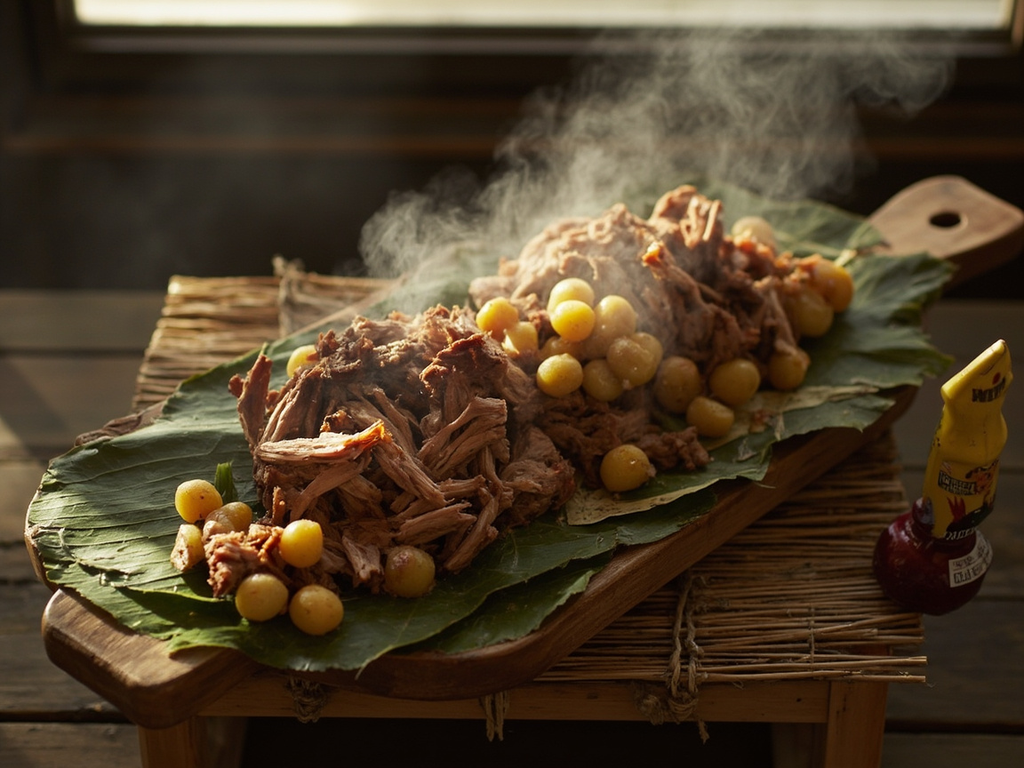
Meat, kūmara and vegetables slow-cooked in a covered pit on hot stones, which gives them an inimitable smoky flavor. It is the dish for weddings, funerals, and formal welcomes.
Allow me to describe what I have observed so many times among the Tūhoe, deep in the Urewera forest. At dawn, the men dig the pit and heat stones in a great fire; when the heat is just right, the meat and kūmara wrapped in green leaves are placed inside, water is sprinkled, and the earth closes over the whole secret. I noted in my journal that the oven must not be opened too soon: patience is half the recipe. When it is finally opened, fragrant steam rises, and I assure you no table in Wellington has ever seemed more generous to me than that flax mat laden with shared food.
- •Pork (introduced by Europeans) — a quarter (main meat)
- •Kūmara — in abundance (sweet starch)
- •Potatoes — in abundance (starch)
- •Green leaves (rau, cabbage or non-toxic foliage) — several handfuls (wrapping and flavor)
- •Heated volcanic stones — according to the oven (heat source)
- •Water — a few litres (generates steam)
Hāngī, the earth-oven feast
Meat, kūmara and vegetables slow-cooked in a covered pit on hot stones, which gives them an inimitable smoky flavor. It is the dish for weddings, funerals, and formal welcomes.
Why this dish? During his long years among the Tūhoe, in the mists of Te Urewera, Best attended many hākari and recorded in detail the technique of the earth oven. The hāngī is the great-occasion dish he saw gather an entire village.
Allow me to describe what I have observed so many times among the Tūhoe, deep in the Urewera forest. At dawn, the men dig the pit and heat stones in a great fire; when the heat is just right, the meat and kūmara wrapped in green leaves are placed inside, water is sprinkled, and the earth closes over the whole secret. I noted in my journal that the oven must not be opened too soon: patience is half the recipe. When it is finally opened, fragrant steam rises, and I assure you no table in Wellington has ever seemed more generous to me than that flax mat laden with shared food.
Ingredients (period version)
- Pork (introduced by Europeans) — a quarter (main meat)
- Kūmara — in abundance (sweet starch)
- Potatoes — in abundance (starch)
- Green leaves (rau, cabbage or non-toxic foliage) — several handfuls (wrapping and flavor)
- Heated volcanic stones — according to the oven (heat source)
- Water — a few litres (generates steam)
Ingredients
- Pork shoulder — 1.2 kg (main meat)
- Kūmara (sweet potato) — 4 medium (sweet starch)
- Potatoes — 6 medium (starch)
- Green cabbage — 1/2, roughly chopped (vegetable and moisture)
- Coarse salt — 1 tbsp (seasoning)
- Hot water — 300 ml (steam in the oven)
Method
- Preheat oven to 140 °C: lacking a pit, we mimic slow steaming.
- Salt the pork and place it in the center of a large deep dish.
- Arrange kūmara and potatoes in large chunks around it, then the cabbage.
- Pour hot water into the bottom, cover tightly with baking paper then aluminium foil (or a lid).
- Bake for 3 to 3½ hours without opening, until the meat shreds.
- Rest 10 min, then serve everything together on a large board, to share by hand.
How it was made : The true hāngī (or umu) is cooked underground: stones are heated in a fire, placed at the bottom of a pit, food in woven baskets is laid on a bed of damp foliage, water is sprinkled to create steam, then the pit is covered with mats and earth for several hours. Best described this process as one of the great skills of daily Māori life.
The contemporary twist : To evoke the earth oven, add a pinch of smoked beech powder or a touch of liquid smoke to the pork: the illusion of umu aroma without digging up the garden.
Sources : Elsdon Best, Forest Lore of the Maori (1942) · Elsdon Best, The Maori (1924)
Elsdon Best · Charactorium