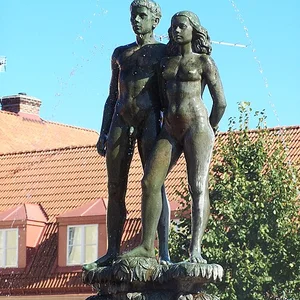

In Norse mythology, Embla is the first woman, created along with Ask (the first man) by the gods from two pieces of wood found on the shore. The couple are the ancestors of humankind in Scandinavian cosmogony.
Embla
Ask and Embla
5 min read
Frequently asked questions
Key Facts
- The first woman in Norse mythology, created along with Ask by the gods Odin, Vili, and Vé (or Hœnir and Lóðurr depending on the source)
- Shaped from a piece of wood (elm or another species) found on the shore by the gods
- Received from the gods the breath of life, intelligence/movement and the senses, warmth and color
- Mentioned in the Völuspá and the Gylfaginning of Snorri's Edda (written in the 13th century)
- Regarded as the common ancestor of all humankind in Scandinavian cosmogony
Works & Achievements
Ask and Embla are, in Norse cosmogony, the ancestors of all human beings. Their “work” is the very existence of humanity.
The couple receive the middle world as their dwelling and establish the first human community there.
According to Norse mythology, every generation of men and women descends from them, making them the starting point of all genealogies.
By receiving breath, spirit and warm blood, they embody the idea that the human being is an assemblage of gifts bestowed by the gods.
Anecdotes
According to Norse mythology, Ask and Embla were at first nothing more than two lifeless pieces of wood washed up on a shore. Three gods passing by gave them life: the couple thus became the ancestors of all humankind, somewhat like Adam and Eve in the biblical tradition.
The name Ask means “ash tree” in Old Norse, a tree central to Scandinavian cosmology since the world-tree Yggdrasil is itself an ash. The name Embla is more mysterious: scholars waver between “elm” and “vine,” with no certainty.
In the poem *Völuspá*, the gods do not merely give the couple life: each brings a specific gift. One offers breath, another spirit and intelligence, the third the warmth of blood and the fair colors of the face. The human being is thus presented as an assembly of divine gifts.
The two great sources that tell of their creation disagree on the identity of the creators. The poem *Völuspá* names Odin, Hœnir, and Lóðurr, while Snorri Sturluson, in his *Prose Edda*, names the three brothers Odin, Vili, and Vé.
Before receiving the gods' gifts, Ask and Embla are described as “without fate,” that is, lacking vital force and a future. This idea shows how essential the notion of fate was in the thinking of the ancient Scandinavians.
Primary Sources
They found on the shore, weak in strength, Ask and Embla, void of destiny. They had neither breath, nor spirit, nor blood, nor color, nor fair appearance.
The sons of Borr were walking along the seashore and found two trees; they took them and made men of them. The first gave them breath and life, the second wit and movement, the third form, speech, hearing, and sight.
Odin gave them breath, Hœnir gave spirit, Lóðurr gave the warmth of blood and the fair colors.
Key Places
The place where the gods find the two pieces of wood while walking. It is the mythical setting for the creation of the first humans.
The “middle world,” the earthly realm encircled by the ocean, given to humans as their home. It is where Ask and Embla found humankind.
A cosmic ash tree linking the nine worlds and supporting the universe. It echoes the name of Ask, the ash, the first man.
The celestial realm of the Aesir gods, including Odin, creator of Ask and Embla. It is from there that the gods who give the couple life come.
Typical Objects

Ashwood washed up on the shore from which the first man is fashioned. The ash is a sacred tree central to Norse cosmology.

Second piece of wood found on the shore, from which the first woman is created. Its exact species (elm or vine) remains debated among scholars.

Gift bestowed by Odin, which animates the inert pieces of wood. It represents the vital principle, the spirit that makes the human being alive.

Gift of reason, movement and inspiration granted to the primordial couple. It distinguishes the thinking human from mere wood.

Gift that confers the warmth of blood and the fair colours of the face, giving the body its living appearance. It completes the transformation of wood into a human being.
School Curriculum
Vocabulary & Tags
Key Vocabulary
Daily Life
Morning
As purely mythological figures, Ask and Embla have no daily routine described in the texts. We can nonetheless imagine the life of the first humans of Midgard beginning at dawn, to the rhythm of the sunlight placed in the sky by the gods.
Afternoon
The Norse sources recount no scene of everyday life for the couple. By analogy with ancient Scandinavian society, the day would have been devoted to securing subsistence in a world only just shaped.
Evening
No evening gathering is described in the Eddas for Ask and Embla. The evenings of the ancient Scandinavians unfolded around the hearth, a place for telling myths such as that of their own creation.
Food
The texts do not specify their diet. In the ancient Norse world, the diet was based on cereals, fish, meat, dairy products, and wild berries.
Clothing
At their creation, Ask and Embla first receive their appearance and colors before any clothing. The ancient Scandinavians wore tunics of wool and linen, cloaks, and brooches.
Housing
Ask and Embla receive Midgard as their dwelling, with no specific home mentioned. The people of the Viking Age lived in long houses of wood, wattle and daub, and turf, heated by a central hearth.
Historical Timeline
Period Vocabulary
Liens externes & ressources
Références
Œuvres
Création de l'humanité
Temps mythique
Peuplement de Midgard
Temps mythique
Transmission de la lignée humaine
Temps mythique
Réception des dons divins
Temps mythique